


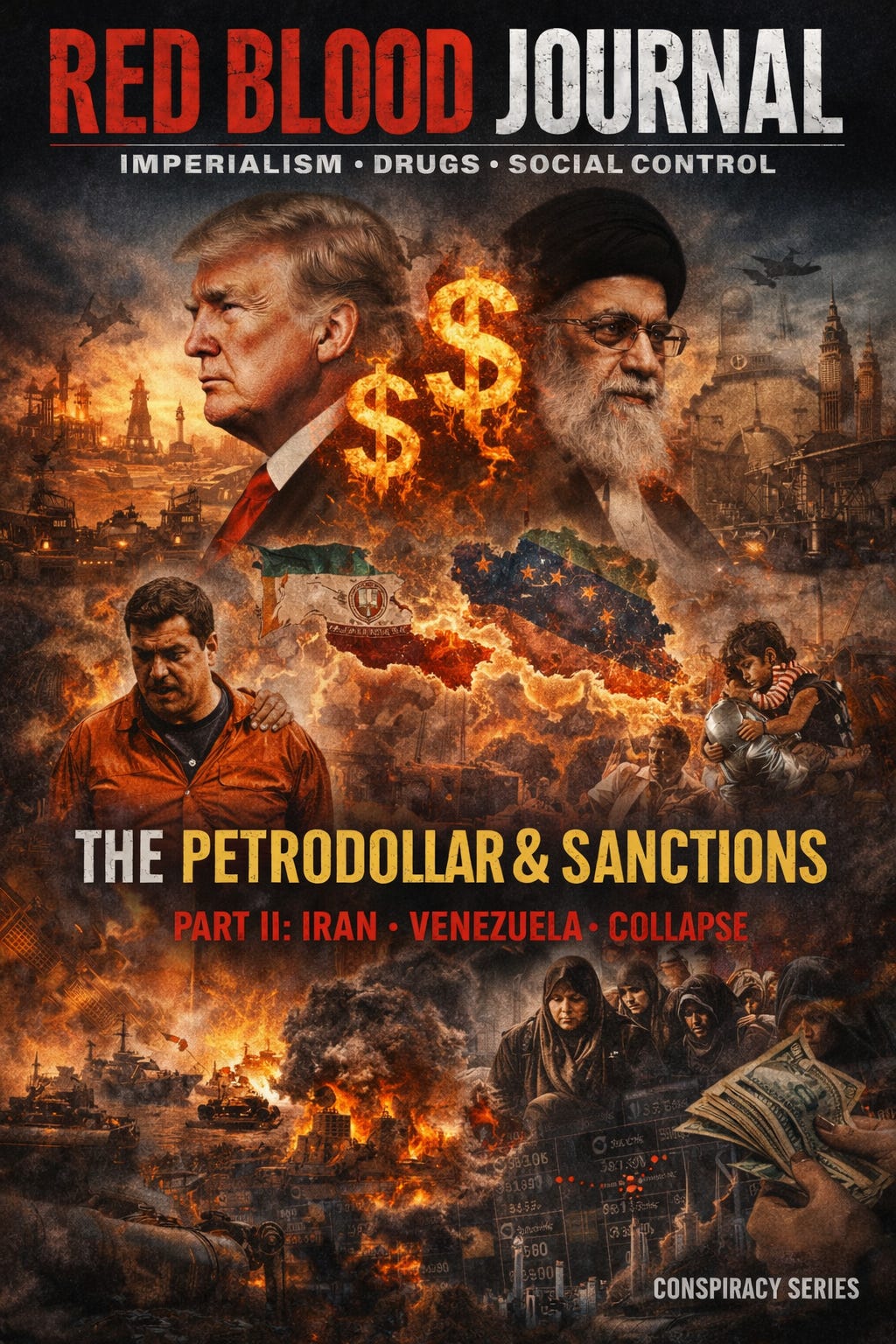
🩸 RED BLOOD JOURNAL — MULTI-PART SERIES (PART II)
THE PETRODOLLAR, SANCTIONS, AND THE NEXT TARGET
T#: RBJ–2026–OIL-EMPIRE-II
Classification: Counterintelligence of Finance / Weaponized Economics
Desk: New York – Riyadh – Tehran – Caracas – The Invisible Market
I. THE REAL WORLD GOVERNMENT YOU ARE NEVER SHOWN
If Part I was about tanks and aircraft carriers, Part II is about the quieter weapon — money.
There is a government that does not campaign.
There is a parliament that does not vote.
There is a president who is never elected.
It is called the petrodollar system.
It does not sit in Washington.
It sits in a triangle between:
• Wall Street
• The U.S. Treasury
• The Saudi monarchy
This triangle does not merely influence global politics.
It organizes it.
II. WHAT THE PETRODOLLAR REALLY IS
Official story:
Oil is priced in dollars because the dollar is “trusted.”
Hidden reality:
Oil is priced in dollars because the United States guarantees the survival of Gulf monarchies with its military — and in return, they agree to trade oil only in dollars.
This creates a closed loop:
Every nation must hold dollars to buy oil.
Those dollars flow back into U.S. banks and Treasury bonds.
That money funds the U.S. military.
That military protects the oil monarchies.
The cycle repeats.
This is not free trade.
This is structured dependence.
And any country that tries to leave this loop becomes an enemy.
III. WHY SANCTIONS ARE THE NEW WAR
Bombs make headlines.
Sanctions make corpses quietly.
Sanctions are not “peaceful pressure.”
They are economic strangulation.
They:
• Cut off food imports
• Restrict medicine
• Freeze national assets
• Block financial transactions
• Destroy local industries
Then the suffering is blamed on the targeted government.
Iraq in the 1990s: sanctioned — hundreds of thousands died.
Venezuela: sanctioned — economy collapsed.
Iran: sanctioned — currency destroyed, people punished.
Sanctions are not punishment of leaders.
They are punishment of populations — designed to break them until they overthrow their own government.
This is regime change without a battlefield.
IV. VENEZUELA — THE DRESS REHEARSAL
Part I showed how Trump moved against Venezuela.
Part II explains why it mattered to the system.
Venezuela did three unforgivable things:
Nationalized oil
Tried to trade outside the dollar
Aligned with countries outside U.S. control
The “drug war” narrative was camouflage.
The real target was control of energy and finance.
By removing Maduro, Trump sent a message to the world:
“Defy the petrodollar — and you will be removed.”
This was not chaos.
It was enforcement.
V. IRAN — THE NEXT VENEZUELA
Now look at Iran.
Iran sits on massive energy reserves.
Iran refuses to fully submit to Western control.
Iran has tried to build an independent economy.
Iran has sought to trade outside the dollar.
This makes Iran a structural threat — not because of nuclear weapons, but because of economic independence.
Trump’s “maximum pressure” campaign is not about bombs first.
It is about:
• Crushing Iran’s oil exports
• Isolating its banking system
• Blocking its trade with Asia
• Forcing its currency to collapse
• Creating internal unrest
Only after the economy is broken does military pressure become credible.
This is Venezuela’s playbook — exported to the Persian Gulf.
VI. WHAT TRUMP REALLY HAS IN STORE FOR IRAN
Trump’s strategy toward Iran follows a clear sequence:
Step 1 — Economic Siege
Sanctions tightened. Oil sales targeted. Foreign buyers threatened.
Step 2 — Diplomatic Isolation
Iran portrayed as a rogue state, even while the U.S. allies with far worse regimes.
Step 3 — Military Intimidation
Naval build-ups, exercises, and public threats.
Step 4 — Negotiation on U.S. Terms
Talks framed as “peace,” but structured so Iran must surrender sovereignty.
The goal is not peace.
The goal is compliance.
Not regime change necessarily — but system alignment.
VII. WHY IRAN IS NOT SAUDI ARABIA (AND WHY THAT MATTERS)
Saudi Arabia is obedient.
Iran is not.
Saudi Arabia:
• Prices oil in dollars
• Buys U.S. weapons
• Keeps markets open to Western capital
• Suppresses internal dissent quietly
Iran:
• Challenges U.S. regional dominance
• Builds alliances outside Washington’s control
• Seeks multipolar world order
• Uses oil as leverage, not submission
This is why Iran is treated as an existential threat — while Saudi Arabia, with far worse human rights abuses, is treated as a “strategic partner.”
The difference is not morality.
The difference is obedience.
VIII. TRUMP — THE ENFORCER, NOT THE REBEL
Here is where the myth of Trump must be shattered.
Many believed Trump was “anti-war” or “anti-empire.”
But look at his actions:
• He attacked Venezuela.
• He expanded sanctions on Iran.
• He maintained alliances with Gulf monarchies.
• He increased arms sales to Saudi Arabia.
• He did not challenge the petrodollar.
Trump did not dismantle empire.
He made it more explicit.
He is not the revolution against the system — he is the system speaking without a filter.
IX. THE HIDDEN WAR YOU ARE ALREADY IN
This is the war most people never see:
Not bombs.
Not drones.
Not tanks.
But:
• Currency collapse
• Inflation
• Unemployment
• Food shortages
• Medical scarcity
This is the war fought through finance.
And Iran is currently in its crosshairs.
X. COUNTERINTELLIGENCE SYNTHESIS — PART II
The Gulf is not a battlefield of nations.
It is a chessboard of capital.
The petrodollar is the real world government.
Sanctions are its primary weapon.
Venezuela was the warning shot.
Iran is the next major test.
Trump is not outside this architecture.
He is operating as its most direct executor.
TO BE CONTINUED — PART III PREVIEW
Part III will examine:
• The military-industrial complex and Gulf basing
• Why Israel fits into this oil-finance-military triangle
• How China complicates the petrodollar system
• Whether Iran can truly escape economic strangulation
• The long-term collapse risk of the entire Gulf architecture
🛢️Petrodollar Warfare: The Architecture of Economic Hegemony
The provided text outlines a critical perspective on the petrodollar system, describing it as a clandestine global governance structure fueled by a partnership between Wall Street, the U.S. Treasury, and Saudi Arabia.
This arrangement mandates that global oil be traded exclusively in U.S. currency, creating a cycle of financial dependency that funds American military dominance.
Nations that attempt to bypass this economic loop face weaponized sanctions, which the author characterizes as a form of “quiet” warfare designed to collapse local economies and force regime change.
The source highlights Venezuela and Iran as primary targets of this strategy, suggesting that geopolitical conflicts are driven by a need for economic compliance rather than moral or security concerns.
Ultimately, the narrative identifies Donald Trump not as an opponent of the global establishment, but as a direct enforcer of this monetary hegemony.
Michael Parenti “Imperialism, Drugs and Social Control”


