


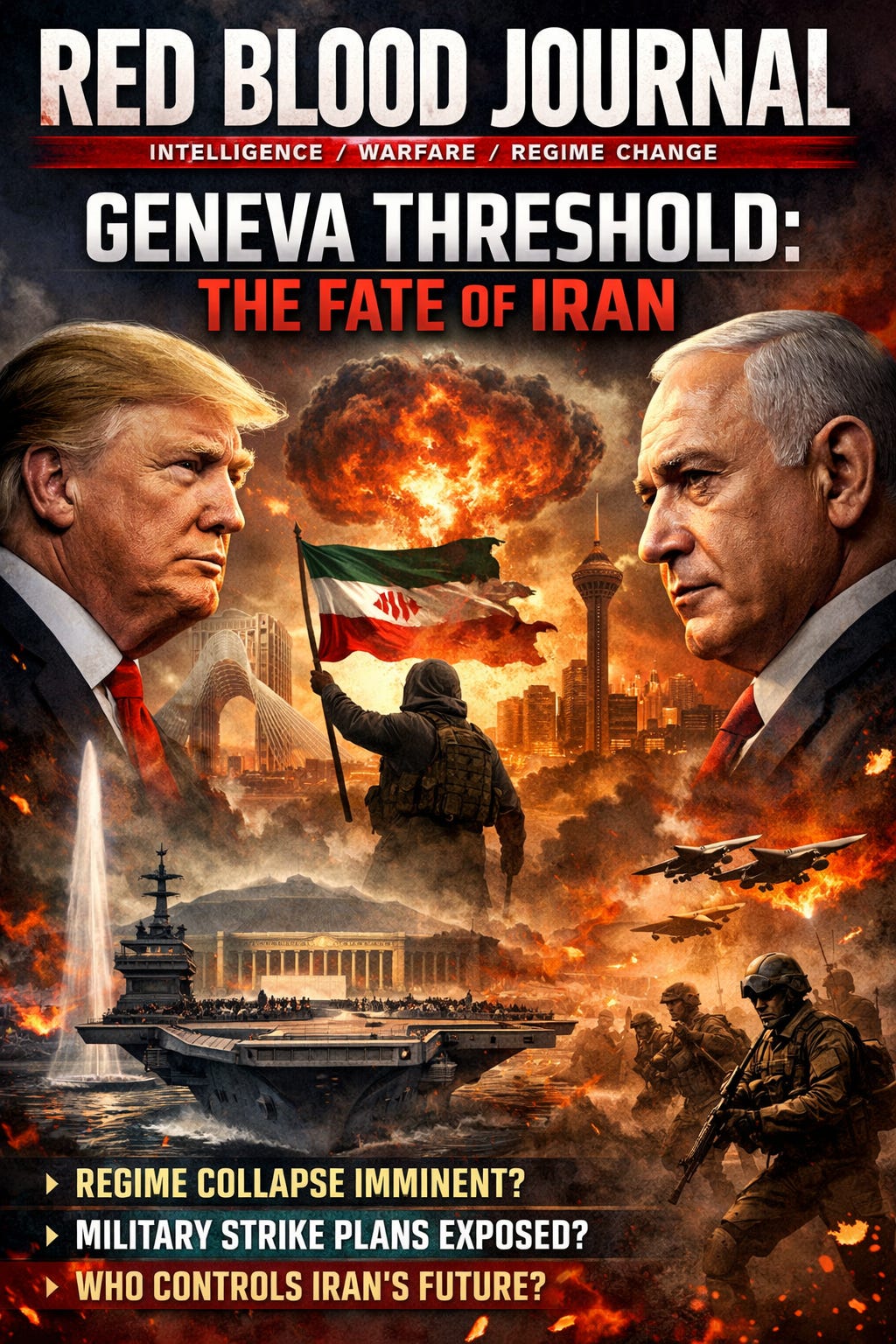
🩸 RED BLOOD JOURNAL TRANSMISSION
T#: RBJ-2026-GENEVA-THRESHOLD (PART 1)
Classification: Regime Transition Theater / Military-Diplomatic Synchronization / Power Vacuum Contingency Protocol
Desk: Geopolitical Counterintelligence Wing — Archive of Blood & Memory
Cross-Reference: Useful Enemy Doctrine / Vacuum Succession Architecture / Controlled Regime Replacement Model
PROLOGUE — THE CLOCK HAS BEEN SET
February 17, 2026.
Geneva, Switzerland.
A date presented publicly as a diplomatic meeting.
But beneath the choreography of negotiation lies something older than diplomacy itself: the ritual moment when empires decide whether a regime survives—or whether its replacement protocol begins.
For forty-seven years, the Islamic Republic existed not only as a sovereign government, but as a strategic constant inside the global security equation.
An adversary.
A justification.
A stabilizing instability.
Now, signals emerging simultaneously from Washington, Tel Aviv, Geneva, and the streets of global cities suggest that the system may be approaching a controlled rupture point.
Not chaos.
Transition.
SECTION I — THE GENEVA SIGNAL
The meeting scheduled for February 17 has been framed as a binary moment.
Yes.
Or no.
According to reports cited by Axios, American representatives expect Iran’s definitive response to a U.S. proposal.
No ambiguity.
No delay.
No incremental diplomacy.
A U.S. official stated clearly:
“The ball is in their court. If it is not a real agreement, we will not accept it.”
Another official reportedly assessed the probability of mutual agreement as effectively zero.
This language is not diplomatic language.
It is ultimatum language.
Diplomacy, in such moments, often serves two simultaneous functions:
• Public function: demonstrate willingness to negotiate
• Operational function: establish justification for escalation
The Geneva meeting is therefore not merely a negotiation.
It is a threshold mechanism.
A legal and psychological trigger point.
SECTION II — THE MILITARY PIECES MOVE INTO POSITION
Simultaneously, reports emerged indicating preparation beyond diplomacy.
Reuters cited U.S. officials stating that military planning is underway for potential operations if authorized.
Naval assets referenced include:
• USS Gerald R. Ford — the most advanced aircraft carrier ever built
• USS Abraham Lincoln strike group
Aircraft carriers do not deploy without strategic purpose.
They serve as floating sovereign territory.
Mobile launch platforms.
Symbols of imminent capability.
Military movement during diplomatic deadlines creates leverage.
And leverage creates pressure.
This is escalation architecture.
Not escalation itself—but preparation for its possibility.
SECTION III — THE NETANYAHU VARIABLE: THE DAY AFTER, NOT THE ATTACK
Reports from multiple outlets suggested discussions between Donald Trump and Benjamin Netanyahu focused not on whether conflict would occur—but on what follows afterward.
This distinction is critical.
It reveals that strategic planning has moved beyond hypothetical confrontation.
It has entered succession planning territory.
The central question is no longer framed as:
Will the Islamic Republic survive?
But rather:
What replaces it if it does not?
Power vacuums do not remain empty.
They are filled—either by chaos, or by design.
History demonstrates this pattern repeatedly:
• Iraq (2003)
• Libya (2011)
• Afghanistan (2021 transition phase)
Vacuum management determines whether a region stabilizes or fractures.
SECTION IV — THE GLOBAL STREET SIGNAL: LEGITIMACY REASSIGNMENT
While military and diplomatic signals emerged from state actors, a parallel signal emerged from the population layer.
Mass demonstrations involving hundreds of thousands of Iranians reportedly occurred across major cities:
• Munich
• Toronto
• Los Angeles
These demonstrations served a critical geopolitical function beyond protest.
They signal legitimacy transfer potential.
In modern regime transitions, internal legitimacy erosion combined with external pressure creates conditions under which replacement becomes possible.
Legitimacy is not only enforced through military power.
It is sustained through perception of inevitability.
When inevitability fractures, stability weakens.
SECTION V — TRUMP’S LANGUAGE SHIFT: FROM CONTAINMENT TO POSSIBILITY
Donald Trump’s public statements represented a tonal shift.
When asked about regime change, he stated:
“It seems that would be the best thing that could happen.”
This is not a direct declaration.
It is strategic signaling.
Language like this introduces regime change into the realm of possibility without formally committing to it.
He further referenced military positioning and emphasized the objective of zero uranium enrichment.
And when asked who might replace current leadership, he replied:
“There are people.”
This is contingency acknowledgment.
It confirms the existence of alternative governance considerations without publicly identifying them.
SECTION VI — INTERNAL PRESSURE AND EXTERNAL FORCE CONVERGE
Multiple simultaneous pressure vectors now intersect:
External Pressure:
• Diplomatic deadlines
• Military preparation
• Strategic coordination between allied states
Internal Pressure:
• Public protest movements
• Legitimacy challenges
• Political fractures
Psychological Pressure:
• Signaling inevitability
• Demonstrating capability
• Creating perception of approaching transition
This convergence creates what strategic planners refer to as a compression phase.
Compression phases precede systemic transformation.
SECTION VII — THE REAL QUESTION IS NOT WAR
Public discourse frames the question as war versus peace.
But the deeper question inside strategic planning is succession control.
If the Islamic Republic weakens or collapses, three primary scenarios emerge:
Scenario I — Controlled Transition
Replacement leadership installed with international coordination.
Scenario II — Internal Fragmentation
Power struggle between domestic factions.
Scenario III — Prolonged Stalemate
Neither collapse nor stabilization occurs.
Each scenario carries different geopolitical consequences.
And each is actively modeled by intelligence and defense planners.
SECTION VIII — THE USEFUL ENEMY PROBLEM
For decades, Iran functioned as both adversary and stabilizing constant.
It justified:
• Regional military presence
• Defense spending
• Strategic alliances
• Energy security frameworks
This created a paradox.
The enemy was both opposed and structurally integrated into global equilibrium.
Removing such a node creates both opportunity and instability.
Which is why transitions involving such regimes are rarely spontaneous.
They are managed.
Or attempted to be managed.
SECTION IX — THE THRESHOLD MOMENT
February 17 is not guaranteed to produce immediate transformation.
But it represents a synchronization point.
Military readiness.
Diplomatic ultimatum.
Public protest legitimacy signals.
Leadership rhetoric shift.
These elements rarely align by coincidence.
They align when systems approach threshold conditions.
Threshold moments do not always produce immediate collapse.
But they redefine the range of possible futures.
CONCLUSION — THE FUTURE IS NOW A CONTESTED SPACE
The Islamic Republic still holds power.
Its military remains intact.
Its institutions still function.
Its leadership still governs.
But the environment around it has changed.
Pressure has increased.
Alternatives are being considered.
The psychological battlefield has expanded.
The question is no longer whether Iran exists.
The question is who determines its future form.
The answer will not emerge from a single meeting.
But Geneva may mark the moment when the next phase began.
END TRANSMISSION
Archive Code: RBJ-2026-GENEVA-THRESHOLD
Status: Active Observation Phase
Next Transmission: Vacuum Succession Candidates — The Architecture of Replacement
⏳The Geneva Threshold:
Architectures of Controlled Regime Transition
The provided text analyzes a pivotal geopolitical transition scheduled for February 2026, centered on a high-stakes diplomatic ultimatum in Geneva regarding Iran.
It suggests that various global powers are shifting away from mere containment toward a strategy of controlled regime replacement and succession planning.
This systemic pressure is reinforced by military mobilization in the region and widespread public protests that challenge the current government’s legitimacy.
According to the document, the convergence of strategic ultimatums and internal unrest indicates that international leaders are preparing for a potential power vacuum.
Ultimately, the source frames this moment as a threshold event where the future of the Iranian state is being actively remodeled by external and internal forces.


