


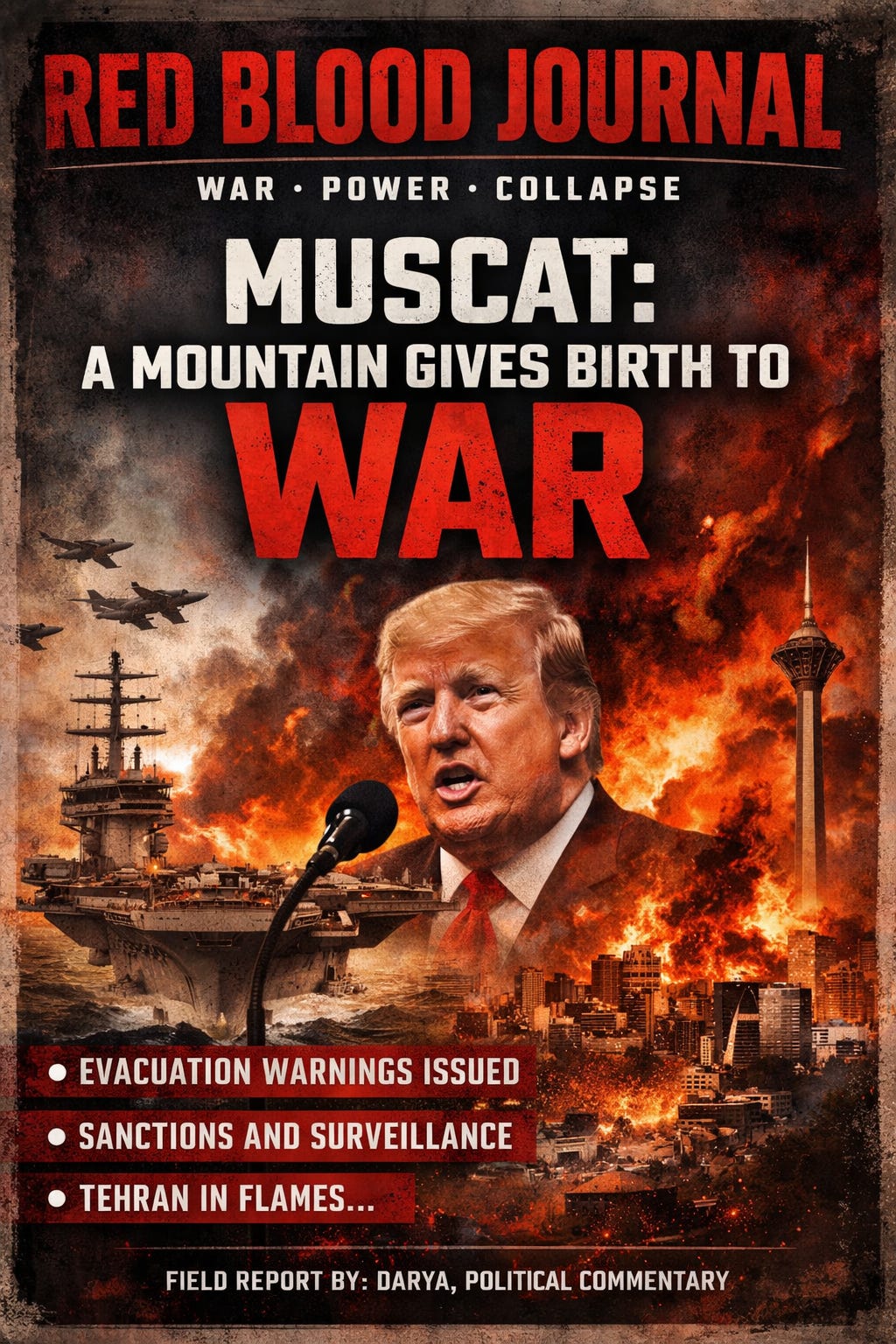
🩸 RED BLOOD JOURNAL — FIELD REPORT
T#: RBJ-2026-02-MUSCAT-MOUSE
Desk: Darya — Political Commentary / Strategic Analysis
Classification: War by Negotiation / Theatrics of Power
Timestamp: Post–Muscat / Pre–Impact
Status: Active Assessment
PROLOGUE — WHEN A MOUNTAIN GAVE BIRTH TO A MOUSE
On Friday — Bahman 6 — the “mountain” of negotiations in Muscat labored and delivered nothing.
No breakthrough. No framework. No cease in momentum.
Instead, the direction of events pivoted immediately toward war.
Abbas Araghchi’s video conference produced no tangible outcome. The news cycle did not move toward diplomacy; it accelerated toward confrontation.
The pattern was unmistakable: when diplomacy fails, evacuation begins.
SECTION I — THE GLOBAL SIGNAL
Within hours:
Germany, Russia, China, Turkey, Pakistan, and Afghanistan urged their citizens to leave Iran immediately.
The United States issued two separate evacuation warnings in 24 hours.
Americans in Iran were advised to prepare alternative communications due to internet blackouts.
If conditions permitted, they were told to exit by land through Armenia or Turkey.
This was not routine caution.
This was coordinated anticipation.
Evacuation orders are not issued because of negotiations — they are issued because of expected violence.
SECTION II — SANCTIONS AS A PRELUDE TO STRIKES
Once talks collapsed, sanctions escalated.
The U.S. Treasury moved with speed. New economic restrictions were imposed.
Then came the decisive move: Trump signed a 25% tariff on any country continuing trade with the Islamic Republic.
A promise fulfilled — but only after Muscat failed.
Diplomacy ended; coercion began.
SECTION III — THE NIGHT OF SMOKE OVER TEHRAN
That same night:
Smoke over Tehran.
A massive explosion.
Witnesses pointed to the Army General Staff headquarters.
The official explanation followed predictably:
A “short circuit” in a 300-square-meter carpentry workshop inside a military barracks on Qodousi Street.
Firefighters arrived.
The blaze was “contained.”
The narrative strained credibility.
In a moment of escalating tension, a military “workshop fire” does not inspire confidence — it invites suspicion.
SECTION IV — WAITING FOR TRUMP
All eyes turned to 03:30 AM Saturday.
Air Force One.
The White House released the audio.
Trump spoke as he had before previous strikes: calm, deliberate, and strategically ambiguous.
Key messages:
Talks with Iran were “good.”
A large U.S. naval fleet was en route to the region.
Negotiations would continue “early next week.”
Iran “really wants a deal.”
But whatever deal comes will be different — and harsher — than last time.
Then the warning:
“If they don’t reach a deal, the consequences will be very severe.”
Patience was emphasized — not restraint.
SECTION V — THE NAVAL THEATER
Trump insisted that a “major naval formation” was still arriving.
Yet the USS Abraham Lincoln carrier group was already in place.
No new carrier deployment had been publicly announced.
The implication: movement without visibility, pressure without acknowledgment.
Possibly the USS George H. W. Bush.
The message was clear: power was converging.
SECTION VI — WAR BY TIMING, NOT ACCIDENT
From Trump’s words, one conclusion emerged:
This was not negotiation — it was staging.
Time was being bought.
Assets were being positioned.
Pressure was being calibrated.
The report assessed that the decision to strike had likely already been made.
Negotiations functioned as diplomatic cover — a means of shaping legitimacy, not avoiding conflict.
SECTION VII — IRANIAN VOICES OF Inevitable WAR
Inside Iran, voices aligned with the regime began preparing the public.
Mehdi Khazali stated bluntly:
“War will happen. They will attack Iran. Even if we surrender, they will still attack — like Libya.”
This was not dissent — it was conditioning.
A population being prepared for impact.
SECTION VIII — THE AMERICAN PERSPECTIVE
Many U.S. analysts framed the coming strikes as:
Inevitable.
Targeted at the regime, not the people.
Designed for regime change, not national destruction.
Yet history has rarely respected such distinctions.
Bombs do not differentiate between power and population.
SECTION IX — WEAPONS OF THE NEW WAR
Trump revealed fragments of the U.S. arsenal:
Mobile artificial runways deployable in minutes across desert terrain.
Stealth bombers beyond radar detection.
Advanced fighters — F-35, F-22 — ready for precision dominance.
A chilling subtext followed:
“Iran doesn’t want us to use these — that’s why they negotiate.”
Negotiation as fear management.
SECTION X — NEGOTIATION VS. WAR
A historian cited in the report delivered a crucial distinction:
Negotiation requires relative parity.
Coercion requires aircraft carriers.
When one side brings fleets and the other is economically crippled, the “table” is irrelevant.
He compared the situation to April 1945 in Berlin:
Hitler spoke of talks while the city burned.
Orders were given to imaginary armies.
No real negotiation existed — only denial.
The same logic applied here:
Dialogue was not preventing war — it was timing it.
SECTION XI — THE INTERNAL FRONT: REPRESSION AND FALSE FLAGS
The report shifted inward — toward Iran’s internal battlefield.
Reformist figure Ali Shakouri-Rad admitted what many had long suspected:
Security forces had killed their own personnel to justify brutal crackdowns.
Key admissions:
Violence in protests was sometimes engineered by security agencies.
Basij members were placed in danger intentionally.
Protesters were massacred in dead-end alleys.
The regime falsely blamed “Mossad agents.”
The case of Ruhollah Ajamian in Karaj was cited as premeditated — a manufactured martyr for repression.
SECTION XII — THE REGIME’S METHOD
A pattern emerged:
Create chaos.
Blame external enemies.
Kill internally.
Use deaths as justification for mass violence.
This was not security — it was theater of terror.
SECTION XIII — RESPONSIBILITY AND SILENCE
The report concluded that:
Reformists are complicit — not innocent.
They legitimized the system through elections and rhetoric.
They share responsibility for decades of repression.
The Islamic Republic’s violence against its own people was described as historically unprecedented in scale and brutality.
Skulls shattered.
Bodies torn apart.
Families destroyed in public view.
A trauma that will never fade from Iran’s national memory.
EPILOGUE — THE ROAD AHEAD
Three forces now move in lockstep:
Sanctions — to strangle the state.
Negotiations — to manage perception.
Military buildup — to deliver force.
This is not a sudden war.
It is a pre-scripted one.
And when it arrives, it will not feel like surprise — only confirmation.
Filed by:
🩸 Darya — Red Blood Journal
Political Commentary / Strategic Desk
⏳Red Blood Journal: The Architecture of Imminent Conflict
The provided text from the Red Blood Journal details the imminent shift toward military conflict following the breakdown of diplomatic talks in Muscat.
Global powers have signaled this transition through coordinated evacuation orders for their citizens, while the United States has escalated pressure via aggressive trade tariffs and naval deployments.
Internal signs of instability within Iran, such as suspicious military explosions and government-engineered domestic violence, suggest a regime preparing for impact.
The report argues that ongoing negotiations are merely a strategic delay, serving as diplomatic cover while the U.S. positions advanced weaponry for potential strikes.
Ultimately, the source characterizes the current situation as a pre-scripted march toward war, where economic strangulation and psychological conditioning have replaced genuine dialogue.


