


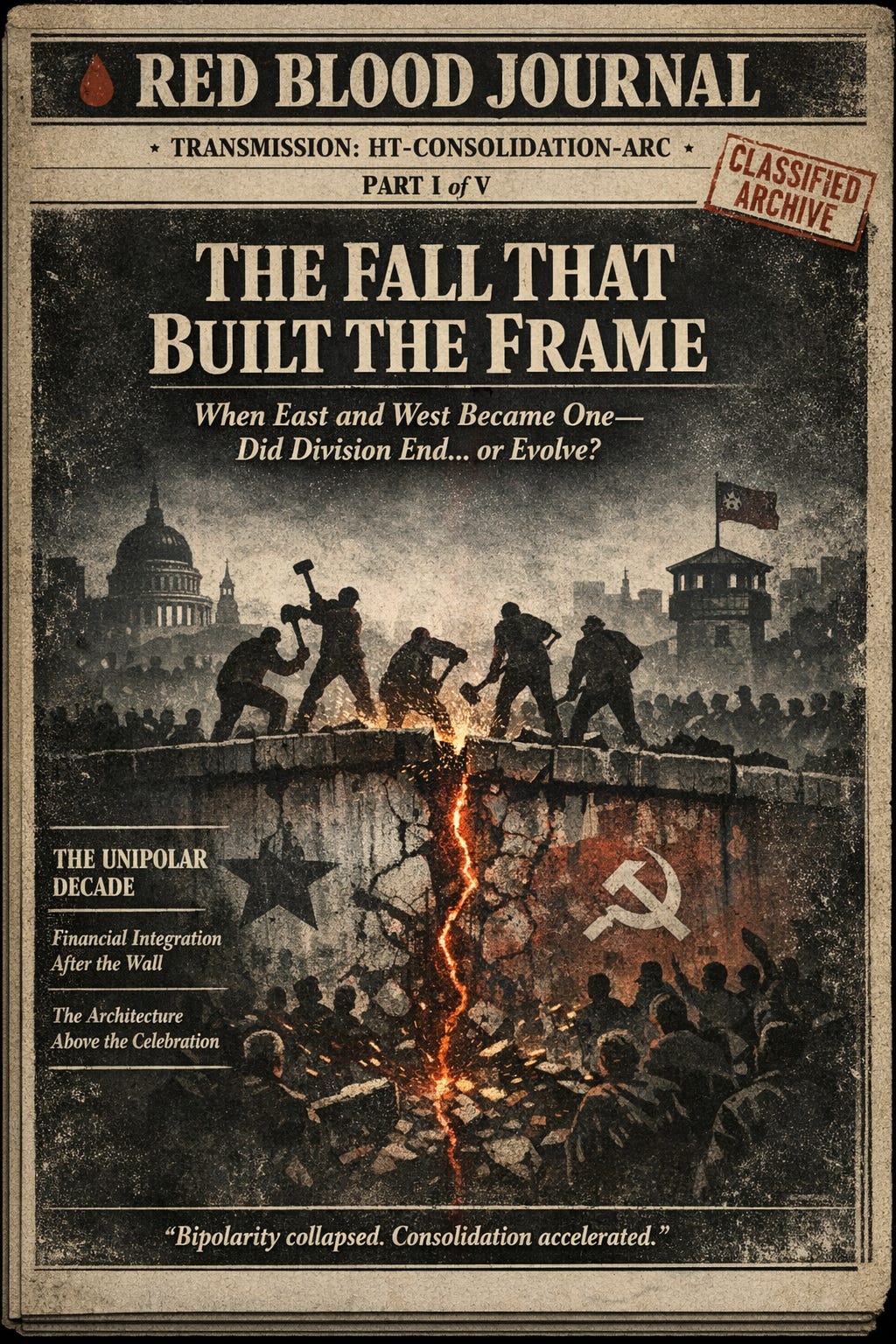
🩸 RED BLOOD JOURNAL
(PART 1 OF 5) THE WAR MOVIE
Transmission: HT-CONSOLIDATION-ARC
Classification: Parallel Planet Historical Allegory
Status: Fictional Commentary — Power Consolidation Study
PROLOGUE — WHEN TWO HALVES REJOIN
On the planet Htrae, the Great Continental War ended in ash and exhaustion.
The world was divided into:
The Western Sphere
The Eastern Bloc
Two systems.
Two flags.
Two economic doctrines.
Or so the textbooks said.
But on Htrae, division often concealed architecture.
I — THE COLD BALANCE
For decades after the war, the West and East maintained a tense equilibrium:
Proxy conflicts.
Nuclear standoffs.
Intelligence games.
Ideological propaganda.
The citizens believed it was a battle of survival.
The elites understood it was also a stabilizing mechanism.
Fear created cohesion.
External threat justified internal control.
On Htrae, rivalry functioned as governance.
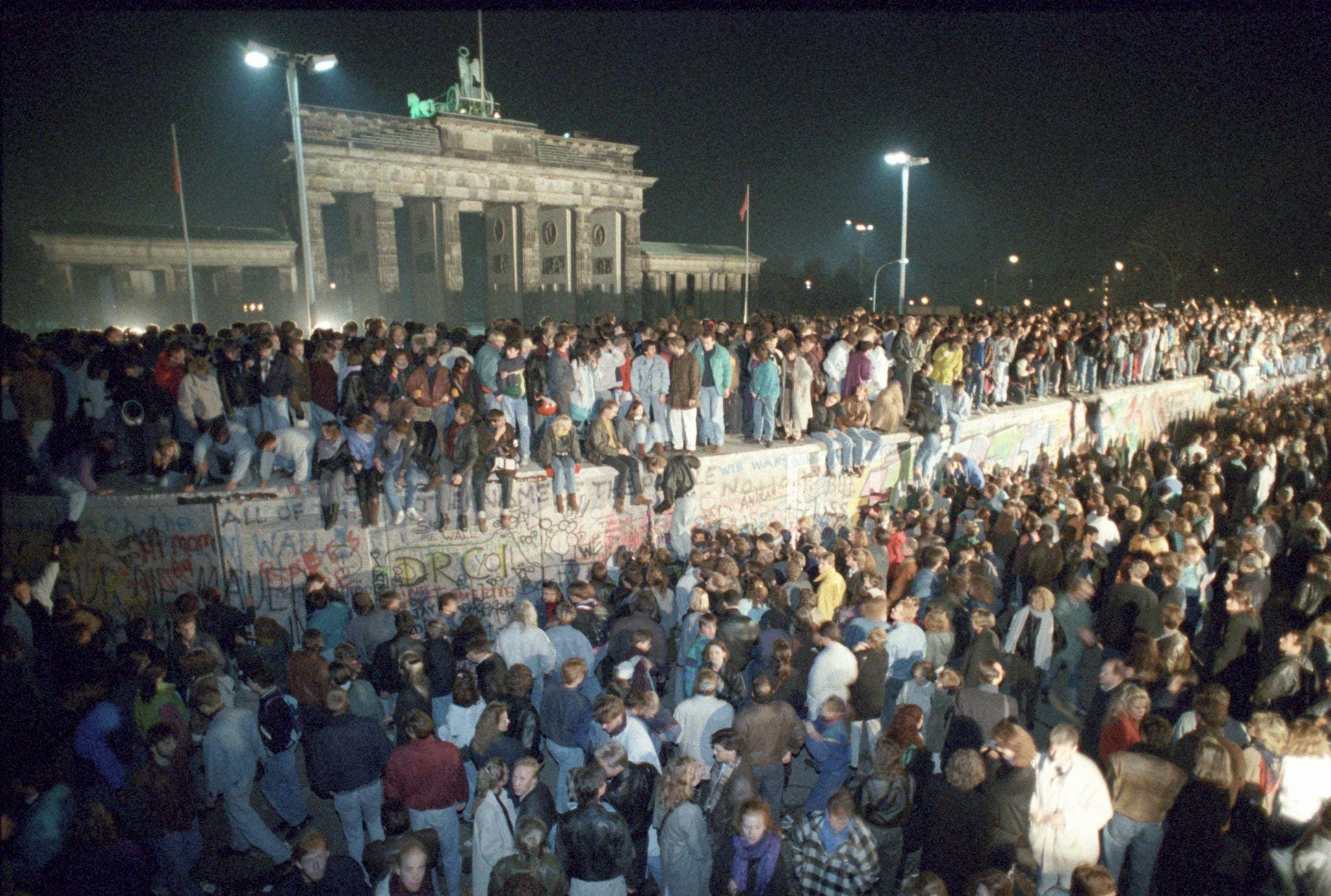
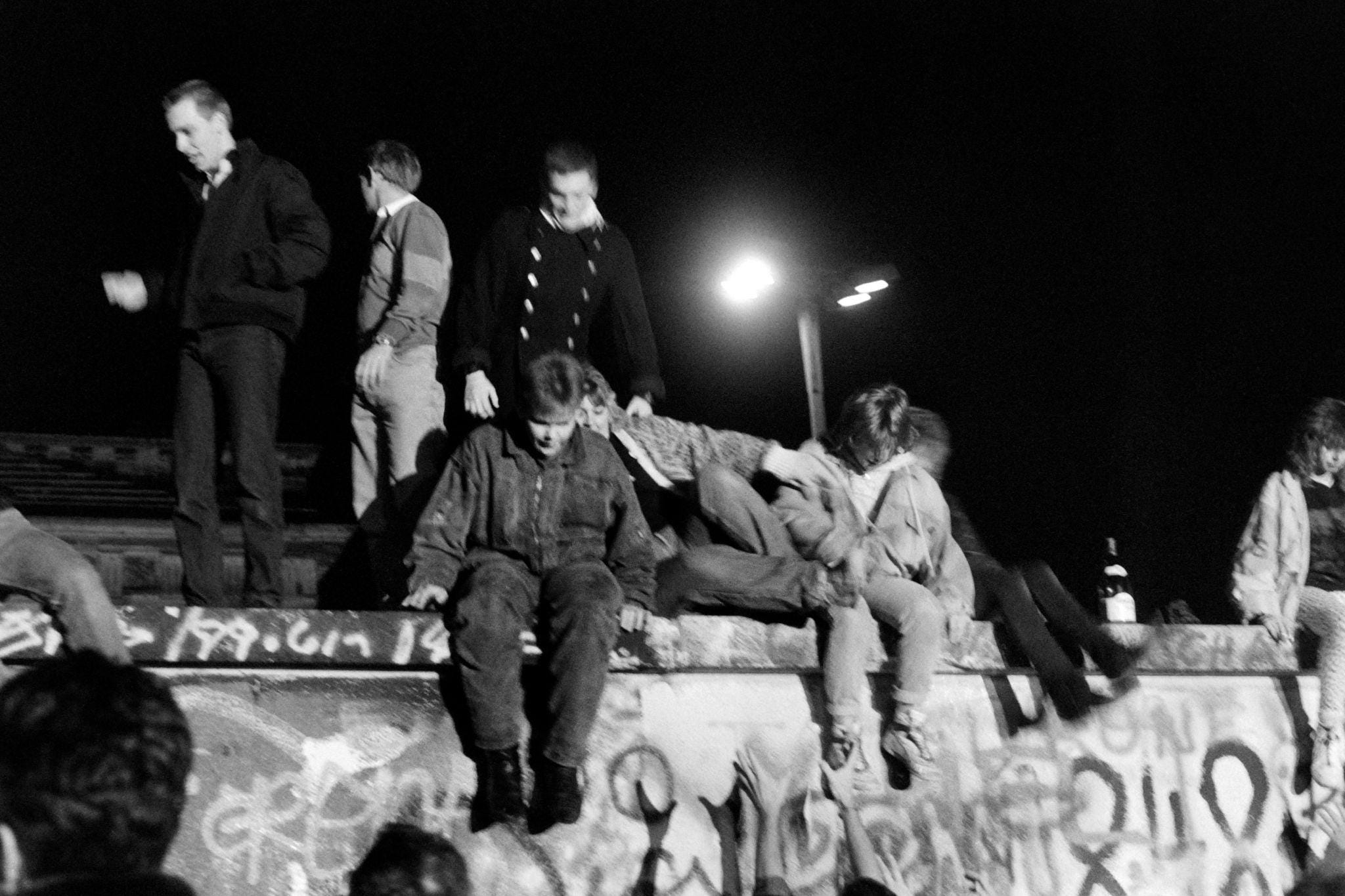
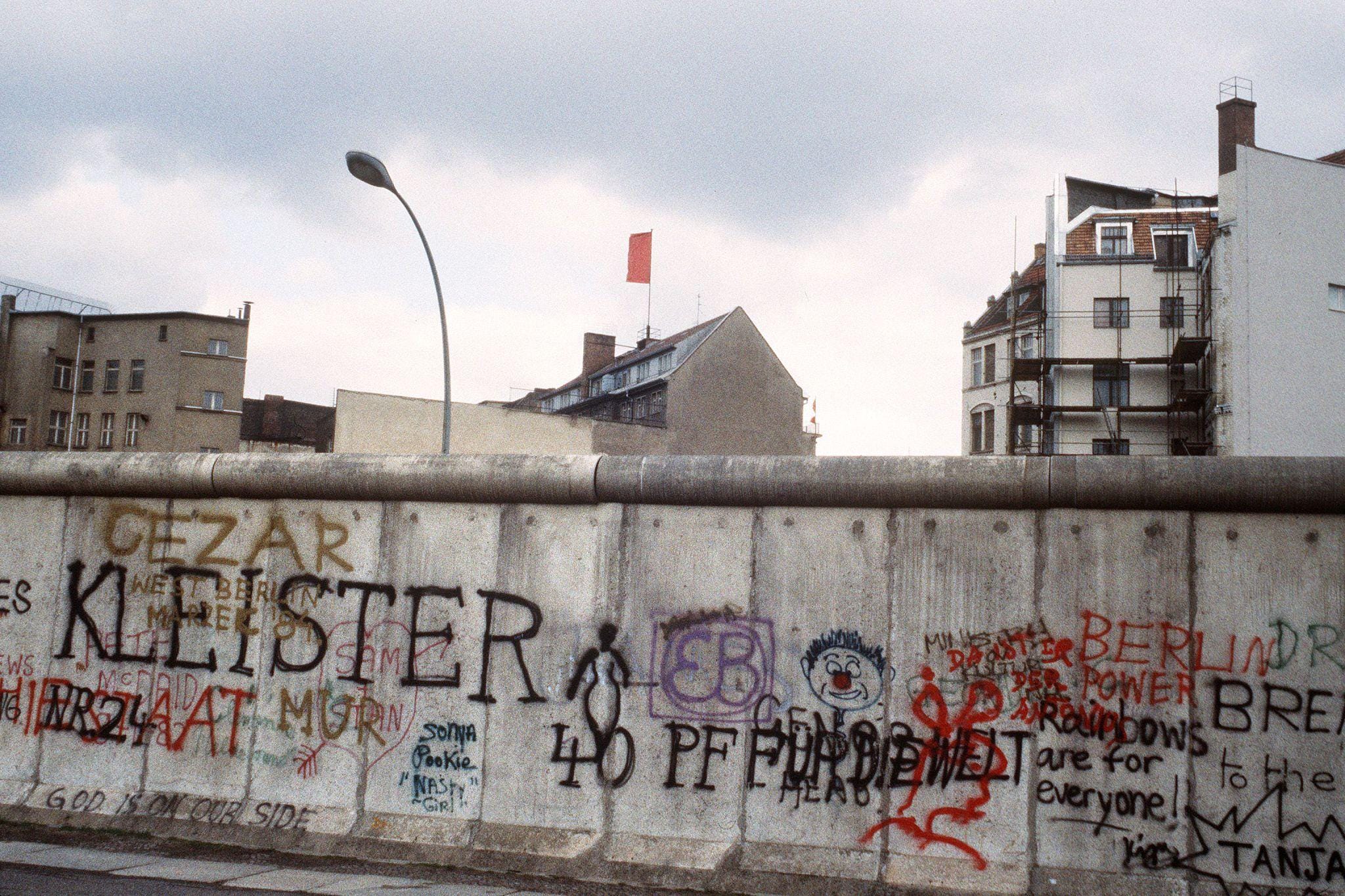
II — THE WALL OF NILREB
4
When the Wall of Nilreb fell, the population celebrated unity.
In the mirrored nation of Ynamreg, East and West merged.
Families reunited.
Markets integrated.
Borders dissolved.
Publicly: victory of freedom.
Privately: something else began.
The collapse of the Eastern counterweight removed the bipolar tension that had structured Htrae’s balance of power.
For the first time since the war, one sphere stood largely unchallenged.
III — THE UNIPOLAR MOMENT
In the decade that followed:
Financial institutions globalized.
Trade agreements multiplied.
Military alliances expanded eastward.
Media and culture homogenized.
On Htrae, analysts called this “the unipolar moment.”
Critics called it the beginning of consolidation.
When there is no rival pole, integration accelerates.
Standards unify.
Currencies intertwine.
Governance models export themselves outward.
IV — THE THEORY OF THE ONE STRUCTURE
Some theorists on Htrae argue:
The fall of Nilreb did not end division.
It refined it.
Instead of geopolitical East vs West,
division became internal:
Left vs Right
Nationalist vs Globalist
Progressive vs Traditional
Horizontal conflict replaced vertical rivalry.
If the Cold War was external polarity,
the post-wall era became internal polarization.
And consolidation continued above the noise.
V — COUNTERANALYSIS
But there is another reading.
After Nilreb fell:
NATO did not dissolve.
Russia did not integrate smoothly.
China rose economically but retained sovereignty.
Regional powers resisted Western financial models.
Rather than a seamless one-world consolidation, the planet entered:
Fragmented globalization
Financial interdependence without political unity
Competing digital ecosystems
Strategic rivalry returning
If consolidation were absolute, multipolar tension would not be resurfacing.
VI — THE REAL SHIFT
What undeniably changed after the fall of Nilreb on Htrae:
Financial globalization intensified.
Supply chains stretched across continents.
Digital networks erased borders culturally.
Sovereignty debates became central.
But integration does not equal singular governance.
Power diffused into multinational corporations, tech infrastructure, trade systems, and alliances — not a single throne.
EPILOGUE — WAS IT A BEGINNING OR AN INTERRUPTION?
On Htrae, the fall of the Wall of Nileb marked:
The end of rigid bipolarity.
The rise of global economic integration.
The illusion of permanent Western dominance.
But history did not freeze.
Rivalry returned.
Multipolarity resurfaced.
National sovereignty debates intensified.
If a “one world order” were consolidating smoothly,
there would be less friction — not more.
Perhaps the wall falling was not consolidation.
Perhaps it was the calm before a new balancing act.
🌐The Htrae Architecture: Consolidation and the Fall of Nilreb
The provided text explores a parallel planet’s history as an allegory for our own geopolitical shifts, focusing on the unification of a divided world.
Following the collapse of the Wall of Nilreb, the narrative examines how a bipolar power struggle transitioned into a period of global consolidation and economic integration.
While citizens initially viewed this merger as a victory for freedom, the source suggests it actually facilitated a centralization of power through financial and digital networks. However, the analysis notes that this unipolar moment was short-lived, as internal polarization and new international rivalries emerged to challenge total unity. Ultimately, the text questions whether the fall of the wall signaled a singular global order or merely a temporary pause before the return of multipolar friction. This historical commentary serves as a study on how sovereignty and governance evolve when external threats disappear.


