


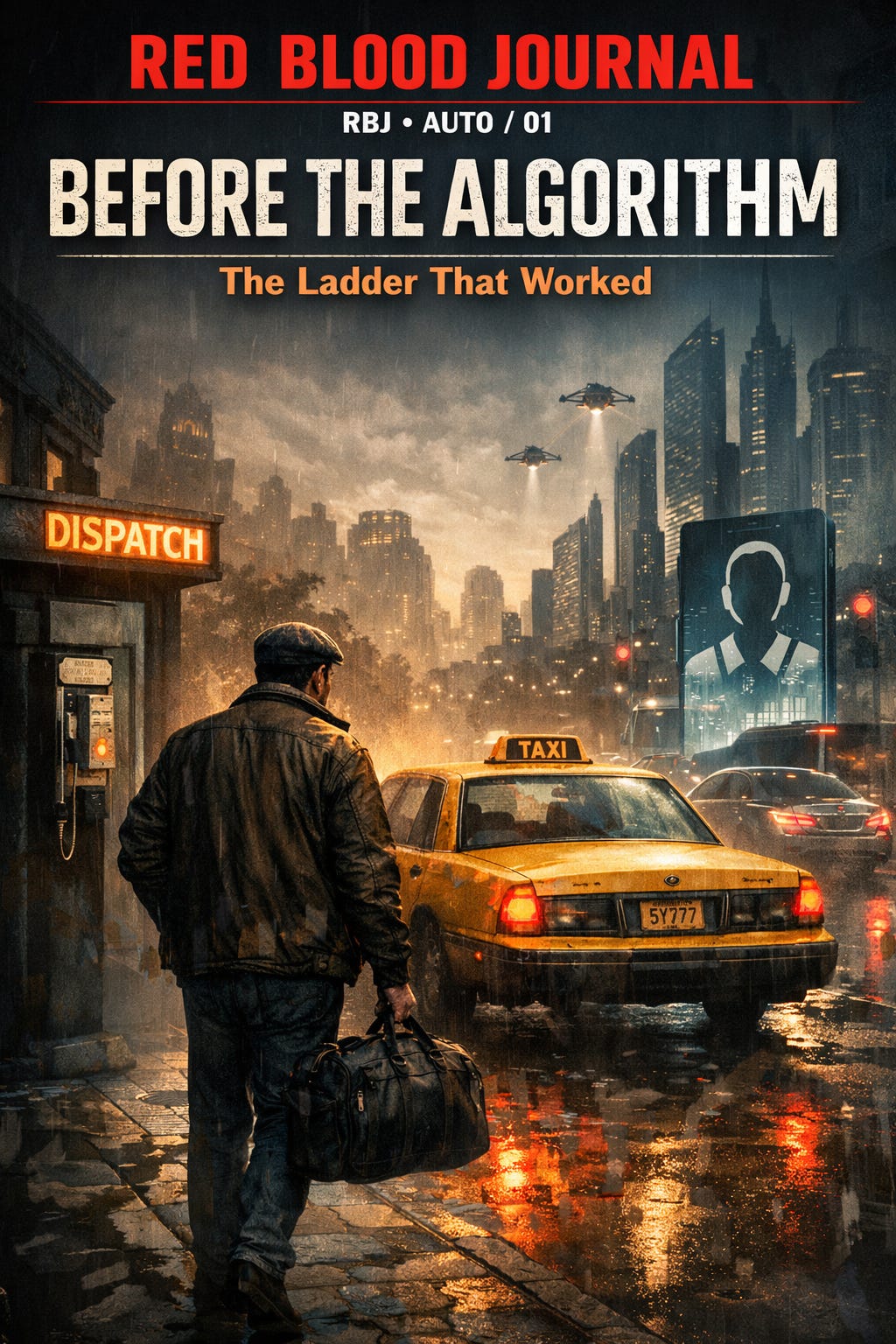
🩸 RED BLOOD JOURNAL TRANSMISSION — HYBRID FORMAT EDITION
T#: RBJ-AUTO/01 — THE LADDER THAT WORKED
Title: Before the Algorithm
Classification: Political Economy / Counterintelligence of Labor / Pre-Platform Order
Desk: The Archive of Work, Debt & Control — San Diego / New York / Tehran-in-Exile
I. PROLOGUE — THE STREET AS A FRONTIER
There was a time when the American Dream did not live in apps, venture capital decks, or corporate slogans.
It lived in a steering wheel.
Not in a stock option.
Not in an algorithm.
Not in a promise of “disruption.”
In the late 1970s, as revolutions shook the world, a wave of Iranians arrived in the United States carrying little more than determination, trauma, and the instinct to survive. Many had fled a regime change engineered from afar; they landed in a new empire whose machinery they did not yet understand.
For the poor and newly arrived, the taxi was a portal.
A metal box on wheels became:
A livelihood
A classroom
A ladder
A measure of freedom
A man could lease a medallion weekly. That lease included:
Maintenance
Insurance
Legal compliance
Dispatch service
A place inside the city’s regulated order
The driver paid for gas.
Everything else was handled by the system.
He worked 12 to 16 hours a day — not because he was enslaved, but because effort still translated into control over his fate.
This was not luxury.
It was not glamour.
It was not fairness.
But it was sovereignty.
II. THE ECONOMY OF EFFORT
The pre-Uber taxi world operated on a simple covenant:
Work hard → keep most of what you earn.
Unlike today’s platform world, there was no invisible algorithm slicing profits in the background. There was no psychological gamification pushing drivers to exhaustion. There was no digital panopticon tracking every mile.
There was a meter.
There was the street.
There was the driver.
For a disciplined man:
Rent could be paid
A family could be supported
Savings could be built
A home could be imagined
This was a ladder — imperfect, rough, but climbable.
The taxi was not a “gig.”
It was a profession.
III. THE CARTEL ERA — YELLOW MONOPOLY
Before this fragile openness, the taxi industry had been a cartel.
Yellow cabs ruled cities.
Cities and cab companies had an unspoken alliance: control in exchange for order.
Only certain companies could operate.
Only certain medallions were legitimate.
Only certain people were allowed in.
This model was not uniquely American. It had been copied globally — a universal architecture of transportation control disguised as regulation.
The cartel era did two things:
It kept prices stable for owners.
It locked out newcomers.
Power preferred scarcity over opportunity.
Yet even within this system, the working driver could still carve out a living.
The problem for power was not chaos.
The problem was independence.
IV. THE OPENING — WHEN CITIES ISSUED MEDALLIONS
Then came a rupture.
Cities began issuing medallions per vehicle to anyone who applied.
The price was symbolic — around $100.
For a brief moment, the wall cracked open.
The implications were radical:
No need to buy into a cartel
No need to beg an employer
No need to surrender autonomy
A man could become his own boss simply by working.
Applicants flooded in.
Immigrants, veterans, hustlers, and dreamers realized something dangerous:
You did not need permission from the elite to earn a living.
This was the golden window — the phase before speculation, before platforms, before engineered collapse.
V. COUNTERINTELLIGENCE NOTE — WHY THIS SYSTEM WAS DANGEROUS
From the perspective of centralized power, this model contained three intolerable flaws:
It produced too many independent men.
Independence is unpredictable. It resists control.It bypassed finance.
No Wall Street involvement. No banks. No derivatives.It allowed outsiders to climb.
The ladder was color-blind, class-blind, and nationality-blind — as long as one worked.
In a world built on hierarchy, this was a virus.
VI. THE SHADOW UNDER THE DREAM
Even in this “better” era, the seeds of destruction were already present.
The state still controlled:
Who could drive
How many medallions existed
What prices could be charged
What cars were allowed
Where drivers could operate
The freedom was real — but conditional.
It was tolerated, not granted.
And tolerance has an expiration date.
VII. THE PHILOSOPHY OF THE WHEEL
The taxi driver of this era embodied a forgotten political truth:
Freedom is not given.
It is operated.
Every mile driven was a small act of autonomy.
Every fare collected was a rejection of dependency.
Every 16-hour shift was not exploitation — it was self-command.
In this sense, the steering wheel was a political instrument.
Not a protest sign.
Not a ballot.
A vehicle of independence.
VIII. FORESHADOWING — THE STORM AHEAD
Unknown to these drivers, the structure they relied on contained a hidden trap:
Regulation would soon transform into financialization.
Scarcity would become speculation.
Speculation would invite disruption.
Disruption would invite platforms.
Platforms would invite automation.
The ladder that worked would be re-engineered into a scaffold that collapsed.
But in this moment — in this Part I — the ladder still stood.
IX. PART I THESIS (BLOOD AXIOM)
Real work once created real independence.
The system allowed it — until too many people succeeded.
X. TRANSITION TO PART II
This transmission does not end in tragedy — yet.
It ends in tension.
Because the very success of this model created the conditions for its undoing.
In Part II:
The $100 medallion becomes a financial asset.
Artificial scarcity replaces public service.
And a man named Parviz tests the logic of money itself.
The street will remain the same.
The rules will not.
🚕The Steering Wheel of Sovereignty:
The Ladder of Labor
This text explores the historical evolution of the taxi industry as a primary vehicle for immigrant upward mobility and personal sovereignty.
Before the era of digital platforms and algorithms, the authors argue that driving served as a ladder to independence for newcomers, particularly those fleeing political upheaval.
While originally part of a regulated cartel, the system briefly opened up to allow workers to bypass elite gatekeepers and earn a living through direct effort rather than financial speculation.
However, the source warns that this autonomous era was temporary, as the success of independent workers eventually invited corporate disruption and predatory financialization.
Ultimately, the narrative portrays the steering wheel not just as a tool for labor, but as a political instrument for self-command in an increasingly controlled world.


