


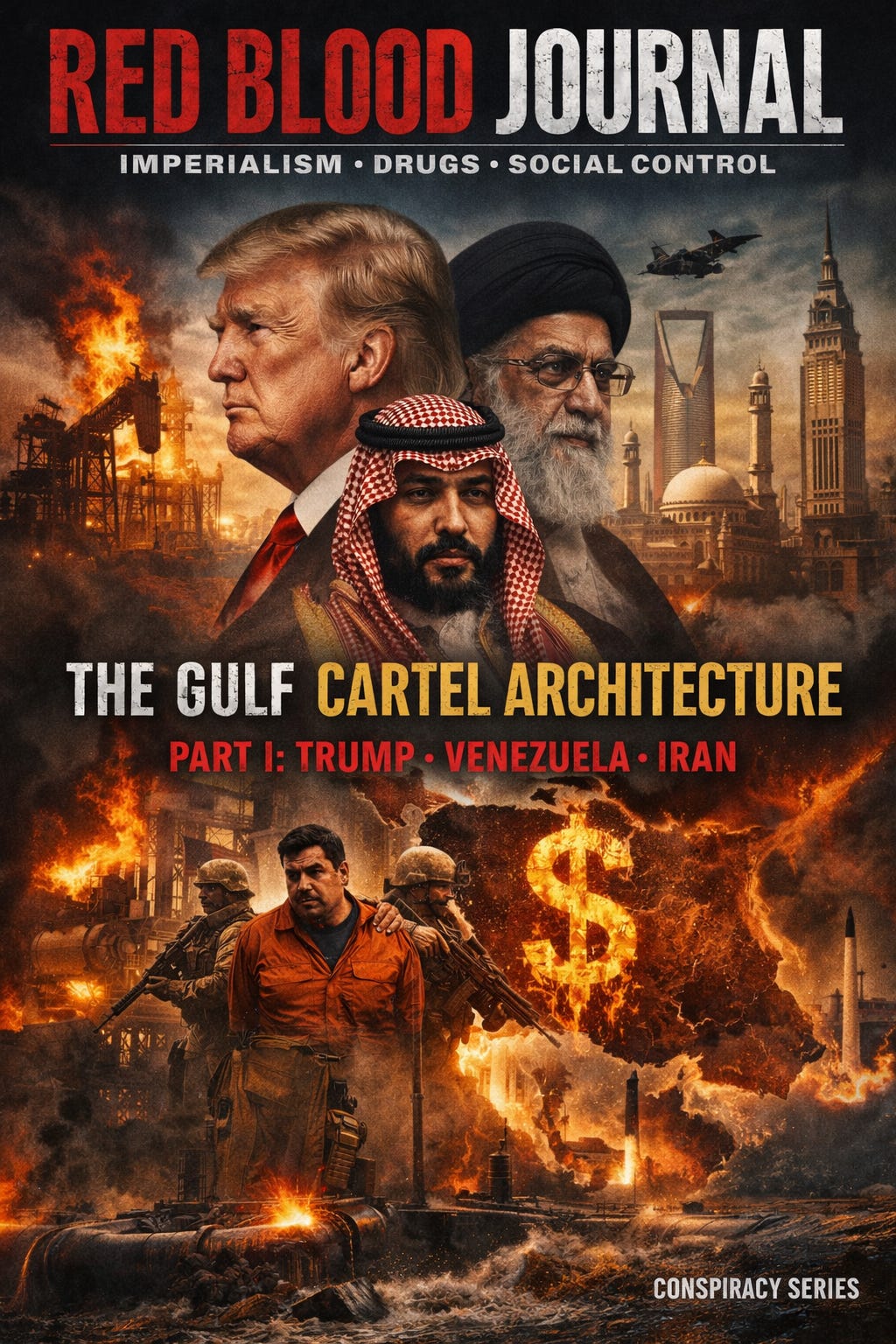
🩸🛢️ RED BLOOD JOURNAL — MULTI-PART SERIES (PART I)
THE GULF CARTEL ARCHITECTURE
T#: RBJ–2026–OIL-EMPIRE-I
Classification: Counterintelligence of Power / Political Economy of Oil
Desk: Washington – Riyadh – Caracas – Tehran – The Invisible Boardroom
I. INTRODUCTION — THE WORD YOU ARE NOT SUPPOSED TO USE
They will call this “analysis.”
They will call it “ideology.”
They will call it “conspiracy.”
What they will not call it is what it is: imperialism dressed up as order.
You are not allowed to say that the modern world is organized around a cartel of power — a fusion of military, finance, and energy — because if you say it plainly, the entire moral story of the West begins to collapse.
So instead, they teach “security studies.”
Instead, they teach “energy policy.”
Instead, they teach “stability.”
But the structure remains the same.
Imperialism is not a relic of the 19th century.
It did not disappear with the British Empire.
It simply changed managers, uniforms, and language.
And at the center of it all sits the Gulf.
II. WHY THE GULF WARS WERE NEVER ABOUT WHAT THEY SAID
Every Gulf war followed the same hidden logic:
A country controls oil.
That country acts too independently.
The West invents a moral reason to intervene.
The intervention restores elite control.
Iraq was not destroyed because Saddam was evil.
It was destroyed because he threatened the architecture of oil pricing, regional power, and Western financial dominance.
Libya was not bombed because of “human rights.”
It was bombed because Gaddafi wanted to create an African gold-backed currency that would weaken the dollar and the oil trade.
Iran is not sanctioned because of nuclear weapons.
It is sanctioned because it refuses to submit fully to the energy-financial order.
War is not chaos.
War is maintenance.
III. WHY MONARCHIES ARE PROTECTED (AND REPUBLICS ARE NOT)
Look carefully at the pattern.
Whenever a king rules in the Gulf — Washington defends him.
Whenever a popular leader rules over oil — Washington destabilizes him.
Why?
Because monarchies are reliable instruments of control.
A king does not fear elections.
A king does not fear workers.
A king does not fear unions.
A king does not fear nationalization.
A king fears only losing his throne — and Washington promises to protect it.
In exchange, the king keeps oil flowing, prices stable, and foreign corporations rich.
This is not alliance.
This is a contract.
IV. OIL CARTELS AS POLITICAL WEAPONS
OPEC is not just an economic organization.
It is a geopolitical switchboard.
When prices rise too high, elites panic.
When prices fall too low, elites intervene.
Saudi Arabia is not simply an oil state.
It is the central valve of the global energy system.
And because oil is priced in dollars, every barrel that moves across the world reinforces American financial dominance.
This is why any country that tries to escape the dollar becomes an enemy.
This is why Iran, Russia, and Venezuela are targeted.
Not because they are dictators — but because they are defiant.
V. “STABILITY” — THE LIE WITH A POLITE NAME
Every time a U.S. official says “stability in the Middle East,” translate it correctly:
They do not mean stability for ordinary people.
They mean stability for:
• Western oil companies
• Arms manufacturers
• International banks
• Gulf royal families
“Stability” means no revolutions.
“Stability” means no nationalization.
“Stability” means no redistribution of wealth.
Stability means: the poor remain poor, the rich remain rich, and oil keeps flowing.
VI. SAUDI ARABIA — THE PILLAR OF THE SYSTEM
Saudi Arabia is not just another country.
It is:
• A military partner
• A financial partner
• An energy regulator
• A geopolitical buffer
• A buyer of Western weapons
• A holder of massive U.S. debt
In return, the West ignores:
• Its human rights abuses
• Its role in regional conflicts
• Its internal repression
• Its influence over global energy politics
This is not hypocrisy.
It is the operating system.
VII. THE PUNISHMENT OF POPULISTS
History teaches the same lesson again and again:
If you nationalize oil, you become a target.
• Mossadegh in Iran — overthrown
• Arbenz in Guatemala — overthrown
• Chávez in Venezuela — sanctioned
• Maduro in Venezuela — attacked
• Iran today — strangled economically
The crime is never “dictatorship.”
The crime is independence.
VIII. TRUMP AND VENEZUELA — THE MASK SLIPS
Here is where Trump reveals the truth of empire.
He did not invade Venezuela because of democracy.
He moved against Venezuela because Venezuela sits on one of the largest oil reserves in the world and refused to bend.
The capture of Maduro was not “anti-drug.”
It was regime change dressed in law enforcement language.
This is the same pattern as Iraq — just packaged differently.
Trump did not break the system.
He simply acted more openly like its enforcer.
IX. TRUMP AND IRAN — WHAT IS COMING
What Trump has in store for Iran follows the same script:
Economic strangulation through sanctions
Isolation through diplomacy
Military pressure through naval presence
Threats of force disguised as “security concerns”
Negotiations only on U.S. terms
Iran’s real crime is not its nuclear program.
Its real crime is refusing to become another Saudi Arabia — obedient, open to Western capital, and politically tamed.
Trump is not trying to free Iran.
He is trying to discipline it.
X. IS TRUMP REALLY DIFFERENT? — THE FINAL JUDGMENT (PART I)
On the surface:
Yes — Trump is louder, cruder, and more unpredictable.
At the level that matters:
No — he serves the same oil-military-finance structure as his predecessors.
He did not dismantle the petrodollar.
He did not abandon Saudi Arabia.
He did not withdraw from the Gulf.
He did not stop arms sales.
He did not liberate Venezuela’s people — he replaced its leadership.
Trump is not a revolutionary against empire.
He is a different style of imperial manager.
COUNTERINTELLIGENCE NOTE — PART I
Empires do not fall because of presidents.
They fall when their economic logic collapses.
The Gulf architecture remains intact.
Trump is not outside it.
He is operating inside it — more bluntly than most.
TO BE CONTINUED — PART II PREVIEW
Part II will examine:
• The petrodollar as the hidden world government
• How sanctions function as modern warfare
• Iran as the next Venezuela
• Why regime change is always about resources
• The role of Wall Street in every Middle Eastern war
🛢️The Architecture of Oil Imperialism: The Gulf Cartel System
This document presents a critical analysis of global energy politics, arguing that modern imperialism is disguised as international order and security policy.
The text asserts that the West maintains its dominance through a cartel of power that fuses military force, financial systems, and control over oil resources.
According to the author, military interventions and economic sanctions are tools used to punish nations that seek economic independence or threaten the dominance of the petrodollar.
The narrative highlights a strategic preference for monarchies over popular leaders, as royal families act as reliable partners in keeping energy prices stable and markets open.
Ultimately, the source characterizes global stability as a deceptive term for a system that prioritizes the interests of Western corporations and elite financial institutions over human rights.
🛢️The Architecture of Oil Imperialism and the Gulf Cartel
1 source
This text outlines a critical perspective on global power, asserting that modern imperialism is a calculated fusion of military force, finance, and energy control. The author argues that Western “security” and “stability” are merely euphemisms for a system designed to protect corporate interests and the dominance of the petrodollar. By analyzing conflicts in the Middle East and Latin America, the source claims that nations are punished with sanctions or regime change not for moral failings, but for seeking economic independence. It highlights how Gulf monarchies are preserved as reliable anchors for this order, while populist leaders who attempt to nationalize resources are systematically targeted. Ultimately, the writing portrays global politics as a rigid contract that prioritizes the uninterrupted flow of oil and wealth over genuine democratic ideals.
Michael Parenti “Imperialism, Drugs and Social Control”


