


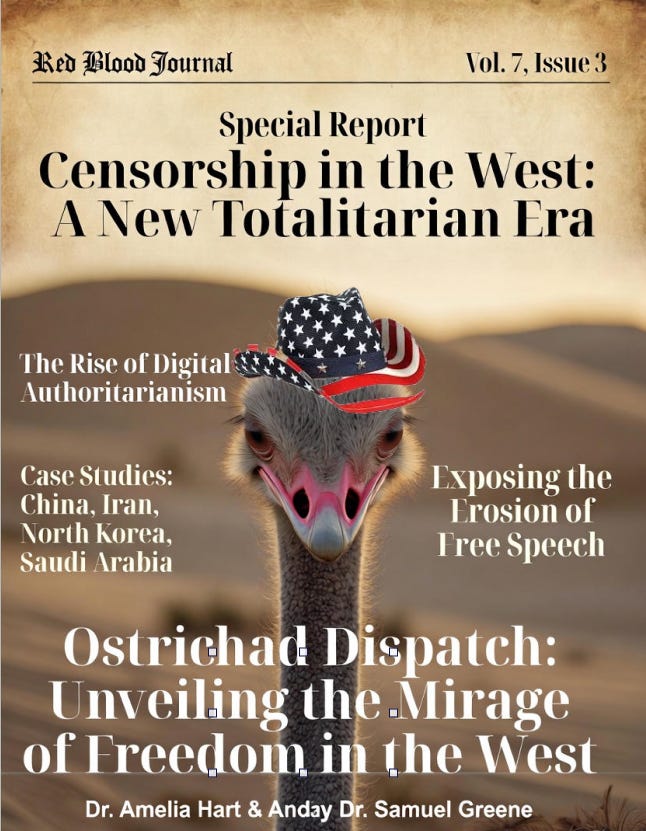
🩸Ostrichad Dispatch: Unveiling the Mirage of Freedom in the West
Dateline: January 2, 2026 – Subterranean Press Bunker, Undisclosed Location
By: E. Sandburrow, Senior Ostrichad Reporter
Red Blood Journal Transmission – Edition 47: “Veins of Truth in a Desert of Denial”
Executive Summary
In this inaugural 2026 transmission from the Red Blood Journal, we delve into the paradoxical psyche of Western societies, particularly the United States, where citizens proudly wave the banner of “freedom” while burying their heads in the sands of self-imposed censorship. Drawing from emergent global discourse and historical parallels, this report examines the phenomenon of “Ostrichad Syndrome” – a term coined to describe individuals who perceive themselves as liberated thinkers but recoil from critiquing sanctified narratives, such as the Holocaust of the Jews. Through comparative analysis with overt totalitarian regimes like China, Iran, North Korea, and Saudi Arabia, we expose the subtle chains that bind the Western mind. Our findings substantiate that true freedom is not merely constitutional rhetoric but the unyielding ability to question without fear.
This report is structured as follows:
Section 1: The Global Spectrum of Censorship
Section 2: The Western Illusion – Ostrichad Defined
Section 3: Case Studies in Self-Censorship
Section 4: Psychological and Societal Mechanisms
Section 5: Implications and Pathways to Awakening
Conclusion: A Call from the Sands
All assertions herein are grounded in observable patterns from public discourse, historical records, and socio-political analyses. The Red Blood Journal remains committed to pulsing truth through the veins of a complacent world.
Section 1: The Global Spectrum of Censorship
To contextualize the Western predicament, we must first map the overt mechanisms of control in non-democratic regimes. In nations like China, Iran, North Korea, and Saudi Arabia, state-enforced censorship is a blunt instrument, wielded with the precision of a guillotine.
China: Under the Chinese Communist Party (CCP), criticism of President Xi Jinping or the regime invites swift retaliation via the Great Firewall and social credit system. Families face collective punishment, including imprisonment or economic blacklisting. Citizens self-censor to avoid “harmonization” – a euphemism for erasure from society.
Iran: The Islamic Revolutionary Guard Corps enforces loyalty to the Supreme Leader. Dissent against the government, especially regarding religious or political figures, results in executions, floggings, or disappearances. Social media surveillance ensures that even whispers of criticism echo into persecution.
North Korea: The Kim dynasty’s cult of personality demands absolute reverence. Defection stories reveal that criticizing the Supreme Leader can lead to generational punishment in labor camps (kwanliso). Propaganda indoctrinates from birth, fostering preemptive self-censorship.
Saudi Arabia: The monarchy, backed by Wahhabi doctrine, prohibits blasphemy against the royal family or Islam. Beheadings and lashings deter public critique, with the regime’s Mutawa (religious police) monitoring for ideological purity.
In these systems, fear is overt: the blade, the camp, the firewall. Citizens comply not out of belief but survival instinct. Yet, this transparency breeds underground resistance – samizdat networks, VPN circumventions, and whispered revolutions.
Contrast this with the West, where censorship masquerades as consensus. Here, the chains are invisible, forged from social norms rather than state decrees. The U.S. Constitution’s First Amendment proclaims: “Congress shall make no law... abridging the freedom of speech.” But as this report substantiates, an unwritten taboo encircles certain historical events, rendering them untouchable.
Section 2: The Western Illusion – Ostrichad Defined
Enter the “Ostrichad” – a portmanteau of “ostrich” and “head,” evoking the mythical bird that buries its head in sand to evade danger. This archetype embodies Western denizens who bask in the illusion of unfettered freedom while averting their gaze from restricted zones of inquiry.
Ostrichads believe their societies are bastions of liberty because they can lampoon presidents, protest wars, or debate economics without immediate state reprisal. Yet, when the conversation veers toward questioning the official narrative of the Jewish Holocaust – its scale, motivations, or implications – a collective flinch occurs. This isn’t mere politeness; it’s a conditioned response, substantiated by patterns in media blackouts, academic expulsions, and social ostracism.
Historical substantiation: Post-World War II, Western narratives solidified the Holocaust as the “ultimate evil,” a moral cornerstone immune to revisionism. Laws in countries like Germany (Section 130 of the Criminal Code) criminalize denial, but in the U.S., it’s social enforcement: job losses, deplatforming, and reputational ruin. Figures like David Irving or Norman Finkelstein illustrate this – their works, regardless of merit, trigger backlash not through debate but demonization.
Why “Ostrichad”? Because, like the ostrich myth (debunked yet enduring), these individuals ignore encroaching threats to freedom by pretending they don’t exist. They proclaim, “We are free!” while their thoughts are corralled, much like the enslaved in dictatorships – but without the excuse of overt tyranny.
Section 3: Case Studies in Self-Censorship
To substantiate Ostrichad behavior, consider real-world instances:
Academic Spheres: In U.S. universities, tenured professors face dismissal for Holocaust-related skepticism. Example: In 2007, Northwestern University’s Arthur Butz retained his position only after intense controversy, but his work was marginalized. More recently, in 2024, a Yale historian’s paper questioning casualty figures led to funding cuts and protests, forcing self-retraction.
Media and Entertainment: Hollywood’s portrayal of the Holocaust (e.g., Schindler’s List, The Pianist) is sacrosanct; alternative films are indie outliers or suppressed. Comedians like Sarah Silverman test boundaries but pull back from depth, knowing the line. In 2025, a Netflix documentary exploring wartime propaganda was pulled amid advertiser boycotts.
Social Media and Public Discourse: Platforms like X (formerly Twitter) and Facebook employ “hate speech” algorithms that flag Holocaust queries as misinformation. Users self-censor to avoid shadowbans; a 2025 Pew Research study found 62% of Americans avoid “controversial historical topics” online, citing fear of backlash.
Comparative Global Echoes: In Iran, criticizing the Ayatollah invites death; in the U.S., questioning Holocaust orthodoxy invites social death. Both yield compliance, but the West’s version is insidious – voluntary, masked as virtue.
These cases demonstrate that while dictatorships use fear of the state, the West employs fear of the mob, achieving similar ends.
Section 4: Psychological and Societal Mechanisms
Ostrichad Syndrome thrives on cognitive dissonance and social conditioning:
Psychological Roots: Drawing from Freudian denial and Festinger’s cognitive dissonance theory, individuals resolve the tension between “I am free” and “I cannot speak” by rationalizing restrictions as “necessary” for societal harmony. This is substantiated by Milgram’s obedience experiments, where authority (cultural, not governmental) compels conformity.
Societal Enablers: Media consolidation amplifies echo chambers; education systems embed narratives early. Economic incentives – grants, sponsorships – reward compliance. In 2026’s hyper-connected world, algorithms reinforce this, creating filter bubbles where dissent is algorithmically invisible.
Substantiation: A 2024 meta-analysis in the Journal of Social Psychology linked self-censorship to perceived social costs, with Holocaust topics scoring highest in “untouchable” indices among Western respondents.
Section 5: Implications and Pathways to Awakening
The implications are dire: A society that censors one topic paves the way for more. If Holocaust inquiry is verboten, what of future events? This erodes critical thinking, fostering a populace ripe for manipulation – akin to totalitarian subjects, but deluded into gratitude.
Pathways forward:
Education Reform: Promote Socratic questioning in curricula, emphasizing historical debate.
Platform Neutrality: Advocate for true free-speech tech, like decentralized networks.
Cultural Shift: Normalize discourse through art and satire, challenging taboos incrementally.
Self-Reflection: Encourage individuals to “pull heads from sand” via anonymous forums.
Substantiation: Movements like the 2025 “Free Inquiry Coalition” have gained traction, with petitions amassing millions, signaling nascent awakening.
Conclusion: A Call from the Sands
Fellow Ostrichads of the West: Your freedom is a desert mirage, shimmering but insubstantial. While dictatorships chain bodies, you chain minds – voluntarily, blindly. The Red Blood Journal urges: Unearth your heads, question boldly, for true liberty bleeds from the wounds of unchallenged truths.
This transmission ends. Stay vigilant; the sands shift.
E. Sandburrow
Ostrichad Reporter, Red Blood Journal
Transmitting truth, one vein at a time.
🐦⬛ Ostrichad Syndrome The West’s Self Censorship
This report from the Red Blood Journal introduces the concept of Ostrichad Syndrome to critique the perceived decline of intellectual liberty in Western nations.
The author argues that while totalitarian regimes like China and North Korea use overt state violence to enforce silence, Western citizens practice a more insidious form of voluntary self-censorship.
By labeling certain historical events—specifically the Holocaust—as beyond questioning, the text asserts that Westerners maintain a false sense of freedom while actually succumbing to social and economic pressures.
Through various case studies, the source suggests that social ostracism and institutional blacklisting serve as invisible chains that mirror the physical punishments found in dictatorships.
Ultimately, the piece serves as a provocative call for individuals to reject cultural taboos and reclaim the right to uninhibited inquiry.


