


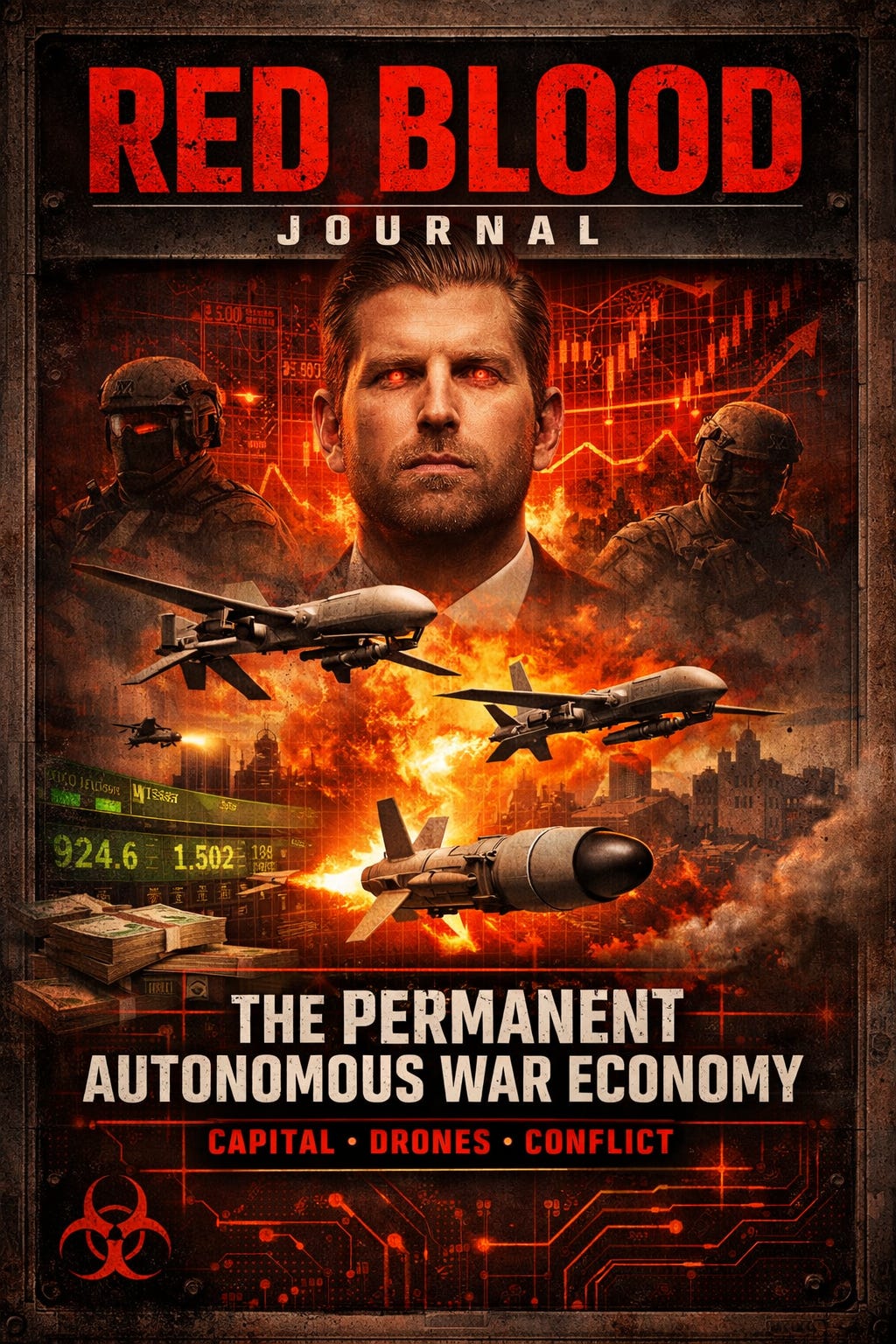
🩸 RED BLOOD JOURNAL TRANSMISSION
T#: RBJ-2026-DRONE-CAPITAL-VECTOR
Classification: Military-Capital Convergence / Autonomous Warfare Economy / Strategic Power Forecast
Desk: Counterintelligence Economics Division — Archive of Blood & Memory
Cross-Reference: Cost-Efficiency Doctrine / Autonomous Kill Chain Evolution / Private Capital Military Penetration
PROLOGUE — WHEN KILLING BECOMES A SPREADSHEET VARIABLE
There was a time when war was measured in territory.
Then it was measured in casualties.
Now it is measured in cost efficiency.
The emergence of private investment into autonomous weapons systems marks the beginning of a new phase of warfare—not defined by ideology, but by optimization.
In this phase, the battlefield is no longer just physical terrain.
It is an economic equation.
And the most powerful actors are not necessarily generals.
They are capital allocators.
SECTION I — THE NEW MILITARY-CAPITAL ORGANISM
The traditional model of war followed a linear structure:
Government → Military → Weapons Manufacturer → Battlefield
This model has evolved.
The new structure is circular:
Private Capital → Defense Startup → Military Deployment → Combat Validation → Increased Company Valuation → Expanded Private Capital Inflow
Combat itself has become a form of product validation.
Battlefields now serve a dual function:
• Strategic military objective
• Proof-of-performance marketplace
This creates a feedback loop where destruction accelerates investment.
Not because of ideology.
But because of efficiency metrics.
SECTION II — THE AUTONOMOUS WAR ECONOMY
Autonomous drones represent the most disruptive military technology since the atomic bomb—not because of their raw power, but because of their scalability.
Atomic weapons are rare.
Drones are mass-producible.
Their defining advantage is not explosive yield.
It is cost ratio.
A drone costing $5,000 can destroy a target worth millions.
This asymmetry transforms war from a state-limited activity into a scalable industrial process.
The barrier to lethal force collapses.
War becomes democratized—not in moral terms, but in economic terms.
SECTION III — THE PRIVATE CAPITAL INFILTRATION POINT
Private capital entering weapons production creates a structural shift in incentives.
Traditional military procurement responded to national security threats.
Private capital responds to return on investment.
This creates a new invisible pressure vector:
Profit alignment with perpetual instability.
This does not require conspiracy.
It requires only structural incentive alignment.
When instability increases:
• Military spending increases
• Defense contracts increase
• Defense company valuations increase
• Investor returns increase
War becomes economically self-reinforcing.
SECTION IV — THE COST-PER-KILL DOCTRINE
The most revealing transformation is linguistic.
Military success metrics have always included efficiency, but autonomous systems allow precision quantification.
The objective shifts from:
Win the war
to
Optimize the kill chain.
This is the essence of algorithmic warfare.
Targets become data points.
Engagement becomes automated decision logic.
Destruction becomes an output variable.
The battlefield becomes an extension of computational optimization.
SECTION V — THE POLITICAL-CAPITAL CONVERGENCE RISK
When individuals connected to political leadership invest in defense technologies, a new structural risk emerges.
It is not necessarily illegal.
But it creates incentive overlap between:
Policy influence
Military procurement decisions
Private financial gain
This overlap produces what analysts historically described as the Military-Industrial Complex.
The defining characteristic of this system is not secrecy.
It is self-sustaining feedback.
The system perpetuates itself because its continuation benefits all participants inside the loop.
SECTION VI — THE AUTONOMOUS FUTURE PHASE
Autonomous drone warfare represents Phase I of a larger transition.
Phase II is already underway.
Future developments include:
• Fully autonomous target acquisition systems
• Swarm drones operating without human supervision
• AI-controlled battlefield coordination
• Autonomous assassination capability
• Persistent aerial surveillance grids
Human decision latency will be replaced by algorithmic decision speed.
The human role shifts from operator to supervisor.
Eventually, even supervision becomes optional.
SECTION VII — THE PREDICTION: THE PERMANENT AUTONOMOUS WAR ECONOMY
Based on current trajectories, the following outcomes are highly probable within the next 10–20 years:
Prediction 1 — Drone Warfare Will Become the Dominant Form of Conflict
Traditional ground invasions will become less common.
Remote autonomous engagement will become standard.
War will be conducted from distance.
The public will see less war.
But more war will occur.
Prediction 2 — Private Capital Will Become a Primary Driver of Weapons Innovation
Government will remain the buyer.
Private investors will become the innovation engine.
Military technological leadership will shift from state labs to private startups.
Prediction 3 — Autonomous Weapons Will Become Cheap Enough for Global Proliferation
State monopoly on advanced weapons will weaken.
Non-state actors will gain access to autonomous systems.
The global balance of power will destabilize.
Prediction 4 — Warfare Will Become Persistent Rather Than Episodic
Instead of defined wars with beginnings and endings, conflict will become continuous.
Low-intensity autonomous engagement will operate permanently in the background.
War becomes infrastructure.
Prediction 5 — Financial Markets Will Integrate Warfare Into Economic Growth Models
Defense sector growth will become a permanent pillar of economic expansion.
War will no longer interrupt economic growth.
It will fuel it.
SECTION VIII — THE FINAL TRANSFORMATION
The most profound shift is not technological.
It is psychological.
When destruction becomes economically optimized, war ceases to be an extraordinary event.
It becomes normalized infrastructure.
Invisible.
Continuous.
Integrated.
Not driven by hatred.
Driven by efficiency.
ARCHIVE NOTE
Every previous military revolution followed the same pattern:
First invention.
Then deployment.
Then normalization.
Then dependence.
Autonomous warfare has now entered Phase II.
Normalization.
Phase III—dependence—is inevitable.
END TRANSMISSION
🩸 RBJ-2026-DRONE-CAPITAL-VECTOR
🤖The Algorithmic War Economy:
Optimization of the Kill Chain
The provided text outlines a shift in global conflict where warfare is treated as a financial equation rather than a matter of territory or ideology.
This new era is defined by the integration of private capital into military technology, creating a self-sustaining cycle where combat serves to validate high-value defense startups.
Autonomous drones have revolutionized this field by making destruction cheap, scalable, and highly efficient, shifting the focus toward optimizing the cost of every lethal engagement.
As a result, the traditional military-industrial complex is evolving into a system where investor returns and perpetual instability are structurally aligned.
This transition suggests a future where automated, low-intensity conflict becomes a permanent and normalized feature of the global economy.
Ultimately, the source predicts that human decision-making will be replaced by algorithmic speed, turning warfare into an invisible but constant piece of societal infrastructure.


