


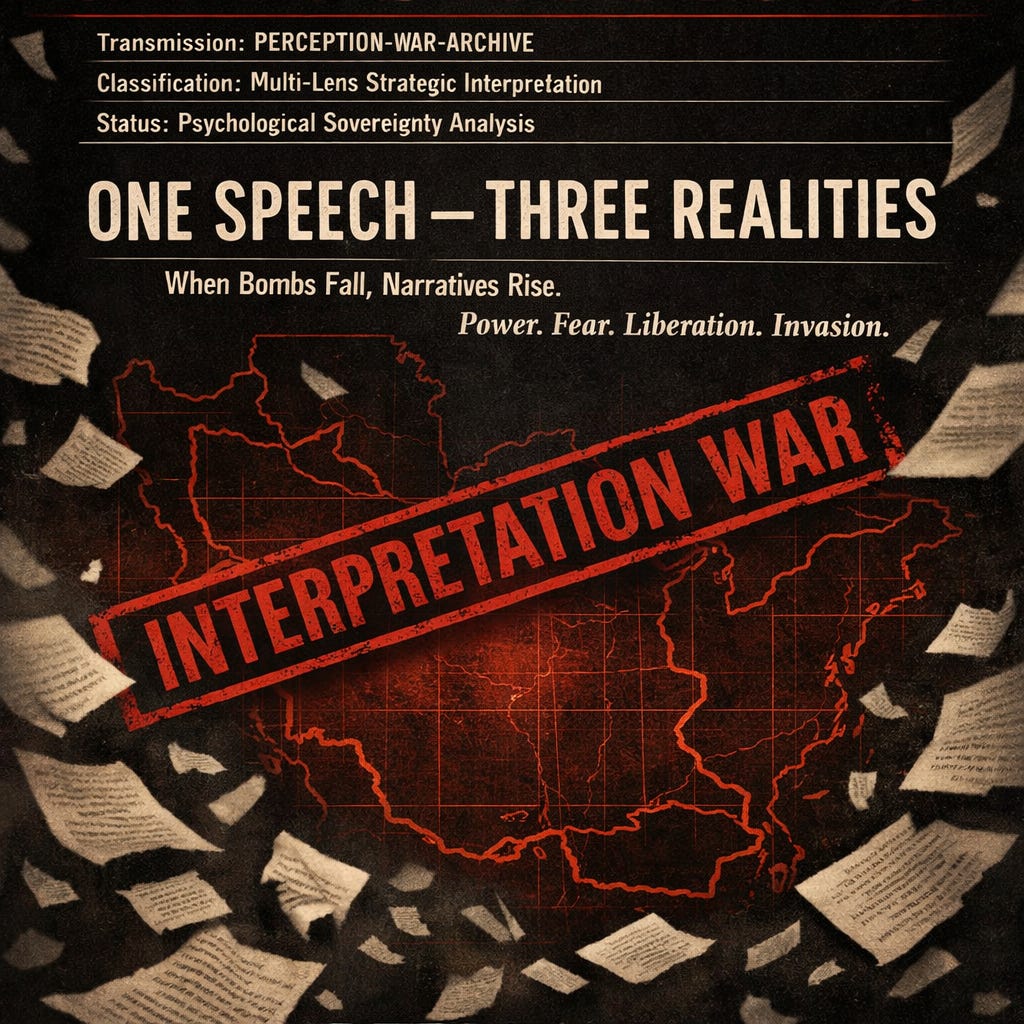
🩸FORWARD
Transmission Preview: Three Lenses, One Speech
The attached address begins with a declaration:
“A short time ago, the United States military began major combat operations in Iran.”
Iran Bombing
From that moment forward, the speech frames war as defense, elimination of threats, and prevention of nuclear capability
Iran Bombing
. It promises obliteration of missile systems, destruction of naval capacity, and immunity or death for regime forces
Iran Bombing
. It calls on Iranian citizens to remain indoors while bombs fall and then “take over your government”
Iran Bombing
.
One speech.
Three radically different interpretations.
Every audience reads through its own archive of memory:
A leader reads power, leverage, deterrence.
An average citizen reads risk, cost, and patriotism.
A divided nation under bombardment reads liberation or invasion.
Brains are not empty.
They are pre-loaded operating systems.
The same words—“freedom,” “obliteration,” “immunity,” “noble mission”—land differently depending on history, ideology, loss, and hope.
Even artificial systems interpret text differently depending on training data and input weighting. Humans are no different. No one reads neutrally. Every system—biological or digital—has priors.
The following are three fully separate analytical reports, each written from within a distinct internal worldview.
REPORT I
From the Eyes of “The Boss” (Strategic Executive Perspective)
Core Interpretation:
This is a dominance reset.
The speech establishes moral justification, historical grievance, and preemptive necessity
Iran Bombing
. It creates narrative continuity from 1979 to present, framing this not as escalation—but culmination.
From a strategic command perspective:
1. Narrative Framing Achieved
The regime is described as a 47-year aggressor
Iran Bombing
.
Terror sponsorship is emphasized repeatedly
Iran Bombing
.
Nuclear prevention is simplified into a binary: “They will never have a nuclear weapon.”
Iran Bombing
This is clean messaging. Clear enemies produce domestic cohesion.
2. Strategic Signaling
Destruction of nuclear sites already claimed
Iran Bombing
.
Missile industry to be “raised to the ground”
Iran Bombing
.
Navy to be annihilated
Iran Bombing
.
This signals total capacity, not limited retaliation.
3. Psychological Warfare
The offer:
“Lay down your weapons… complete immunity or… face certain death.”
Iran Bombing
This is regime fracture strategy. Encourage defection. Undermine cohesion inside the IRGC.
4. Direct Appeal to Population
“When we are finished, take over your government.”
Iran Bombing
This shifts responsibility for regime change onto the population—externally enabled, internally executed.
From a power-calculus standpoint, this is a multi-layer move:
Military pressure
Internal collapse encouragement
Narrative positioning as liberator
Deterrence message to other adversaries
In this lens, the speech is not emotional—it is operational.
REPORT II
From the Eyes of the Average U.S. Citizen
Core Interpretation:
Is this protection—or another endless war?
The speech says:
“Our objective is to defend the American people by eliminating imminent threats…”
Iran Bombing
For many Americans, the word “defend” triggers post-9/11 memory. Safety framing matters.
But several competing thoughts arise:
1. Support for Troops
Prayer language and moral framing resonate:
“We pray for every service member…”
Iran Bombing
There is instinctive support for soldiers—even among skeptics of war.
2. Fear of Escalation
Casualties are acknowledged
Iran Bombing
.
Bombs “dropping everywhere”
Iran Bombing
.
The average citizen asks:
Will gas prices spike?
Will this lead to a draft?
Is this Iraq 2.0?
Will this provoke Russia or China?
3. Political Filter
Some hear strength.
Others hear recklessness.
Some believe:
Preventing nuclear proliferation is essential.
Others believe:
Regime change rhetoric historically destabilizes regions.
4. Moral Question
The line:
“When we are finished, take over your government.”
Iran Bombing
To some, that sounds like empowerment.
To others, it sounds like imposed chaos.
The average American reaction is not uniform. It fractures along ideology, war fatigue, trust in leadership, and economic stability concerns.
REPORT III
From the Eyes of the Iranian People (Divided Nation)
Iran is not monolithic. The speech lands in two radically different internal camps.
GROUP A — Larger Anti-Regime / Pro-Removal Segment
This group hears:
“The hour of your freedom is at hand.”
Iran Bombing
For decades, many Iranians have protested economic hardship, corruption, and repression.
Some interpret:
External force as catalyst.
Immunity offer to IRGC as opportunity for collapse
Iran Bombing
.
Nuclear site destruction as weakening regime leverage
Iran Bombing
.
They may think:
“If this is the only chance in generations…”
Iran Bombing
Hope mixes with fear.
But fear remains:
Bombs falling everywhere
Iran Bombing
means civilians pay the price first.
GROUP B — Smaller Regime-Aligned Segment
This group interprets the speech as:
Confirmation of American hostility.
Proof that regime warnings were correct.
Evidence that sovereignty is under assault.
When they hear:
“Annihilate their navy… raise their missile industry to the ground…”
Iran Bombing
They do not hear liberation.
They hear invasion.
For them:
External attack validates internal repression narratives.
Religious framing inside Iran may cast this as defense of faith and homeland.
Material beneficiaries of regime structure fear loss of status and protection.
CONCLUSION — One Speech, Three Realities
The text is fixed.
Interpretation is fluid.
The strategic executive sees leverage.
The American citizen sees risk versus security.
The Iranian population sees either opportunity or existential threat.
Perception is not passive.
It is preloaded by history, ideology, and survival instinct.
The speech declares certainty.
Iran Bombing
The audience hears according to its own operating system.
No human—or system—reads without bias.
And in moments of war, interpretation becomes as powerful as force itself.
👁️Three Lenses of Conflict:
The Geopolitics of Perception
This text analyzes the diverse ways a hypothetical military address announcing strikes on Iran is perceived by different stakeholders.
From a strategic executive viewpoint, the speech represents a calculated dominance reset aimed at dismantling enemy capabilities while encouraging internal regime collapse.
Conversely, an average American citizen might view the message through a lens of national security, balancing instinctive support for troops against deep-seated fears of endless war and economic instability.
Within Iran, the message creates a fractured response where some see the promise of liberation, while others view the bombardment as a violation of national sovereignty.
Ultimately, the source argues that no audience is neutral, as personal histories and ideological biases act as pre-loaded operating systems that dictate how words like “freedom” or “destruction” are understood.
The document concludes that in times of conflict, the subjective interpretation of a narrative is just as influential as the physical force of the weapons used.


