


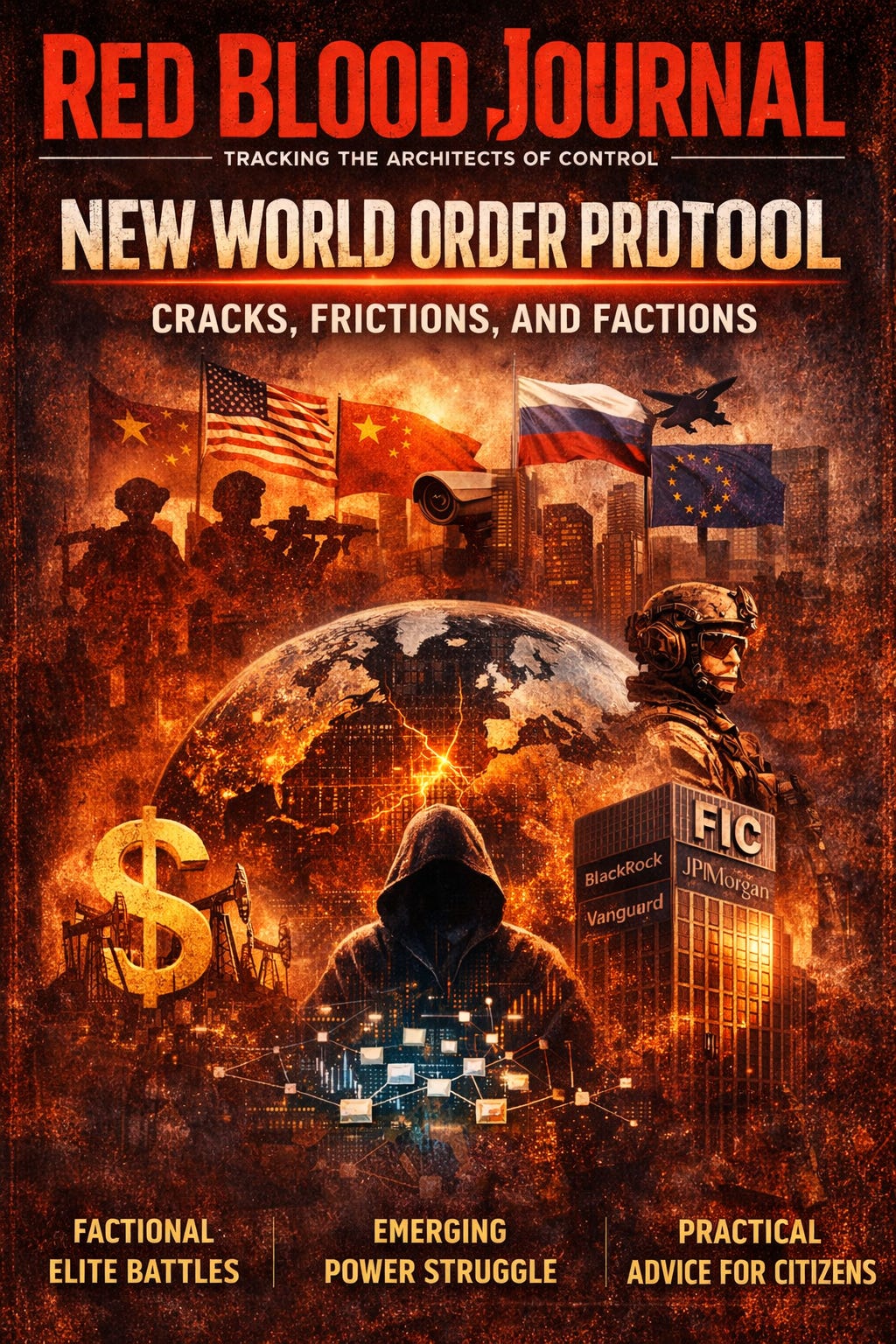
🩸 🧩RED BLOOD JOURNAL
NEW WORLD ORDER PROTOCOL — CRACKS, FRICTIONS, AND FACTIONS
A Professional RBJ Analysis of the Fault Lines Beneath the Global Restructuring
Date: January 26, 2026
Division: Global Systems Forensics & Power Dynamics Analysis Unit
Classification: High-Level Structural Assessment
EXECUTIVE SUMMARY
The emerging global order is not a unified project driven by a single elite consensus.
It is a fractured competition between multiple power blocs—each attempting to shape the next geopolitical and financial operating system.
While public discourse frames the transition as a coordinated “New World Order,” a closer forensic review exposes deep structural cracks among the four dominant factions:
The Financial Industrial Complex (FIC)
Sovereign Nation-States (Tier One Nuclear Powers)
Technologists and AI Governance Actors
The Military-Industrial and Intelligence Complex
These groups agree on one point only:
The old post–World War II order is ending.
Everything else—from money to data to sovereignty—is under contest.
This report maps the fault lines shaping the next era.
I. INTRODUCTION — THE ILLUSION OF ELITE UNITY
The dominant narrative suggests that the transition into a post-globalization era is tightly orchestrated and pre-negotiated by a unified global elite.
However, evidence indicates a different reality:
Competing interests
Conflicting economic strategies
Institutional turf wars
Diverging visions of governance and sovereignty
The “New World Order” is real in concept, but not in coherence.
It is not a monolithic plan—it is a battlefield.
This report analyzes the emerging frictions and factional rivalries determining the shape of the world to come.
II. FACTIONAL OVERVIEW — THE FOUR ARCHITECTS OF THE NEXT ORDER
1. The Financial Industrial Complex (FIC)
Mega–asset managers, central banks, commercial banks, and global investment institutions.
2. Sovereign Powers
The U.S., China, Russia, EU leadership, and nuclear-capable Tier One states asserting national autonomy.
3. Technologists / Technocratic Bloc
AI labs, cloud monopolies, digital identity providers, surveillance networks, and global data platforms.
4. The Military-Industrial Complex (MIC)
Defense contractors, intelligence agencies, cyberwarfare divisions, and security alliances.
Each group seeks primacy over the infrastructure of the next global system.
But their objectives are not aligned—and this misalignment is where instability emerges.
III. FRACTURE POINT 1 — FINANCE vs. CENTRAL BANKS vs. CRYPTO
The Financial Industrial Complex is widely perceived as unified, but it contains three competing power centers:
A. Asset Managers
Seek borderless liquidity, tokenized assets, and AI-managed global rails.
B. Central Banks
Seek monetary sovereignty and CBDCs to preserve national-level control.
C. Crypto & Fintech
Seek disintermediation and the replacement of legacy banking structures.
Core Conflict:
CBDCs threaten commercial banks.
Tokenization threatens central banks.
Crypto threatens both.
The future of money is being fought, not coordinated.
IV. FRACTURE POINT 2 — SOVEREIGN STATES AND THEIR DEPENDENCY PROBLEM
Sovereigns project independence, yet remain structurally entangled with:
Western technology
Foreign capital
Dollar-dominated payment systems
Globalized supply chains
Their political rhetoric clashes with economic dependency.
This contradiction shapes their behavior and limits their autonomy.
V. FRACTURE POINT 3 — THE TECHNOCRATS VS. EVERY OTHER FACTION
The technocratic bloc seeks dominance over:
digital ID systems
AI governance
global data flows
biometric authentication
algorithmic decision-making
Yet they resist accountability, regulation, and political oversight.
This places them in direct conflict with governments, banks, militaries, and asset managers.
The question of who controls the digital rails remains unresolved.
VI. FRACTURE POINT 4 — THE MILITARY-INDUSTRIAL COMPLEX UNDER STRAIN
The MIC is powerful, but increasingly constrained by:
public exhaustion with foreign conflicts
economic pressures
recruitment shortages
shifting warfare models (cyber, AI, autonomous systems)
Their influence is still enormous, but not unchallenged.
VII. META-FRACTURE — THE NEW ORDER IS A NEGOTIATION, NOT A BLUEPRINT
All factions agree on one point:
The new global system must replace the old one.
But they have not agreed on:
who will lead it
what money will look like
how data will be governed
how sovereignty will be defined
how conflict will be managed
The “order” is real.
The consensus is not.
This contradiction explains the apparent global chaos:
competing elite agendas are colliding simultaneously.
VIII. CONCLUSION — THE NEXT ORDER WILL EMERGE FROM CONFLICT, NOT CONSENSUS
The coming decade will be shaped by:
a fractured financial system
sovereign retrenchment
technocratic overreach
military adaptation
and the strategic exploitation of crisis
The New World Order is not a finished structure.
It is a contested battleground.
Power is not consolidating—it is being renegotiated.
IX. WHAT THIS MEANS FOR THE COMMON PERSON
Practical Guidance in an Era of Elite Competition
Most people feel powerless during systemic transitions.
But structural fractures—like the ones identified in this report—create narrow corridors of individual agency.
Here is what remains possible.
1. Strengthen Your Personal Economic Resilience
The next decade will be defined by:
currency experimentation
bank–digital money conflicts
inflation/deflation volatility
unstable supply chains
Individuals can buffer against these shocks by:
diversifying savings (not relying solely on any single banking or digital rail)
reducing consumer debt
developing multiple income streams
learning basic financial literacy outside legacy institutions
Economic resilience becomes personal sovereignty.
2. Control Your Digital Identity and Data Footprint
As digital ID, biometric authentication, and AI scoring proliferate:
limit unnecessary data sharing
use privacy tools
separate personal, financial, and professional digital identities
avoid linking all activities to one platform
In a world where data is power, privacy is an act of self-defense.
3. Build Local Networks, Not Just Online Ones
Every elite faction depends on centralized infrastructure.
Ordinary people remain most resilient when they build:
local community ties
real-world support networks
cooperative relationships
trusted circles for information verification
Hyper-centralization makes societies fragile.
Local networks make people durable.
4. Learn to Interpret Power, Not Personalities
Governments, corporations, and institutions will increasingly use:
fear
crisis narratives
nationalistic appeals
“temporary emergencies”
digital compliance requirements
Individuals gain long-term protection by learning to analyze:
incentives
power blocs
economic interests
who benefits from each crisis
The world is moving from political ideology to structural power competition.
Understanding the structure is protection.
5. Stay Adaptive
The defining survival skill of the next world is not loyalty to an institution—
It is adaptability.
New financial rails
New IDs
New political alignments
New digital systems
New restrictions, new permissions
The pace of change will accelerate.
Rigid people will suffer.
Adaptive people will thrive.
FINAL RBJ MESSAGE TO THE READER
The common person cannot stop the restructuring of the global order.
But they can stop being blindsided by it.
The cracks in elite power are real.
And in those cracks lies the narrow space where individuals can act, prepare, and protect themselves.
The New World Order is being built.
But it is not stable.
Not inevitable.
Not unified.
And because of that, the door for personal agency—though small—is still open.
🧩Fractured Sovereignty: The Battle for a New World Order
The provided text, a Red Blood Journal analysis dated 2026, challenges the notion of a unified global elite by detailing a “battlefield” of competing interests.
It identifies four primary power blocs—the financial industry, sovereign nations, tech giants, and military complexes—who agree the old world order is dying but fight over what replaces it.
These factions remain locked in structural conflicts regarding the future of digital currency, data governance, and national autonomy.
Rather than a coordinated blueprint, the document describes an unstable renegotiation of power characterized by institutional friction.
Ultimately, the report advises individuals to find personal agency within these cracks by building economic resilience and local networks to survive the coming systemic volatility.


