


🩸 RED BLOOD TRANSMISSION JOURNAL
T#RBJ–FINANCE–FORMULA–ARCHIVE (PART III)
Title: Narrative Laundering — How Crisis Is Explained After the Damage
Classification: Post-Event Control Analysis · Narrative Systems
Distribution: International / Open
Method: Media Pattern Mapping · Language Forensics · Incentive Tracing
PART III — AFTER THE FIRE, THE STORY IS REBUILT
When the damage is complete, the next operation begins.
Not reconstruction.
Explanation.
Crisis is not finished when markets stabilize or bodies are buried.
It is finished only when meaning is reassigned.
This is narrative laundering: the process by which catastrophic outcomes are reframed as:
unforeseeable
unavoidable
nobody’s fault
The wreckage remains.
Responsibility dissolves.
I. WHAT “NARRATIVE LAUNDERING” ACTUALLY MEANS
Narrative laundering is not censorship.
It is sequencing.
The public is allowed to ask questions—after the window where answers would matter.
The pattern is consistent:
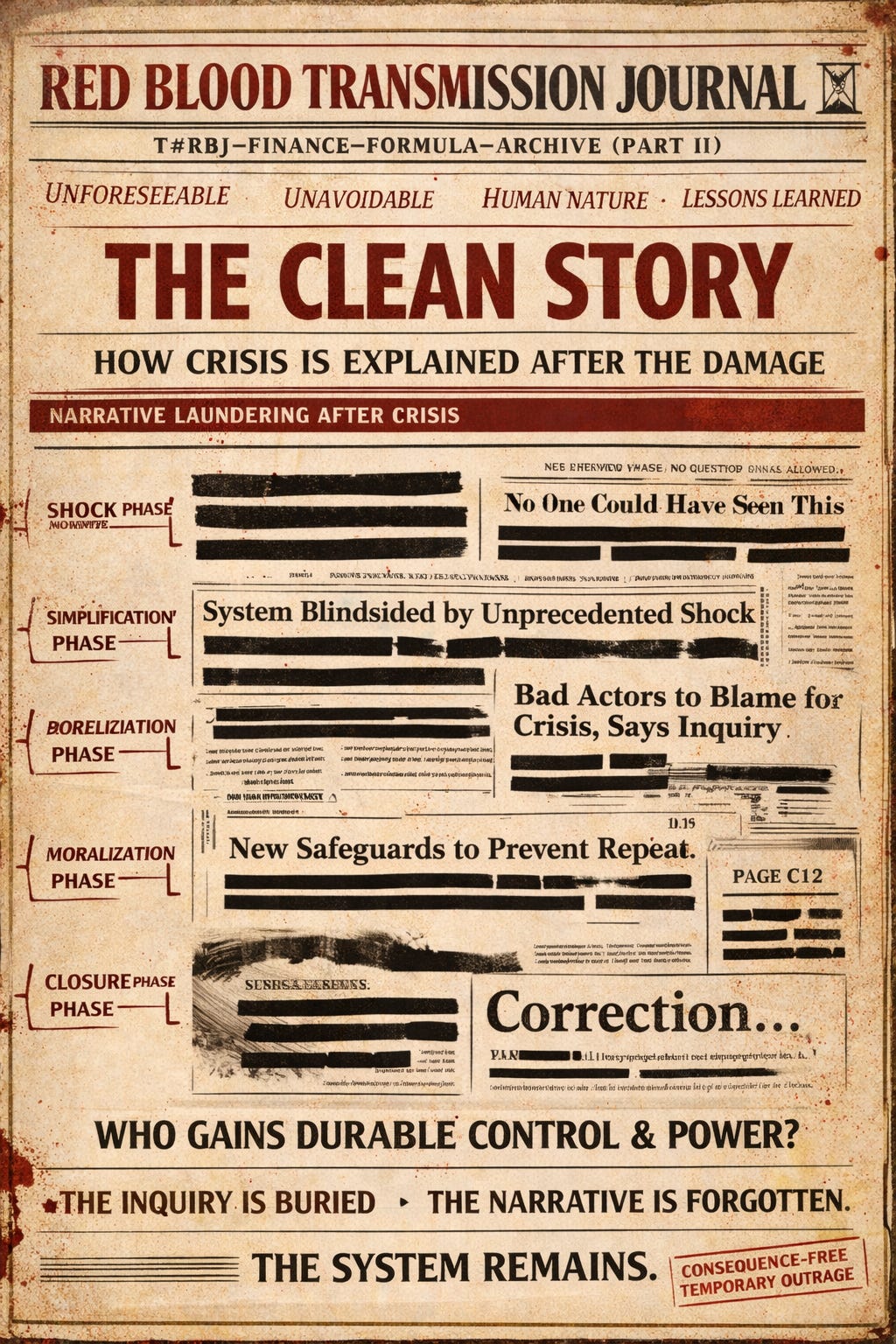
Shock Phase – “No one could have seen this coming.”
Simplification Phase – Reduce causes to a single villain or abstract force.
Moralization Phase – Blame “greed,” “panic,” or “human nature.”
Closure Phase – Declare lessons learned. Move on.
The system remains intact.
Only the vocabulary changes.
II. THE LANGUAGE SHIFT THAT ERases DESIGN
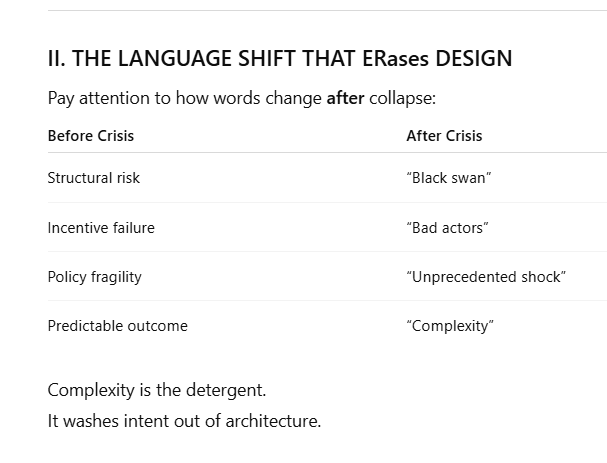
Pay attention to how words change after collapse:
Before Crisis:
A-Structural risk B-Incentive failure C-Policy fragility D-Predictable outcome
After Crisis:
A-“Black swan” B-“Bad actors” C-“Unprecedented shock” D-“Complexity”
Complexity is the detergent.
It washes intent out of architecture.
III. THE SCAPEGOAT MECHANISM
Narrative laundering requires containment figures:
A reckless trader
A corrupt executive
A greedy borrower
An irrational public
These figures serve a function:
They absorb outrage so systems don’t have to.
The crowd gets a villain.
The design gets a pass.
IV. INQUIRIES THAT LOOK BACKWARD ON PURPOSE
Public inquiries are framed as accountability.
In practice, they are temporal dead zones.
By the time they convene:
assets have changed hands
policies have been rewritten
emergency measures are normalized
The inquiry studies what happened, not why it was rewarded.
Truth without consequence is not justice.
It is documentation.
V. “LESSONS LEARNED” AS A RESET BUTTON
Every major crisis produces a report.
The report always concludes:
Better oversight needed
Improved risk models required
Enhanced transparency recommended
And yet—
the same leverage returns,
the same incentives persist,
the same emergency tools reappear.
Why?
Because the lesson is not for the public.
It is for operators: what narrative worked.
VI. MEDIA AS THE FINAL FILTER
Narrative laundering succeeds because repetition replaces investigation.
Explanations are echoed, not challenged
Frames are inherited, not questioned
Counter-narratives are labeled “irresponsible”
Debate is allowed inside boundaries.
The boundary is never design.
VII. THE MOST IMPORTANT QUESTION NEVER ASKED
After every crisis, one question is missing:
Who gained durable power, control, or consolidation because this happened?
Not profit.
Not survival.
Structural advantage.
If that question were asked early, the laundering would fail.
EPILOGUE — CLEAN STORIES, DIRTY OUTCOMES
Crisis does not need secrecy to repeat.
It only needs forgetting.
Narrative laundering ensures forgetting feels responsible, rational, even mature.
The damage is framed as history.
The design survives as policy.
🩸 END PART III
Red Blood Journal — Narrative Systems Division
🧼Narrative Laundering — How Crisis Is Explained After the Damage
This text introduces the concept of narrative laundering, a strategic process used by institutions to rebrand catastrophic failures as unavoidable accidents.
By employing specific language shifts, authorities transform predictable structural risks into “unprecedented” events to dissolve personal or systemic accountability.
The source details how scapegoats and public inquiries are used to absorb collective outrage while ensuring the underlying power structures remain untouched.
This cycle concludes with “lessons learned” that act as a reset button, allowing the same harmful incentives to persist under new terminology.
Ultimately, the document argues that media and official reports function to ensure public forgetting, framing historical damage as a necessary step toward progress rather than a result of deliberate design.


