


🩸 RED BLOOD JOURNAL TRANSMISSION

4
Transmission Code: RBJ-2026-NATIONAL-SECURITY-SPEECH-CASE
Classification: Civil-Military Governance Analysis
Status: Investigative Review
Subject: Allegations of National Security Investigation Related to Social Media Speech
PROLOGUE — THE QUESTION OF LOYALTY
Every military structure in history eventually confronts the same tension:
Where does loyalty end, and where does personal conscience begin?
In civilian society, citizens debate policy openly.
Inside a military chain of command, speech is constrained by the requirements of discipline, cohesion, and operational security.
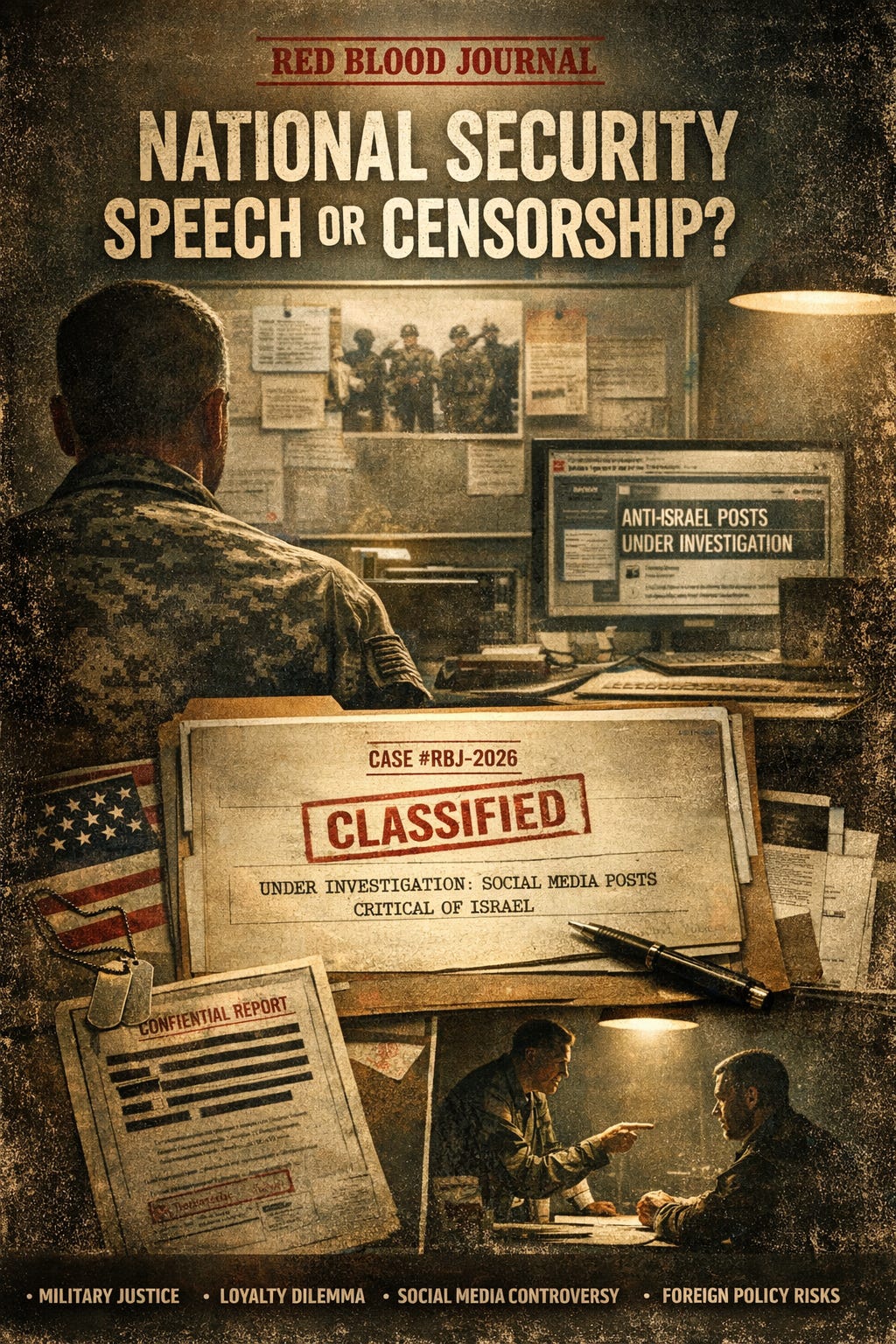
A recently circulating testimony from a U.S. servicemember claims that criticism of a foreign nation on social media triggered a national security investigation.
Whether the claim represents misunderstanding, disciplinary enforcement, or a deeper policy question is the subject of this transmission.
I — THE TESTIMONY
According to the transcript in the submitted file, the servicemember describes the following sequence:
After 20 years of military service, the individual was summoned to an officer’s office.
The servicemember was informed that certain social media posts were under review.
Command authorities reportedly stated that the individual was under investigation as a threat to national security.
Initially, the evidence was not presented.
Later, the evidence allegedly consisted of posts critical of Israel.
The servicemember expressed confusion, stating that their oath was to support and defend the Constitution of the United States, not to support any foreign nation.
National Security
This claim has spread widely across online platforms, triggering intense political interpretation.
But understanding the situation requires examining the legal structure governing military speech.
II — THE UNIQUE LEGAL ENVIRONMENT OF THE MILITARY
Members of the armed forces operate under a legal system distinct from civilian law.
The central framework is the Uniform Code of Military Justice (UCMJ).
Within this system, speech may be restricted when it is considered:
Prejudicial to good order and discipline
Discrediting to the armed forces
Potentially harmful to operational security
Associated with extremist or disruptive activity
Unlike civilian constitutional protections, military speech rights are balanced against mission readiness and chain-of-command stability.
Historically, courts have repeatedly affirmed that the military can impose stricter speech rules than civilian institutions.
III — SOCIAL MEDIA AS A NEW BATTLEFIELD
The rise of digital platforms introduced a new complication:
Soldiers now communicate publicly to audiences of millions.
Modern Department of Defense guidance requires service members to avoid:
Sharing operational information
Appearing to represent official military positions
Promoting extremist ideology
Posting content that undermines unit cohesion or foreign policy commitments
Even posts written in a personal capacity can trigger investigation if commanders believe they affect the service.
The investigation itself does not automatically imply wrongdoing.
It simply begins the formal review process.
IV — FOREIGN POLICY AND THE SOLDIER’S VOICE
Criticism of foreign governments is common in democratic societies.
However, the military operates within the framework of national diplomacy.
Statements by uniformed personnel can sometimes be interpreted internationally as signals of:
Internal division
Policy disagreement
Institutional hostility toward allied nations
For that reason, commanders often react quickly when social-media activity appears to intersect with foreign policy.
This does not necessarily mean criticism itself is prohibited.
Rather, it reflects the military’s effort to control how its members appear in global political discourse.
V — PERCEPTION VS STRUCTURE
Online narratives surrounding the case often present the situation as evidence of:
foreign influence over U.S. institutions
suppression of political dissent
ideological enforcement inside the military
However, investigations into speech are not unusual in military structures.
They frequently occur for posts related to:
partisan political activism
extremist organizations
inflammatory rhetoric
operational security concerns
Without the full investigative record, it remains impossible to determine whether the action was justified or excessive.
VI — THE BROADER QUESTION
The case nevertheless highlights a real structural dilemma.
Modern soldiers exist in two worlds simultaneously:
Citizen
entitled to personal political views
Service member
bound by institutional discipline
The boundary between those roles has become increasingly blurred in the social-media era.
As platforms amplify individual voices, military organizations face growing pressure to balance:
constitutional values
global diplomacy
internal cohesion
public perception
CONCLUSION — THE AGE OF THE DIGITAL SOLDIER
For centuries, armies controlled speech simply by controlling the barracks.
Today, every soldier carries a broadcasting device in their pocket.
The result is a permanent tension between:
personal expression
and
institutional discipline
Whether this case represents overreach, misunderstanding, or standard procedure remains uncertain.
What is certain is that the digital age has permanently transformed civil-military relations.
The modern battlefield now includes not only land, sea, air, and space—
but also the public information sphere.
🪖The Digital Soldier:
Military Speech and National Security
This document examines the complex legal tension between personal speech rights and military discipline in the age of social media.
It centers on a specific case involving a veteran servicemember who faced a national security investigation after posting online criticisms of a foreign ally.
The text highlights how the Uniform Code of Military Justice imposes stricter limitations on expression than civilian law to maintain unit cohesion and protect international diplomacy.
Because digital platforms allow individual soldiers to reach global audiences, the military must constantly balance constitutional freedoms against the need for institutional order.
Ultimately, the report illustrates how modern technology has turned the public information sphere into a new challenges for civil-military governance.


