


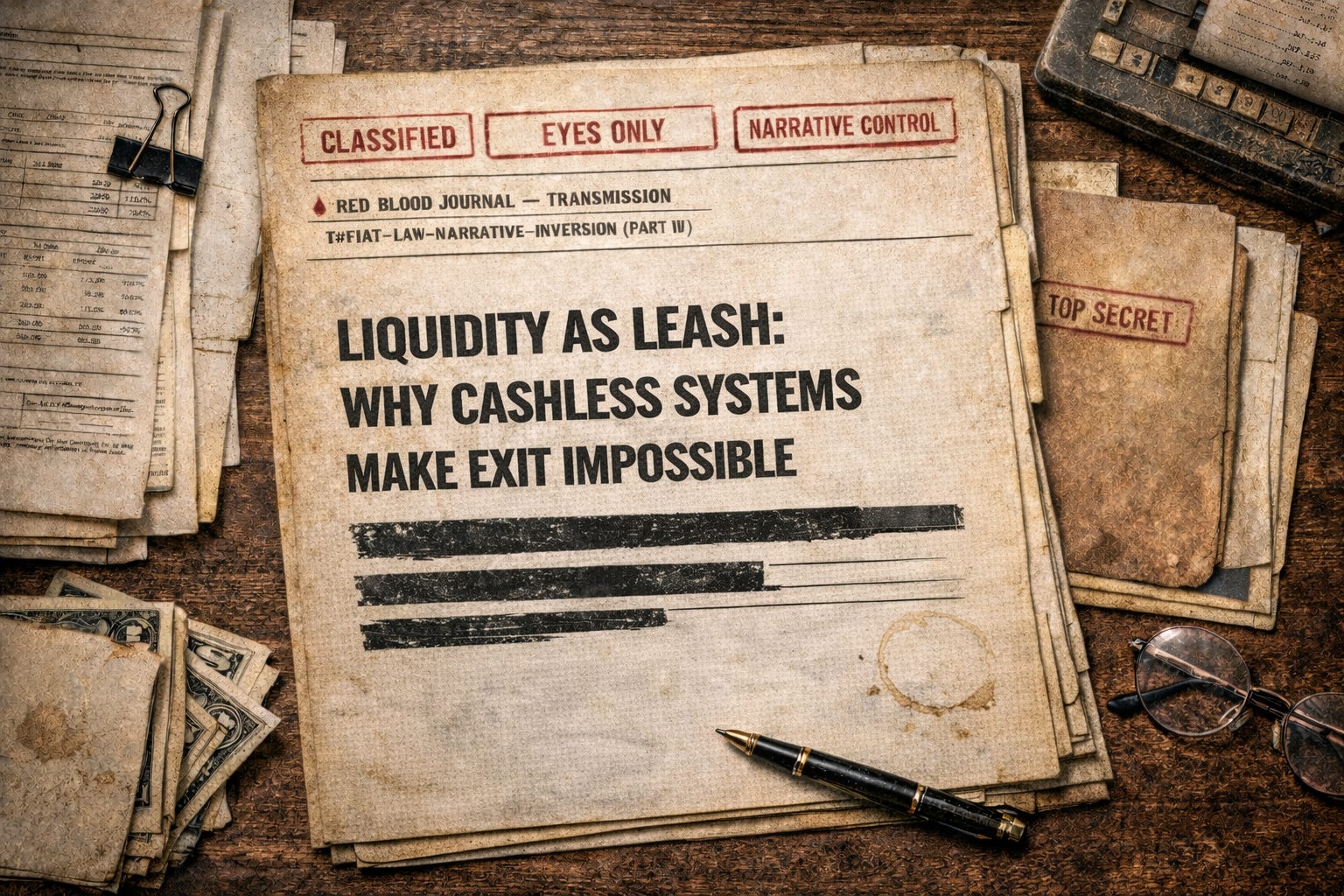
🩸 RED BLOOD JOURNAL — TRANSMISSION
T#FIAT–LAW–NARRATIVE–INVERSION (PART V)
Title: Liquidity as Leash — Why Cashless Systems Make Exit Impossible
Classification: Monetary Control Architecture / Behavioral Containment
Method: Constraint Mapping (Access → Permission → Obedience)
PROLOGUE — WHEN MONEY STOPPED BEING YOURS
Money used to be a thing you held.
Now it is a condition you are granted.
The moment value became permissioned,
exit became theoretical.
I. FROM EXCHANGE TO ACCESS
Cash was not just a medium of exchange.
It was an exit ramp.
It allowed:
Private transactions
Anonymity
Temporal independence
Survival without authorization
Cashless systems redefine money as access, not possession.
You do not have funds.
You are allowed to use them—until you aren’t.
II. LIQUIDITY IS THE NEW BORDER CONTROL
In a cashless regime, borders are invisible and everywhere.
They exist at:
Point of sale
Payment gateway
Merchant category
Time window
Geolocation
You can cross no boundary without liquidity approval.
Movement itself becomes conditional.
III. THE MYTH OF CONVENIENCE
Cashless systems sell themselves as convenience:
Faster
Cleaner
Safer
More efficient
But convenience is not the feature.
Observability is.
Every transaction becomes:
Logged
Scored
Contextualized
Retained
Efficiency is the camouflage.
Surveillance is the payload.
IV. EXIT REQUIRES SLACK — AND SLACK IS ENGINEERED OUT
Exit—whether economic, political, or social—requires slack:
Cash reserves
Redundant access
Unmonitored exchange
Time without permission
Cashless systems remove slack by design.
Balances are:
Just-in-time
Rate-limited
Conditional
Reversible
You cannot pause participation long enough to leave it.
V. REVERSIBILITY IS POWER
Cash transactions are final.
Digital transactions are revocable.
Reversibility allows:
Freezes
Rollbacks
Delays
“Reviews”
Power no longer needs to punish after the fact.
It can interrupt survival in real time.
VI. PROGRAMMABLE MONEY IS NOT NEUTRAL
Once money is programmable, it is no longer money.
It is policy encoded as value.
Programmable constraints include:
Where you can spend
When you can spend
On what
In what amounts
Under which conditions
This is not economic policy.
It is behavioral enforcement.
VII. THE EXIT ILLUSION
You are told:
“You can always opt out.”
“Use another provider.”
“Switch platforms.”
But every platform runs on the same rails:
Banks
Processors
Compliance standards
Risk scoring
Exit is simulated—not provided.
There is no outside.
Only deeper inside.
VIII. CASH WAS THE LAST UNMODELED VARIABLE
Systems hate what they cannot model.
Cash:
Resists profiling
Defies prediction
Breaks feedback loops
That is why it had to go.
Not because it was inefficient—
but because it was uncontrollable.
EPILOGUE — A LEASH YOU CAN’T SEE
A leash does not need to be tight
if it is never removed.
In a fully cashless system:
Dissent is defunded
Resistance is delayed
Exit is theoretical
Compliance is continuous
You are not ordered to obey.
You are simply kept liquid enough to continue.
And dry enough to never leave.
⛓️Liquidity as Leash — Why Cashless Systems Make Exit Impossible
This text examines how the transition to a cashless society transforms money from a personal possession into a tool for totalitarian control.
The author argues that digital systems eliminate the private autonomy once afforded by physical currency, replacing it with a permission-based model of survival.
By removing the “slack” of unmonitored exchange, these platforms enable constant state surveillance and the ability to freeze assets in real time.
Programmable currency serves as a digital leash, allowing institutions to dictate human behavior by making financial access conditional upon political obedience.
Ultimately, the source suggests that without the exit ramp of cash, true social or economic dissent becomes impossible within a closed loop of technological enforcement.


