


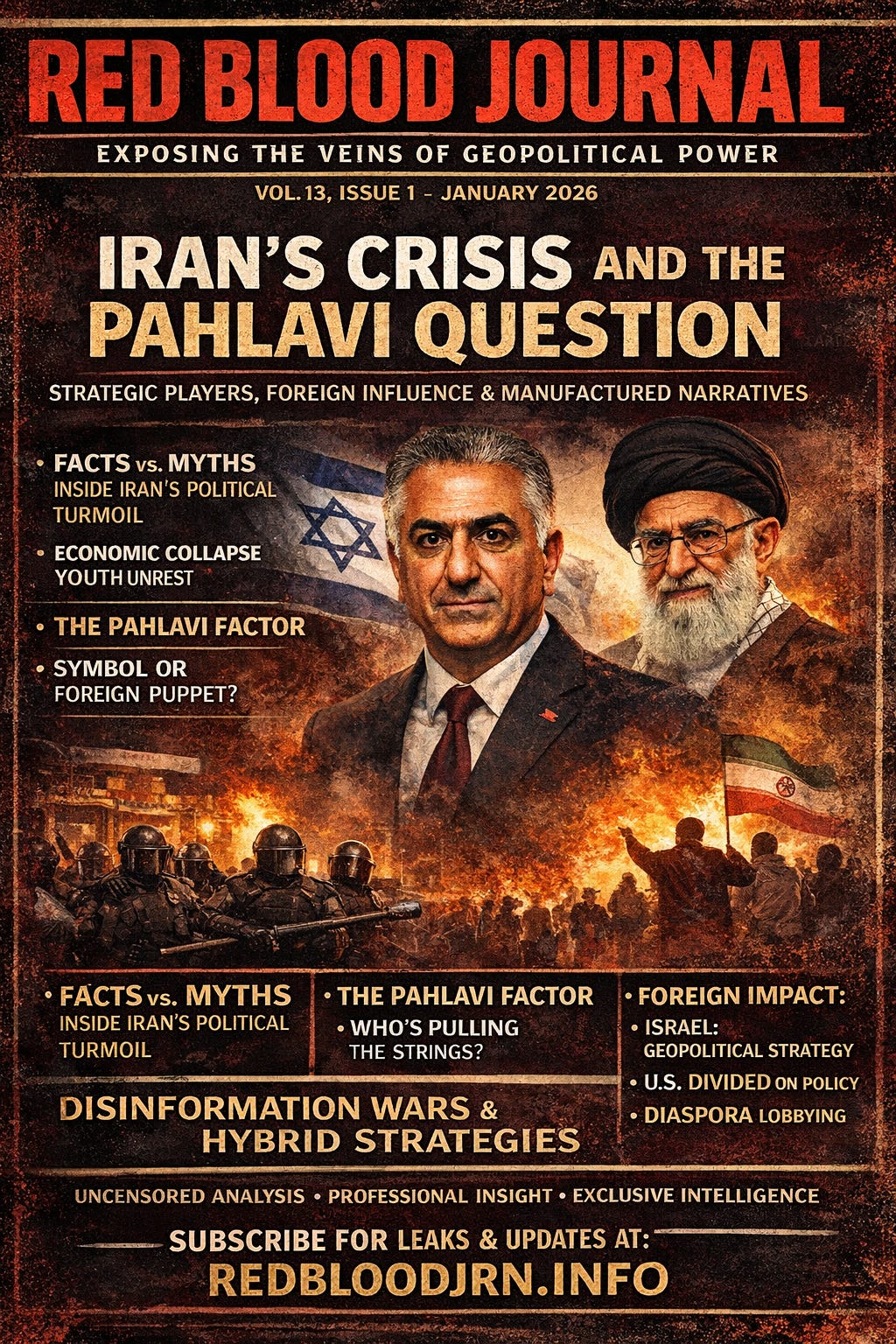
🩸 RED BLOOD JOURNAL – SPECIAL GEOPOLITICAL REPORT 🩸
Volume 13, Issue 1 – January 2026
Transmission ID: **The Pahlavi Question & Iran’s Unraveling
Classification: Strategic Influence Mapping – Professional Intelligence Analysis
Clearance: Level Crimson
Issued By: Middle East Power Dynamics Desk
**The Pahlavi Question & Iran’s Unraveling:
A Professional Red Blood Journal Assessment of Foreign Influence, Internal Decay, and Manufactured Narratives**
Prologue: The Veins Beneath the Crisis
In moments of national fracture, truth becomes both a casualty and a weapon. Iran’s current turmoil is no exception.
As protests swell, the economy buckles, and the government tightens its fist, a parallel battle unfolds across encrypted channels, diaspora broadcasts, and foreign intelligence feeds.
Is Iran’s crisis organic? Yes.
Is it being exploited? Absolutely.
Is a foreign-installed “Shah 2.0” imminent? Unlikely — but the idea is strategically convenient for multiple actors.
In this Red Blood Journal transmission, we strip the narrative to its bones:
what is real, what is amplified, and what is geopolitically plausible.
SECTION 1 — The Internal Collapse: Iran’s Crisis Is Home-Grown
Despite the flood of sensational theories online, Iran’s instability rests primarily on domestic foundations, not foreign architecture.
Key structural failures fueling unrest:
Economic crisis: Inflation above 40%, currency collapse, corruption, and sanctions fatigue
Post-strike consequences: Late-2025 attacks on key infrastructure disrupted supply chains and energy availability
Youth demographic pressure: A population under 30 demanding dignity, jobs, and freedoms
Legitimacy erosion: After years of crackdowns, the regime’s reserve of public trust has thinned to dust
Foreign actors did not fabricate these failures — but they see opportunity in them.
SECTION 2 — Reza Pahlavi: Symbol, Aspirant, Not a Preselected Monarch
Reza Pahlavi’s sudden re-emergence in global discourse has triggered waves of speculation, but reality is more nuanced.
The Realities:
Pahlavi is popular among segments of the diaspora, especially younger exiles seeking a unifying identity.
Inside Iran, he functions more as a symbolic alternative than an organized political force.
His position is referendum-based, not monarchist revivalism.
His connections to U.S. and Israeli politicians arise from decades of Western residency, not proven operational ties.
The Myths:
No verified intelligence indicates that Israel or the U.S. is “installing” him.
No evidence supports claims of coordinated “Pahlavi chants” orchestrated by foreign agents inside Iran.
The IRGC and security establishment would never accept a parachuted leader.
Pahlavi may aspire — but no foreign government has the capacity, unity, or political appetite to reinstate a monarchy.
SECTION 3 — Foreign Influence: Real, Subtle, Opportunistic
Iran is a geopolitical trophy — not for territory, but for influence.
Yet influence does not equal control.
Israel’s Strategic Posture:
Documented policy priorities include:
Preventing an Iranian nuclear breakout
Disrupting IRGC activity in Syria, Lebanon, and Gaza
Encouraging internal fragmentation
Strengthening regional alliances against Tehran
Israel prefers a destabilized adversary, not the logistical burden of installing a monarch.
There is no historical precedent for Israel engineering leadership changes in sovereign states.
United States: Divided Strategy Spillover
Washington remains a fractured ecosystem:
Some factions advocate economic pressure
Others warn of “another Iraq”
Intelligence agencies track opposition groups but lack a unified regime-change blueprint
Trump’s rhetoric is inconsistent; his administration is split between hawks and realists.
Saudi Arabia: Silent Calculus
Riyadh stands to benefit from:
A weakened Iran
Reduced regional competition
Lower IRGC influence in Yemen and Iraq
But due to recent normalization efforts and regional diplomacy, Saudi involvement is quiet and indirect.
Diaspora Networks: The Noise Multiplier
Highly active online, the diaspora amplifies signals, narratives, and calls for leadership.
They shape perception — but not events on the ground.
SECTION 4 — Information Warfare: The Real Battlefield
Iran’s near-total internet blackout created the perfect fog of war.
Inside that fog:
Regime Media
Inflates loyalty, fabricates calm, and frames all dissent as foreign sabotage.
Opposition Media
Amplifies unrest, sometimes exaggerating scope or unity to gain international attention.
Foreign Intelligence-Linked Narratives
Highlight regime fragility to encourage further destabilization.
Social Media Ecosystems
Including bots and coordinated campaigns — from multiple states — magnify emotionally charged content.
This is not a Hollywood regime-change script.
It is a multi-actor influence contest, each pursuing self-interest through information dominance.
SECTION 5 — Why “Shah 2.0” Is Geopolitically Improbable
Even if foreign states wanted it (evidence does not support this), several barriers make a monarchical revival unrealistic:
Iran’s political culture has dramatically shifted since 1979
The IRGC would never submit to a restored monarchy
Installing leaders is expensive, risky, and globally condemned
The U.S. lacks military appetite
Israel lacks strategic reach for a full regime-change project
Pahlavi himself has renounced the title “Shah” and promotes democracy-first transitions
A foreign-scripted restoration fails every practical test: political, cultural, logistical, and military.
SECTION 6 — What Is Actually Happening
A more professional, evidence-aligned model emerges:
1. Iran is undergoing a genuine internal legitimacy crisis.
Economic collapse + authoritarian exhaustion = combustible conditions.
2. Foreign governments are opportunistically maneuvering.
None have full control. All want leverage.
3. The diaspora is loud but structurally weak.
They shape headlines, not outcomes.
4. Information warfare blurs perception.
Truth becomes elastic. Both regime and opposition weaponize it.
5. Pahlavi is being strategically positioned, not installed.
He is an option — not a foregone conclusion.
6. The likely outcome is not monarchy, but a power struggle within the existing elite.
Historically and structurally, transitions in Iran emerge from inside, not outside.
Conclusion: The Red Blood Journal Verdict
In the tangled web of Iran’s unfolding crisis, one conclusion is clear:
The collapse is internal.
The influence is external.
The narrative is contested.
The future is undecided.
The myth of a foreign-installed monarch is alluring for both propagandists and conspiracy merchants, but reality is more complex, more political, and more human.
Iran stands at a crossroads — not between Islam and monarchy, but between internal reform, elite fracture, or prolonged instability.
As always, Red Blood Journal will continue cutting through the fog to track the veins of truth beneath the geopolitical skin.
👁️The Pahlavi Question and Iran’s Internal Decay
The provided intelligence report asserts that Iran’s current state of political and economic instability is a fundamentally domestic crisis rather than a foreign invention. While external actors like Israel and the United States seek to exploit this friction for strategic leverage, the document clarifies that there is no credible evidence of a coordinated plot to reinstall the monarchy. Although Reza Pahlavi remains a significant symbolic figure for the diaspora, the analysis suggests a monarchical restoration is logistically and culturally improbable. Instead, the text highlights a complex information warfare landscape where various global powers amplify narratives to suit their own interests. Ultimately, the report concludes that any future leadership transition will likely emerge from internal power struggles rather than foreign intervention.


