


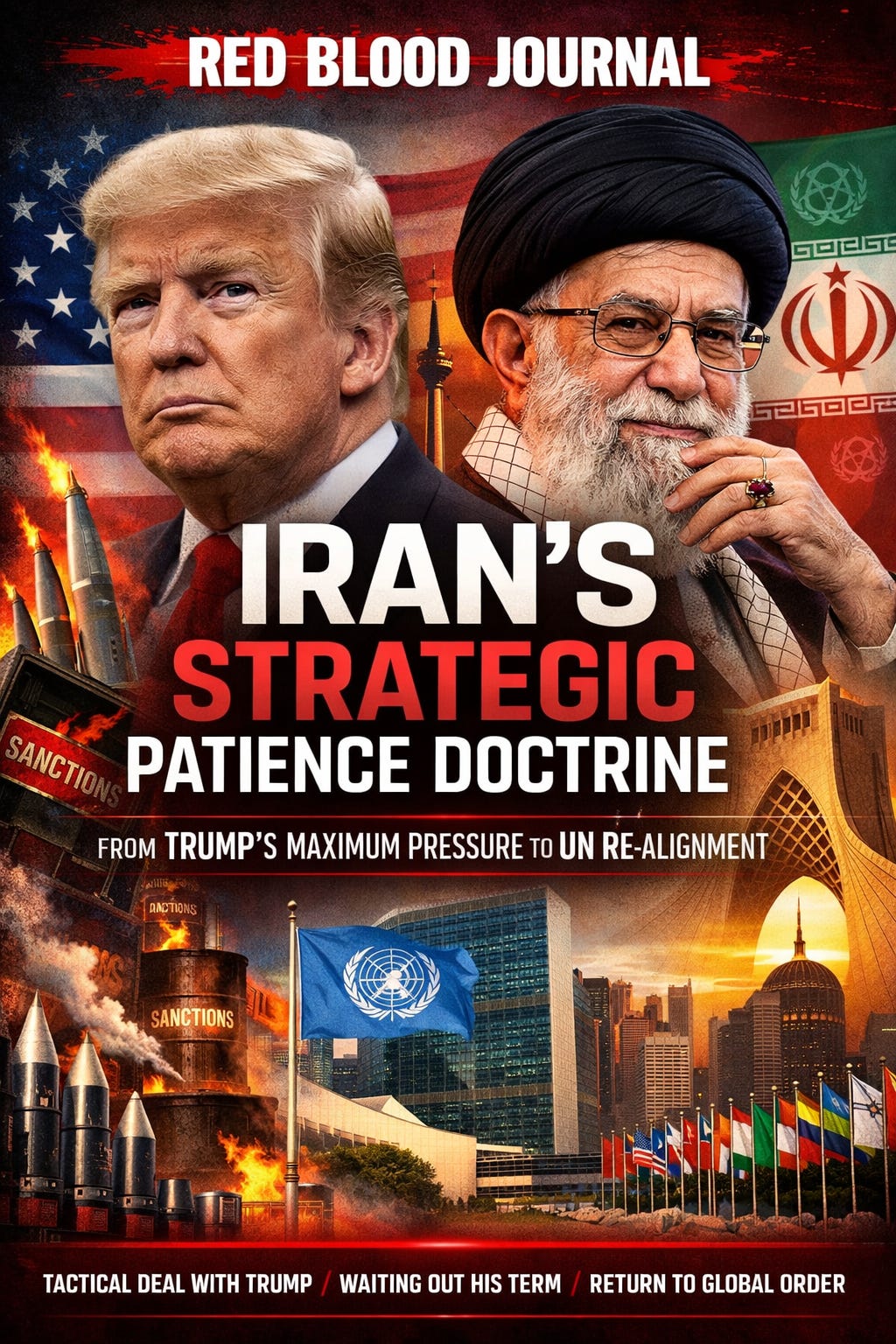
🩸 RED BLOOD JOURNAL TRANSMISSION
T#: RBJ-2026-01-14-IRAN-WAITGAME
Desk: Geopolitics & Deep Architecture (UN / Global Governance Analysis)
Classification: Predictive Scenario – Structured, Professional Assessment
Subject: Iran’s Strategic Patience Doctrine: Tactical Compliance Under Trump and Long-Term Re-Alignment With the UN System
Executive Summary
This transmission presents a structured geopolitical scenario based on observable patterns in U.S. foreign policy under President Trump, Iran’s historical strategic behavior, and the post-Cold War trajectory of multilateral governance institutions.
Core prediction:
Rather than facing immediate regime collapse or externally driven replacement, Iran may adopt a dual-track survival strategy:
Short-term tactical compliance with Trump’s maximum-pressure demands to prevent escalation or decapitation;
Long-term strategic patience, preserving regime continuity until the end of Trump’s presidency;
Subsequent reintegration into UN-centered governance frameworks once global institutions regain influence.
This scenario is grounded in Trump’s proven foreign-policy pattern—combining coercive pressure with willingness to negotiate—and the United Nations’ long-term doctrine of reintegrating “pariah” states into development-oriented frameworks such as the SDGs.
1. Trump’s Foreign Policy Doctrine: Evidence From Practice
1.1 Venezuela: The Hard-Power Regime-Break Model
The Trump administration has used a combination of:
escalating sanctions on individuals, financial systems, and state-owned corporations,
chokepoint operations targeting oil shipments and trade intermediaries,
public delegitimization of national leadership,
and, in 2026, a direct extraction operation targeting President Maduro and his wife on trafficking charges.
This model is explicitly aimed at removing the governing system, not rehabilitating it.
1.2 Iran 1.0 (2018–2020): Maximum Pressure Without Regime Removal
Trump’s withdrawal from the JCPOA launched one of the most sweeping sanctions frameworks in modern history.
The campaign targeted:
oil revenue,
metals, shipping, petrochemicals,
and Iran’s global banking access.
This produced significant internal economic strain but did not escalate into full regime-change operations. Trump consistently kept space open for a “better deal,” indicating a strategic preference for coerced compliance over military overthrow.
1.3 Iran 2.0 (2025–2026): Pressure Reloaded
Following Trump’s 2024 return:
sanctions have been restored and expanded,
Iraqi energy waivers were canceled,
over 100+ individuals and entities tied to Iran’s oil network were sanctioned,
and policy documents explicitly reinstated the “maximum pressure” doctrine.
This framework is severe, but its architecture again suggests that Washington seeks behavioral modification, not immediate collapse of the Iranian state.
2. Scenario Framework: “Tactical Submission, Strategic Patience”
Stage I – Tactical Submission
Iran, faced with severe economic deprivation and the risk of escalation, may agree to:
enhanced nuclear restrictions,
broader inspection access,
moderated regional military activity,
and controlled engagement with Western intermediaries.
This allows the Trump administration to present a symbolic diplomatic victory, while providing the Iranian state enough economic oxygen to prevent collapse.
Stage II – Strategic Patience
Once a new agreement stabilizes the situation:
the Iranian regime consolidates internally,
secures limited sanctions relief for critical economic sectors,
and avoids the Venezuelan-style scenario of leadership removal or systemic implosion.
The guiding logic:
Survive the Trump presidency without making irreversible strategic concessions.
Stage III – Post-Trump Reintegration
After Trump’s term ends—whether in 2029 or earlier depending on conditions—the international landscape shifts:
The UN, EU, and multilateral institutions resume efforts to re-integrate Iran into development compacts, climate initiatives, and governance frameworks.
Iran transitions from “problem state” to “managed partner.”
Global institutions encourage standardized financial, environmental, and regulatory compliance.
This creates a trajectory where Iran emerges weakened but intact, ready to be reabsorbed into a highly structured international governance ecosystem.
3. The Global Governance Vector: UN, SDGs, and System-Level Absorption
3.1 The UN’s Long-Horizon Strategy
The United Nations and related institutions operate through multi-decade vision frameworks such as:
Agenda 2030,
Sustainable Development Goals (SDGs),
transnational climate compacts,
and development-linked financial standards.
These frameworks are not formally a “world government” but function as soft governance architecture, shaping national policy space through:
financial incentives,
normative pressure,
regulatory harmonization,
and development conditionality.
3.2 Iran as a Candidate for Post-Crisis Absorption
A stabilized Iran post-Trump is an attractive target for:
climate financing,
development partnerships,
infrastructure modernization,
sustainable energy transitions,
and ESG-aligned capital inflows.
From a systemic perspective:
An intact but economically dependent Iran is easier to channel into global frameworks than a collapsed or isolated one.
4. Why Iran Would Choose This Path
4.1 Regime Survival Logic
Iran’s leadership observes recent historical precedents:
Iraq and Libya: regime removal led to total destabilization.
Venezuela: pressure has escalated into potential leadership extraction.
A limited, face-saving deal with Washington is a rational survival mechanism.
4.2 Economic Imperatives
Even partial sanctions relief dramatically increases:
currency stability,
oil revenue potential,
domestic regime legitimacy.
4.3 International Incentives
Global institutions prefer:
stability,
energy predictability,
and managed integration over chaotic collapse.
All major actors—UN, EU, China, Russia—benefit from an Iran that stays intact but becomes more economically malleable.
5. Indicators to Monitor
If this scenario is unfolding, key observable markers will include:
Renewed U.S.–Iran back-channel diplomacy via Oman, Qatar, or European intermediaries.
Phased sanctions relief on oil exports and financial transactions.
Shift in official messaging toward portraying negotiations as pragmatic rather than ideological.
UN and EU rhetoric emphasizing Iran’s “constructive role” in regional stability or climate commitments.
Re-entry of foreign capital under development or ESG frameworks tied to global sustainability agendas.
Conclusion
This scenario outlines a coherent, historically grounded, and strategically plausible path:
Trump applies maximum coercive leverage.
Iran avoids collapse through tactical concessions.
Once U.S. political dynamics shift, global governance institutions resume long-term absorption.
The resulting outcome is a hybrid model where Trump secures a visible diplomatic victory while the transnational governance system ultimately reasserts long-term influence.
⏳Iran’s Strategic Patience: Maximum Pressure and Multilateral Reintegration
The provided text outlines a geopolitical forecast regarding Iran’s survival strategy in response to the “maximum pressure” campaign led by the Trump administration.
It suggests that the Iranian regime will likely adopt a policy of tactical compliance to avoid total collapse or leadership removal, similar to recent actions taken against Venezuela.
By making temporary concessions on its nuclear and military activities, Iran aims to endure the current American political climate while maintaining its internal sovereignty.
The analysis predicts that once U.S. leadership changes, Iran will pivot toward long-term reintegration into global governance structures managed by the United Nations.
This transition would involve adopting international development standards and environmental regulations in exchange for economic stability.
Ultimately, the document views this “strategic patience” as a rational path for the regime to secure systemic preservation through eventual absorption into the global financial and regulatory ecosystem.


