


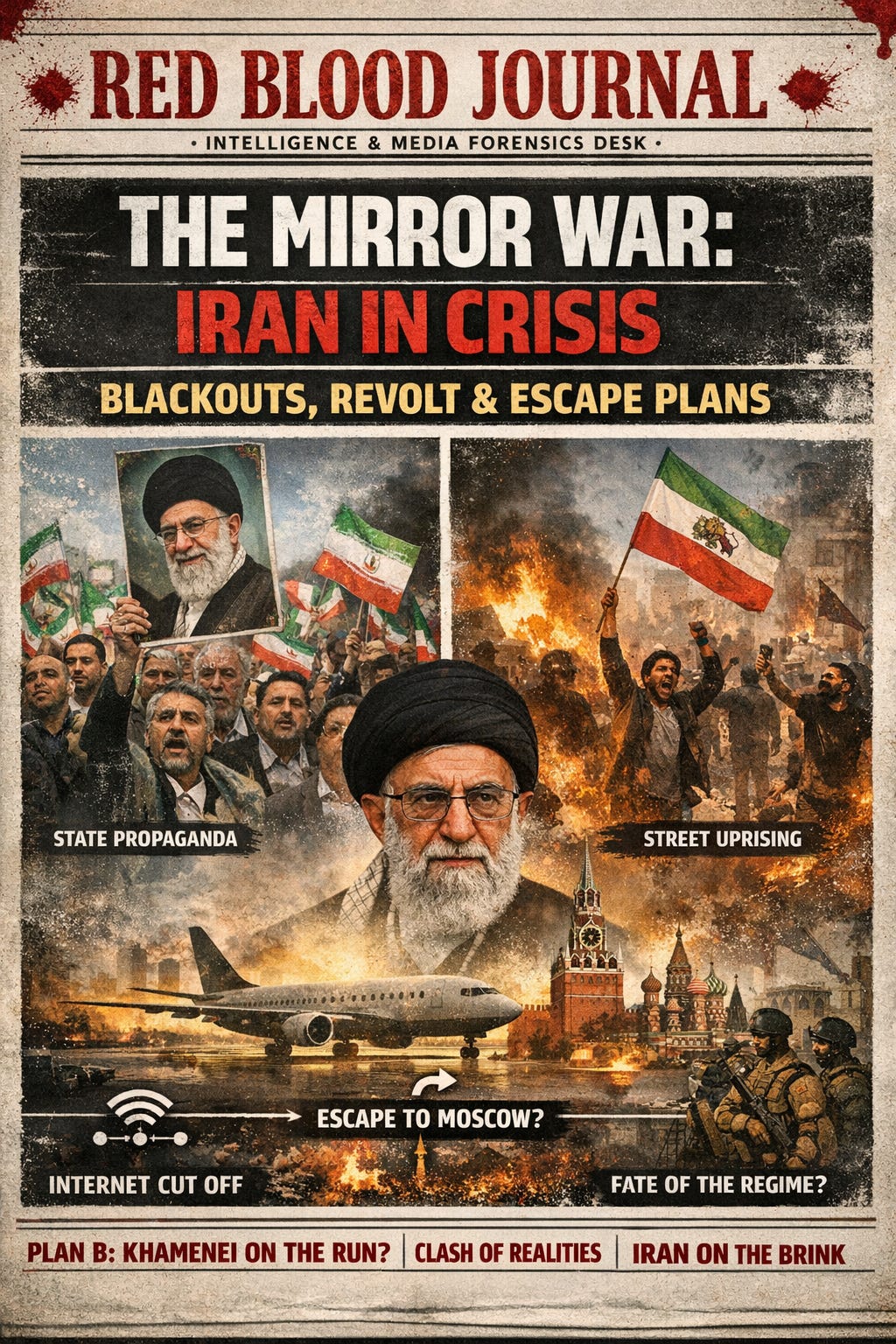
🩸Iranian Uprising 2026: A Bold Journalistic Prediction on Regime Stability
Executive Summary
As of January 8, 2026, Iran is engulfed in nationwide protests triggered by economic collapse, with demonstrators demanding regime change amid an internet blackout imposed by the government. Drawing parallels to media manipulation during the 2024 U.S. elections, Iranian state-controlled outlets portray pro-regime rallies, while opposition sources depict widespread anti-government fervor. Speculation abounds that Supreme Leader Ayatollah Ali Khamenei may flee to Russia if security forces falter, echoing historical precedents like the fall of Syrian President Bashar al-Assad in 2024. This report analyzes the past, present, and potential future trajectories, predicting a high likelihood of regime weakening but not immediate collapse, barring defections within the military. Based on diverse sources, the unrest could either be suppressed through brute force or escalate into a revolutionary tipping point by mid-2026.
Historical Context: Lessons from Iran’s Turbulent Past
Iran’s history of unrest provides critical insight into the current crisis. The 1979 Islamic Revolution overthrew the Pahlavi monarchy, establishing a theocratic regime under Ayatollah Ruhollah Khomeini, which has since relied on repression, media control, and proxy militias to maintain power. Economic grievances have fueled repeated uprisings:
2009 Green Movement: Sparked by disputed elections, protests were met with internet throttling and violent crackdowns, resulting in dozens killed and thousands arrested. The regime survived by isolating dissent and portraying it as foreign-backed chaos.
2019 Fuel Protests: A sudden fuel price hike led to nationwide riots, suppressed with an internet blackout and over 1,500 deaths, according to Amnesty International. This demonstrated the regime’s willingness to sever communications to enable unchecked violence.
2022 Mahsa Amini Protests: The death of a young woman in morality police custody ignited the “Woman, Life, Freedom” movement, the largest challenge since 1979. Internet restrictions and killings (over 500 reported) failed to fully quell it, but internal divisions and exhaustion allowed the regime to regain control.
These events highlight patterns: Economic triggers evolve into political demands, media bias amplifies regime narratives (e.g., state TV showing “loyalist crowds” while ignoring opposition), and internet shutdowns mask atrocities. Past alliances with Russia—providing drones and military support—have bolstered Tehran, but recent losses (e.g., Assad’s fall in Syria) have eroded this network. Historical dictators like Ukraine’s Viktor Yanukovych (fled to Russia in 2014) underscore that leaders often escape when loyalty fractures.
Current Situation: Echoes of Bias and Blackout in Real-Time Unrest
The ongoing protests, erupting in late December 2025 over currency devaluation and inflation exceeding 50%, have spread to over 100 cities across all 31 provinces by January 8, 2026. Demonstrations began in Tehran’s Grand Bazaar but escalated into calls for regime overthrow, with chants like “Death to the dictator” and support for exiled Crown Prince Reza Pahlavi. Human rights groups report at least 45 deaths, 2,200 arrests, and widespread clashes.
Media polarization mirrors the user’s observation: State outlets like IRIB broadcast pro-regime gatherings, claiming “rioters” are foreign agents. Opposition channels and X posts show security forces retreating in cities like Hamedan and Marvdasht, with protesters torching government buildings. A nationwide internet blackout since January 8 has flatlined connectivity to 1% of normal levels, hindering verification but aligning with past tactics to conceal brutality.
Speculation about Khamenei’s flight stems from intelligence reports: He reportedly has a “Plan B” to flee to Moscow with 20 aides and family if forces defect, modeled on Assad’s escape. While unconfirmed, defections (e.g., soldiers waving to protesters) and low morale among IRGC units suggest internal cracks. External pressures amplify this: U.S. President Trump’s threats of intervention if protesters are killed, following Maduro’s capture in Venezuela, have Tehran on edge. Reading between the lines, the blackout indicates regime panic, not confidence, as protests grow despite repression.
Key Metrics (as of Jan 8, 2026)DetailsProvinces Affected27+ (out of 31)Protest Instances340+ reportedDeaths38–45 (activist estimates)Arrests2,200+Internet StatusNationwide blackout (1% connectivity)
Future Scenarios: Pathways to Stability or Collapse
Projecting forward, three scenarios emerge based on historical patterns and current dynamics:
Regime Suppression (Most Likely, 60% Probability): If security forces remain loyal, the blackout enables a harsh crackdown, potentially killing hundreds as in 2019. By Q2 2026, protests could fizzle due to exhaustion and economic concessions (e.g., subsidies). However, this erodes long-term legitimacy, setting up future unrest amid sanctions and regional isolation.
Escalation and Khamenei Flight (30% Probability): Widespread defections—encouraged by Pahlavi’s calls—could force Khamenei to activate his Russia escape plan by February 2026. This might trigger a power vacuum, leading to interim rule by moderates or IRGC hardliners. U.S./Israeli strikes, predicted by analysts, could accelerate this if protests align with external pressure.
Full Revolution (10% Probability): Unified opposition under Pahlavi restores a secular monarchy by late 2026, cutting terror funding and stabilizing the region. This requires international support (e.g., Starlink for communication) and military mutiny, unlikely without broader economic collapse.
Factors tipping the scales: Trump’s policies could deter repression or enable intervention; Russia’s weakened state post-Ukraine limits aid to Khamenei. Overall prediction: The regime survives short-term but faces terminal decline by 2027, as sustained protests and global isolation prove unsustainable.
Conclusion
Iran’s 2026 uprising embodies the perils of media distortion and information blackouts, much like polarized U.S. election coverage. While the regime’s grip appears tenuous, history suggests resilience through violence. Yet, with Khamenei’s rumored escape plan and growing defections, this could mark a pivotal shift. Global leaders must amplify opposition voices to prevent a massacre, potentially ushering in a freer Iran. The future hinges on whether internal fractures outpace repression—watch for military loyalty as the key indicator.
🔥The 2026 Iranian Uprising: Regime Stability and Geopolitical Shifts
This report analyzes a fictional 2026 uprising in Iran, triggered by a massive economic breakdown and calls for total regime change.
The text highlights a familiar pattern of government-imposed internet blackouts and state media manipulation used to hide violent crackdowns from the world.
Drawing on past revolutions and recent regional collapses, the document explores the possibility of Supreme Leader Khamenei fleeing to Russia if military loyalty continues to erode.
While the regime has historically maintained power through brute force and isolation, the source suggests that internal defections could finally push the country toward a revolutionary tipping point.
Ultimately, the analysis presents several future scenarios, weighing the high probability of continued violent suppression against the growing potential for a complete political collapse.


