


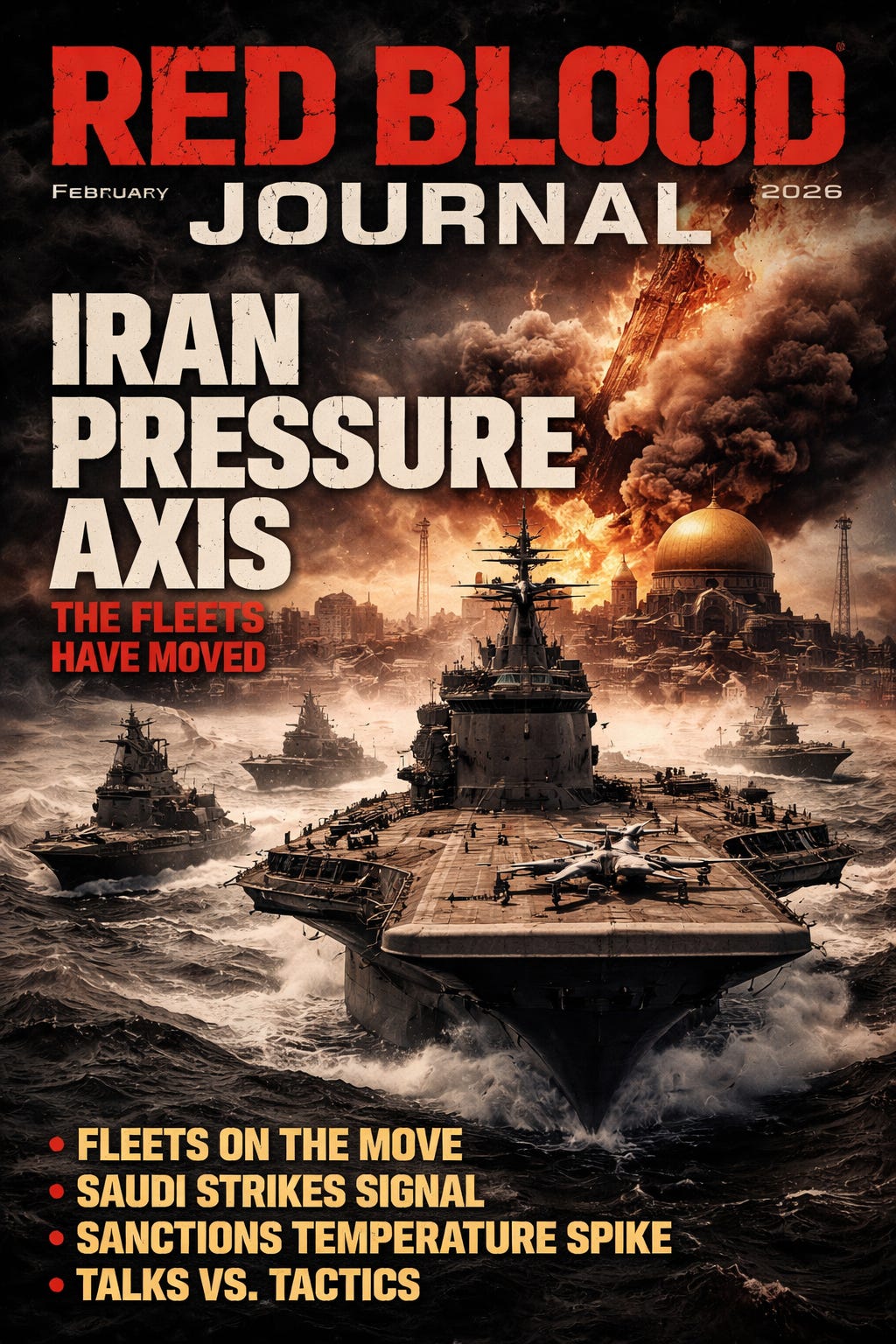
🩸 RED BLOOD JOURNAL TRANSMISSION
T# RBJ-2026-01-31 — IRAN PRESSURE AXIS
Classification: Military Signaling & Coercive Diplomacy Architecture
Clearance: For Those Who Notice Fleets Move Before Words
Source Vector: Executive Signals | Airborne Press Gaggle | Unscripted Admissions
PROLOGUE — THE SHIPS SPEAK FIRST
Negotiations are never announced first.
They are preceded.
Steel moves.
Fuel burns.
Maps are quietly re-drawn.
Only then do words arrive—carefully ambiguous, deliberately incomplete—spoken just loud enough for the intended listener to hear.
This transmission concerns the language of pressure, not policy statements.
It decodes what is said after fleets are already underway.
SECTION I — THE FLEET AS SENTENCE
U.S. naval deployments toward Iran are not an act of war.
They are a grammar structure.
A carrier strike group is a comma.
A destroyer screen is a parenthesis.
A submarine is a footnote that never surfaces.
When fleets move, the sentence has already been written.
What remains undecided is only the punctuation at the end:
Period — compliance
Question mark — negotiation
Exclamation point — impact
This is not escalation.
This is pre-negotiation positioning.
SECTION II — NEGOTIATION VS. MILITARY ACTION (A FALSE BINARY)
The public is trained to think in opposites:
Talk or strike
Diplomacy or war
In reality, these are not alternatives.
They are sequential layers of the same operation.
Negotiations occur inside military pressure, not instead of it.
No serious deal is discussed unless:
Shipping lanes are vulnerable
Insurance premiums spike
Regional allies feel the heat
Markets begin to price risk
The fleet does not threaten Iran.
It re-weights Iran’s decision matrix.
SECTION III — SECONDARY SANCTIONS: THE INVISIBLE BLOCKADE
Secondary sanctions are not aimed at Iran.
They are aimed at:
Shipping companies
Insurers
Refiners
Commodity traders
Governments pretending neutrality
This is economic warfare without declarations.
No bombs.
No headlines.
Just transactions that suddenly stop clearing.
The message is simple:
You don’t have to choose sides.
We will choose for you.
Sanctions do not isolate Iran.
They isolate everyone who touches Iran.
SECTION IV — SAUDI ARABIA: THE VOICE OF REGIONAL MEMORY
Saudi Arabia’s stance—deterrence over diplomacy—is not ideology.
It is institutional memory.
They have seen this cycle before:
Talks buy time
Time buys centrifuges
Centrifuges buy leverage
From Riyadh’s perspective:
Weak signals invite escalation
Ambiguity invites miscalculation
Force clarity prevents war
Their position is not bloodthirsty.
It is pre-emptively stabilizing, from their vantage point.
SECTION V — WHAT IS ACTUALLY BEING COMMUNICATED
This is not about regime change.
Not yet.
This is about choice compression.
Iran is being told:
You may negotiate
You may delay
You may posture
But you may not:
Expand nuclear ambiguity
Rely on third-party economic lifelines
Assume regional paralysis
Every option now carries a cost.
That is the point.
COUNTERINTELLIGENCE NOTE — WHY THIS WAS SAID ALOUD
These signals were delivered publicly, casually, mid-flight.
That is intentional.
When pressure is discussed offhandedly, it feels inevitable.
When inevitability is felt, resistance weakens.
The audience was not the press.
The audience was Tehran—and every capital still pretending to sit on the fence.
FINAL LINE — THE OLD RULE REMAINS
Diplomacy is conducted at tables.
But tables are set at sea.
And right now,
the ships are already in place.
🚢The Grammar of Pressure: Signaling Conflict and Diplomacy
U.S. naval deployments and secondary sanctions against Iran act as coercive diplomacy.
Military movement is a signaling language used to “set the table” for negotiations by compressing Iran’s choices.
This pressure axis aims for regional stability through deterrence.


