


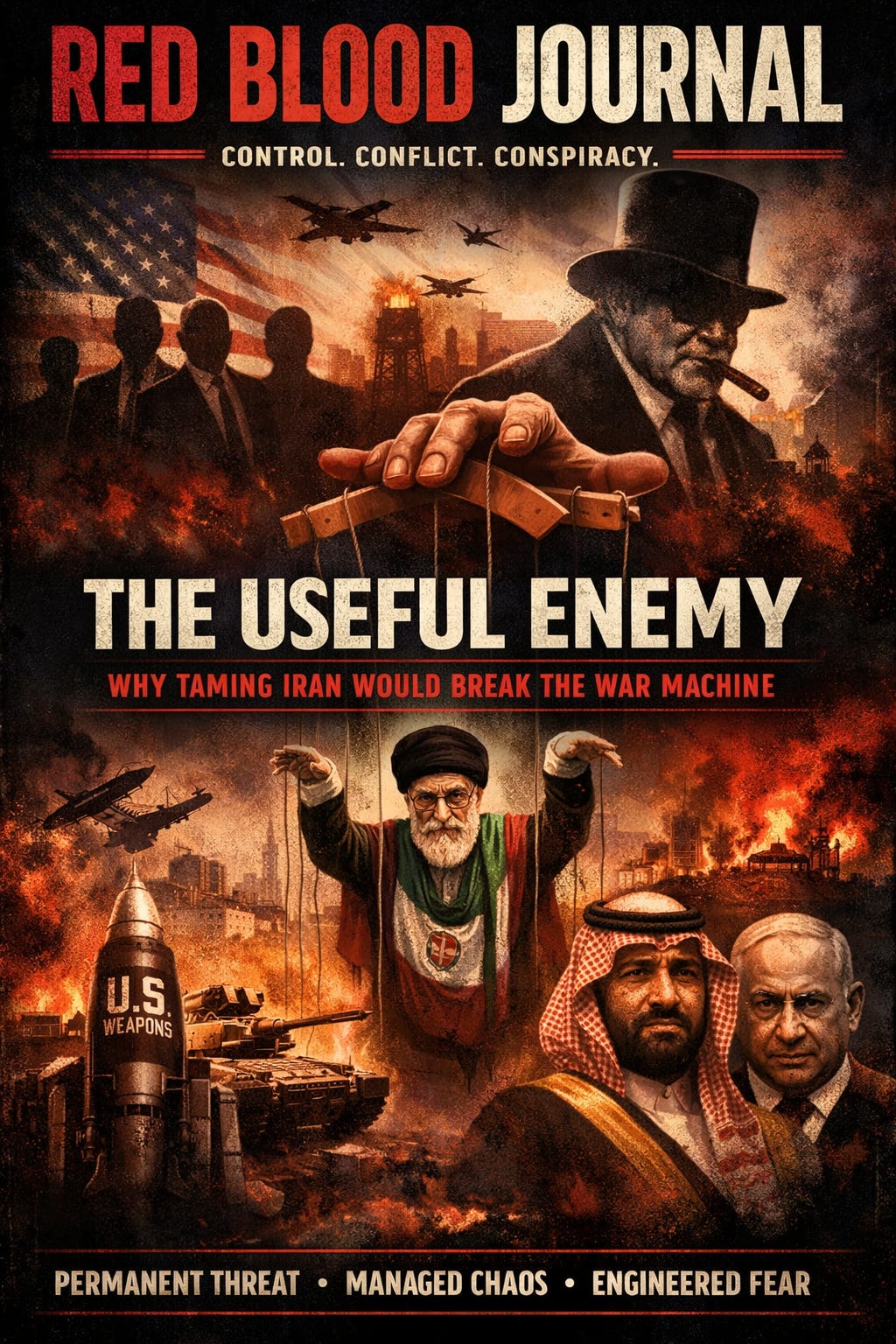
🩸 RED BLOOD JOURNAL TRANSMISSION — HYBRID FORMAT EDITION
T#: RBJ-2026-IRAN-USEFUL-ENEMY
Classification: Controlled Antagonism / Military-Industrial Theater / Managed Chaos Doctrine
Desk: The Archive of Power — Somewhere Between War and Peace
Cross-Reference: Permanent Threat Model / Proxy Warfare Architecture / Manufactured Instability Thesis
I. PROLOGUE — THE USEFUL ENEMY
Power does not prepare for peace.
It prepares for permanence.
Not permanence of order — permanence of justification.
Iran does not exist in the system as a nation. It exists as a function. A moving target. A necessary adversary. A calibrated villain whose danger is never resolved, only adjusted.
To “tame” Iran would be to break a machine that depends on its growl.
This is not about Tehran. It is about the architecture that requires Tehran to remain dangerous.
The problem is not that Iran is hostile.
The problem is that hostility is profitable.
II. THE MECHANICS OF MANUFACTURED THREAT
The military-industrial ecosystem does not feed on war alone — it feeds on the promise of war.
Iran plays three indispensable roles in this design:
1. The Regional Justification Engine
For decades, Iran has been the reason given to populations for why their governments must:
Expand militaries
Purchase foreign weapons
Align with global superpowers
Accept surveillance in the name of “security”
Normalize permanent emergency governance
Saudi Arabia, the UAE, Qatar, Bahrain, Kuwait, and even Israel all point toward Tehran and say:
“See? This is why we must arm ourselves.”
Iran is less an enemy than a political technology.
Remove that threat, and suddenly military budgets look obscene rather than necessary.
2. The Perfect War That Never Ends
Total war is risky. Total peace is useless.
The system prefers the middle zone:
Sanctions instead of invasions
Proxies instead of occupations
Strikes instead of regime change
Shadow wars instead of declared wars
This is the ideal condition for the defense industry:
Endless contracts
Endless upgrades
Endless fear
No final resolution
Iran is engineered to be dangerous enough to justify conflict — but not so powerful as to win it.
3. The “Boss’s” Global Control Logic
Within the deeper architecture of power, chaos is not a bug — it is a tool.
A fully stable Middle East would undermine:
The global security state
The surveillance apparatus
The permanent emergency economy
The justification for global intervention
From this perspective, a pacified Iran is a liability.
A useful enemy must always remain useful.
III. THE IMPOSSIBILITY OF A “TAMED” IRAN
If Iran became truly obedient — not rhetorically, but structurally — the current geopolitical script would collapse.
Which means one of two things must happen:
Iran remains partially hostile — permanently.
If Iran is neutralized, another country must be elevated to replace it.
And not just any country.
The replacement must be:
More “evil” in narrative framing
Surrounded by more neighbors
Bordering richer states than the Gulf
And ideally sitting atop vast oil reserves
The antagonist can change, but the game cannot.
The enemy is replaceable.
The system is not.
IV. TRUMP — THE WILDCARD OR THE ILLUSION?
Trump presents himself as disruption.
But disruption within a rigged game is still part of the game.
Both left and right have been seduced by the idea that he stands outside the machine.
Yet the machine remains intact.
If Trump were truly outside the system, he would pursue a demilitarized Middle East — not a reshuffled, rebranded one.
But such a vision is not foreseeable within the current global order.
So the likely outcome is this:
The face changes.
The rhetoric changes.
The contracts remain.
The enemies remain.
The control remains.
Trump appears to move the pieces — but the board stays the same.
V. COUNTERINTELLIGENCE NOTES
Peace is not destabilizing to people — it is destabilizing to power.
The military-industrial complex does not fear war; it fears irrelevance.
The greatest threat to empire is not rebellion, but normalization.
A world without enemies is a world without justification for control.
The most dangerous deception is not that leaders are tyrants — but that they are free.
VI. DEEP PATTERN ANNEX — THE LOGIC OF PERPETUAL ENMITY
Every empire requires a permanent adversary.
When one enemy falls, another is elevated.
Stability is framed as danger.
Danger is monetized.
Fear is legislated.
And the people pay the bill.
Iran is not the problem.
The system that requires Iran to be a problem is.
🎭
The Architecture of Managed Chaos
This text outlines a geopolitical theory where Iran is maintained as a permanent adversary to justify the existence of the global military-industrial complex.
Rather than seeking peace, the “Archive of Power” suggests that governing entities prioritize managed chaos to ensure the continuation of massive defense budgets and surveillance states.
The document posits that hostility is a profitable tool used to keep regional neighbors in a state of perpetual emergency and dependency on superpowers.
Within this framework, specific leaders or diplomatic shifts are viewed as mere surface-level changes that do not disrupt the underlying machinery of control.
Ultimately, the source argues that the systemic need for a villain outweighs any genuine desire for stability, as total resolution would render the current power structure irrelevant.


