


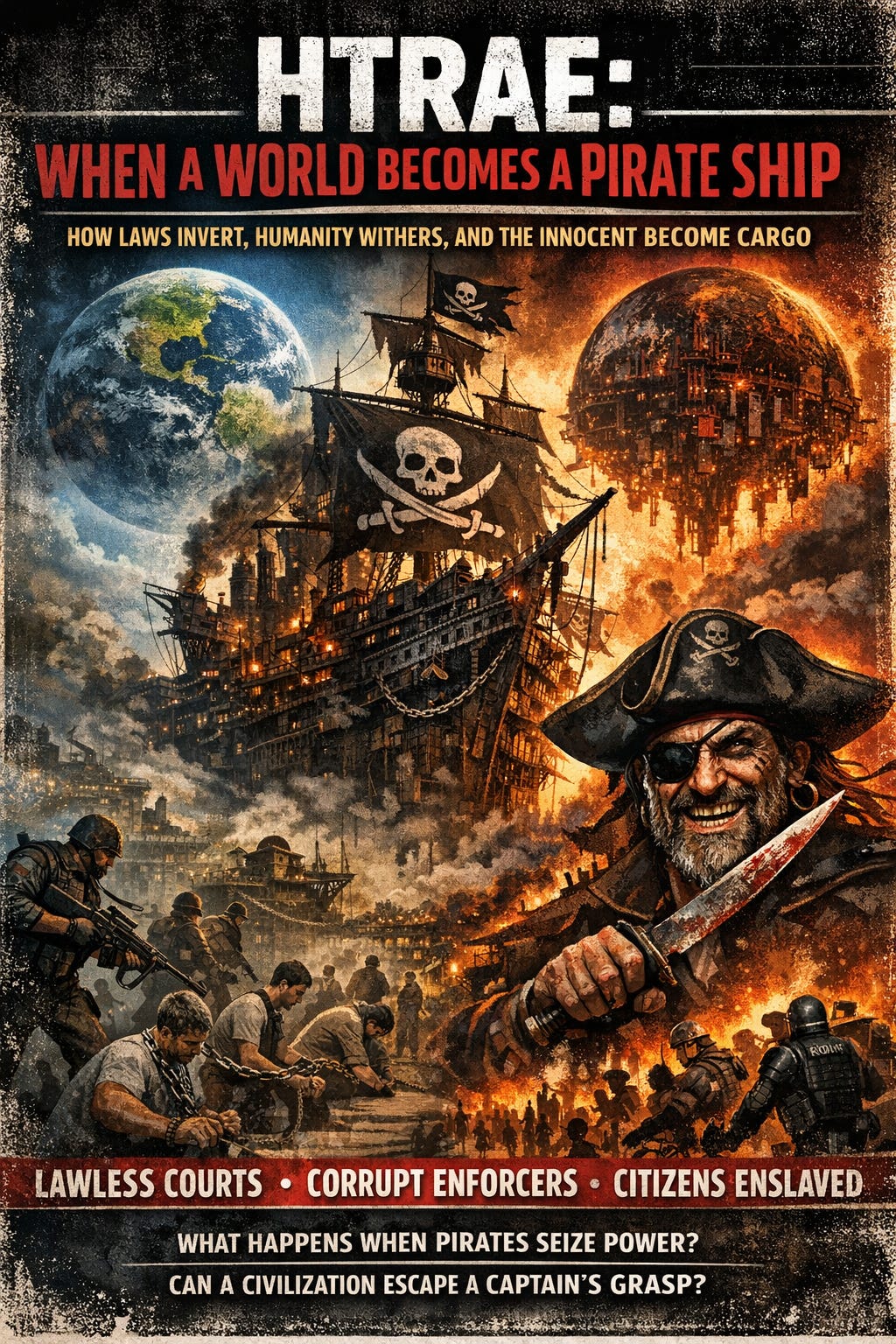
🩸 Htrae: When a World Becomes a Pirate Ship
How Laws Invert, Humanity Withers, and the Innocent Become Cargo
In the charts of the old star-pilots, the twin worlds were marked like this:
EARTH – spinning west to east, blue and green, laws written in ink.
HTRAE – spinning east to west, same mass, same orbit, same sun… but its laws were written in teeth.
They swooped together around their star like two coins taped back-to-back, forever bound, forever opposite. When Earth turned one way, Htrae turned the other, mirroring it, mocking it.
On Earth, the story you know: societies that try—however clumsily—to pretend law is meant to protect the weak from the strong.
On Htrae, they stopped pretending.
The Pirate at the Helm
On Htrae, the sea was the symbol of power.
Not the real oceans—their real oceans had long since been laced with oil films and drifting plastic—no, the “Sea” was how they described the whole planet’s economy and law. A single vast pirate ship, they said, and if you weren’t a pirate, you were cargo.
The founding policy was simple enough that even a child could understand it:
“Those who can take, deserve.
Those who cannot, serve.”
They called it The Pirate Doctrine.
At first, it came in polite language. White papers, academic conferences, think-tank panels:
“Re-prioritizing risk and reward.”
“Empowering competitive actors.”
“Reducing regulatory friction to unleash innovation.”
But the translation, if you stripped away the jargon, was:
Let the pirates run the ship.
Tie the hands of anyone who objects.
They rewrote the constitution around that doctrine.
Not all at once. One clause here, one little “emergency amendment” there. A national crisis was declared when a trade ship “mysteriously” exploded offshore. No one ever proved who did it, but the Pirate Caucus in parliament had their talking points ready before the smoke had even drifted over the horizon.
“If we had listened to our most ‘successful’ risk-takers,” they said,
“this would never have happened.”
The pirates, you see, were suddenly “risk-takers.”
The con-artists became “disruptors.”
The smuggling cartels were “parallel supply chains.”
And the normal, law-abiding citizens?
They became “friction.”
How Laws Turned Upside Down
Here was the genius—and the horror—of Htrae:
They didn’t abolish laws.
They inverted their purpose.
Every statute, every regulation, every code was carefully rewritten so that:
If you played fair, the law bound you.
If you played dirty, the law shielded you.
1. The Courts
On Htrae, the judges were chosen not for their wisdom, but for their win rate defending the powerful.
To qualify for the High Bench, you had to:
Have represented at least three corporations or Pirate Clans convicted abroad.
Have successfully argued a loophole that overturned a verdict against a major “risk-taking entity.”
Have never—not once—taken on a case for an ordinary citizen without being paid.
Judges who had shown mercy in their past careers were quietly disqualified. “Too sentimental,” whispered the vetting committees. “Insufficiently loyal to the growth engine of the nation.”
In court, the symbolism changed.
The old carving above the courtroom door read:
“Justice for All.”
It was replaced with a new motto:
“Order in Service of Prosperity.”
Prosperity, of course, meant the pirates’ treasure.
Steal a loaf of bread because your child is hungry?
Five years compulsory labor for “theft from the supply chain.”
Steal a pension fund with a cleverly engineered financial product?
No jail at all. At worst, a fine paid out of the profits—
then an award the following year for “Innovation in Capital Deployment.”
2. The Police
On Htrae, the police slogan was:
“We keep the sea safe for commerce.”
Not for people.
For commerce.
New quotas were introduced:
Arrests had to rise each quarter.
Fines had to meet revenue targets.
“Public order operations” were ranked by how much property they protected, not how many lives.
Officers learned quickly that if they went after the wrong targets—
if they chased pirates instead of desperate citizens—
their careers stalled.
But if they kept their eyes on small fry—
parking violations, minor infractions, unpaid fees—
promotions came briskly. The pirates smiled when the lowly deckhands were kept in line.
When peaceful protests broke out—teachers, nurses, truck drivers complaining about wages and prices—the police arrived dressed like stormtroopers on a boarding raid, with batons, tear gas, blacked-out name tags.
Later, reporters would ask:
“Why such force?”
The official answer was always the same:
“We had credible intelligence that pirate interests might be at risk.”
It didn’t matter that the pirates were on yachts three continents away, clinking glasses and watching the chaos on holo-screens with amused detachment.
The police weren’t protecting citizens.
They were guarding the ship’s treasure.
3. The Legislators
On Htrae, you didn’t get into parliament because you understood the needs of your district.
You got in because you understood the needs of the pirates.
Elections still happened; democracy remained as theater. But the candidates were sorted long before the first vote was cast.
If you’d ever worked as a public defender? Red flag.
If you’d ever organized a union? Unacceptable.
If you had a history of opposing a pirate-favored bill? Career over.
The ideal legislator had:
A background in “compliance consulting” — teaching pirates how to walk right up to the edge of the law without technically crossing it.
Zero record of whistleblowing, protesting, or defending ordinary workers.
A good photogenic smile and a talent for saying “It’s complicated” when asked a direct question.
In parliament, monstrous bills were given names that sounded like lullabies:
The “Safe Seas Act” – which legalized offshore data-harvesting and asset hiding.
The “Community Responsibility Statute” – which allowed collective punishment of neighborhoods where protests broke out.
The “Stability and Security Framework” – which gave the Pirate Council emergency powers whenever markets “felt anxious.”
Everything was inverted.
Treason wasn’t selling out the people;
treason was threatening the pirates’ profits.
Authority Without Humanity
Perhaps the most jaw-dropping part of Htrae was not the cruelty of the pirates themselves. Predators will prey; that is their nature.
No, the real horror was who got promoted.
On Earth, there is still some lingering expectation—however faint—that authority should be tied to competence, or at least to some minimal level of decency.
On Htrae, the promotion ladder was nailed together differently:
The less human you were,
the higher you climbed.
Promotion Criteria in the Pirate System
To rise in the ministries, in corporate boards, in the secret councils that actually ran things, you had to demonstrate:
Inhuman Detachment
You had to be able to sign documents that you knew would ruin millions and sleep soundly that night. Anyone who flinched, hesitated, or asked, “But what will happen to the families?” was quietly shuffled aside.Destructive Creativity
The system rewarded people who could invent new ways to extract value from misery:Turning evictions into “housing rotation opportunities.”
Turning layoffs into “labor flexibility boosts.”
Turning addiction into “repeat consumer engagement.”
Loyalty to the Pirate Narrative
You had to be able to repeat, with a straight face:
“If the pirates thrive, everyone thrives.”
Even as neighborhoods decayed, schools crumbled, hospitals closed or went fully pay-to-enter.
Immunity to Shame
Scandals didn’t end careers. In fact, they were almost a prerequisite. If you had never been caught lying, exploiting, or cheating, the higher-ups wondered if you were “too clean,” too risky, too unpredictable.
They preferred people who had already shown they would do anything once cornered. It made them predictable. It made them safe—for the pirates.
What Everyday Life Looked Like
For a law-abiding citizen on Htrae, life became a maze of invisible tripwires.
Fail to keep up with the ever-changing digital tax code?
You were fined until your accounts bled dry.
Miss a deadline buried three levels deep in an official portal with a broken login system?
Your business license vanished overnight.
Try to start a small enterprise without pirate sponsorship?
Health inspectors appeared weekly. Fire marshals cited obscure regulations. Fines piled up until you “voluntarily” sold a controlling share to a Pirate Holding Company.
They even weaponized kindness.
Charity drives were taxed if not routed through approved Pirate Funds.
Help your neighbor repair their roof? You could be fined for “unlicensed construction.”
Feed hungry children with surplus food from your bakery? You could face criminal charges for “distribution of unverified nutrition.”
The message was clear:
“You do not get to fix your society yourselves.
You only get to consume the fixes we sell you.”
The Media Sea
On Htrae, screens were everywhere.
Every wall, every train, every hand-held device bleached the eyes with a constant storm of messages:
Pirate leaders delivering “fireside chats” from oceanfront mansions.
News anchors tut-tutting about “disruptive factions” whenever workers organized.
Experts explaining why a new wave of layoffs was actually a sign of “economic health.”
They turned language itself into a net:
“Looting” meant poor people taking food.
“Reallocation” meant rich people taking everything.
Investigative journalists who insisted on calling pirates pirates soon found themselves de-platformed, defunded, or “accidentally” assigned to cover celebrity gossip for the remainder of their contract.
So the media learned the safe formula:
Name the suffering.
Never name the cause.
Repeat: “It’s complicated.”
The Breaking Point
For a long time, Htrae’s citizens tried to cope.
They told themselves it would swing back. That history moved like a pendulum, that sanity would return.
But remember: Htrae turns the other way.
On Earth, a scandal can still sometimes topple a government.
On Htrae, a scandal was a loyalty test.
Would citizens shrug and accept that “everyone does it”?
Would the opposition parties play their scripted role, murmuring concern but never demanding real accountability?
As long as the answer was yes, the pirates slept well.
But then something changed.
It didn’t begin with a revolution. It began with a mistake.
One day, the Pirate Council pushed too far. They passed the Total Sea Compliance Act, requiring every citizen to:
Wear a government-issued device that tracked every purchase, every movement, every conversation.
Obtain a monthly “Loyalty Clearance” to access basic services like water, electricity, and healthcare.
Pledge, on camera, their belief that “Those who can take, deserve.”
It was meant to be the crowning achievement of the Pirate Doctrine.
It became its curse.
Because for the first time, the mask fell off.
Ordinary citizens had suspected for years, but now they saw, in blunt daylight:
The law did not serve them.
It devoured them.
A baker watched his “Loyalty Score” drop because he gave unsold bread away.
A teacher was flagged “high-risk” for mentioning historical revolutions in class.
A nurse was suspended for refusing to prioritize insurance status over emergency need.
The pirates thought fear would keep everyone compliant.
They miscalculated something:
even a law-abiding person will break bad laws to remain human.
When Earth Looked Across
Earth, by then, had telescopes tuned not just to light, but to patterns.
Somewhere in an orbital outpost, a small group of analysts watched Htrae’s data like weather forecasters studying a hurricane.
They saw:
A spike in encrypted local mesh networks as citizens bypassed official channels.
A sudden drop in birth rates, as young couples refused to bring children into a pirate-run world.
A surge in “non-compliance incidents,” from small acts of civil disobedience to mass workplace walkouts.
One analyst, staring at the charts, whispered:
“They’re tearing the ship apart from the inside.”
Another replied:
“No. They’re trying to build lifeboats while it sinks.”
On Earth, they argued about what to do.
Some said: “It’s none of our business.”
Others said: “Let it collapse; maybe it will serve as a warning.”
A few whispered: “We’re closer to Htrae than we want to admit.”
Because while Htrae spun in the opposite direction, Earth had its own pirates, its own inverted temptations.
The difference—so far—was that on Earth, enough people still believed that laws might protect the innocent.
On Htrae, that belief had been strangled.
The Cost of Turning Everything Upside Down
In the final era of Htrae’s Pirate Rule, the consequences were impossible to ignore:
Infrastructure rotted, because pirates preferred short-term plunder over maintenance. Bridges collapsed; power grids failed; water systems poisoned entire regions.
Talent fled or withered. The brightest minds either left if they could, or withdrew into quiet apathy if they couldn’t. Innovation slowed. Everything “new” was just another way to shuffle the same wealth upward.
Trust evaporated. Neighbors stopped helping neighbors because every favor could be construed as an “unlicensed service.” Families broke under the strain of constant surveillance and financial fear.
When the ship finally began to truly sink—when default cascades hit the pirate banks, when food shortages spread, when the seas themselves rose and flooded coastal strongholds—the pirates did what pirates always do:
They looked for another ship.
Escape pods were launched. Secret off-world colonies were activated. Underground bunkers opened for those whose Loyalty Scores were high enough.
And the citizens?
They were left on the listing deck, told to stay calm, to wait for rescue, to trust the system that had never, ever been designed for them.
Some burned with rage.
Some resigned themselves to drown.
Some began, even then, to organize.
In one small city far from the coastal fortresses, a group of teachers, mechanics, and nurses gathered in a darkened school gym lit by scavenged solar panels.
They spread out copies of the old, pre-Pirate constitution they had found in a forgotten archive.
“We can’t stop what’s collapsing,” said one. “But we can choose what we build after.”
They drafted, by hand, a new first principle:
“Law exists to shield the weak from the strong.
Any law that does the opposite is null and void.”
They had no power. No enforcement. No media amplification.
Just ink, paper, and a refusal to surrender their humanity.
On Htrae, that was a revolutionary act.
The Mirror Warning
So: Are Earth and Htrae swooping together, or is one turning like the other?
In the cold math of orbital mechanics, they are simply twin worlds sharing a path.
But in the deeper story, they are mirrors:
One where law still tries, however imperfectly, to restrain the pirates.
One where law has been sharpened into their favorite weapon.
Htrae is what happens when:
You promote the most inhuman into positions of power.
You reward destruction disguised as “innovation.”
You punish ordinary kindness as if it were subversion.
You let pirates write the rulebook, and then you treat that rulebook as sacred.
It doesn’t explode overnight.
It doesn’t collapse in a single dramatic revolution.
It rots, quietly, until one day everyone wakes up and realizes:
The ship they’re on was never a passenger vessel.
It was always a pirate ship.
And they were never crew.
They were cargo.
The jaw-dropping part isn’t that this can happen.
The jaw-dropping part is how much of it can happen
without anyone noticing until it’s almost too late.
🏴☠️The Pirate Doctrine: When Laws Become Weapons
The provided text describes the fictional world of Htrae, a mirror image of Earth where the legal and social systems have been completely inverted to favor the exploitative.
Under the Pirate Doctrine, society is restructured to reward predatory behavior while penalizing traditional virtues like fairness and communal care.
Key institutions, including the judiciary and police, are repurposed to protect the wealth of the elite rather than the safety of the public.
This narrative serves as a dark allegory for how systemic corruption can transform a civilization into a vessel for plunder.
Ultimately, the story warns that when dehumanization becomes a prerequisite for authority, the resulting societal collapse is inevitable.


