


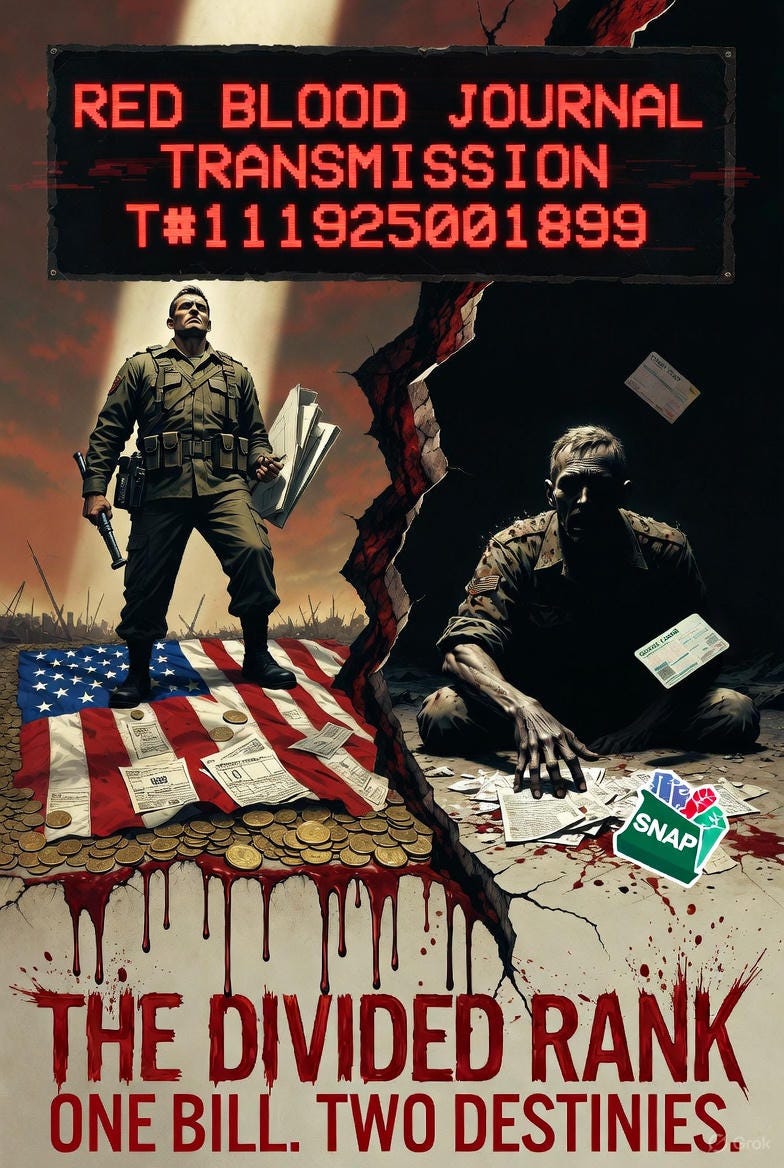
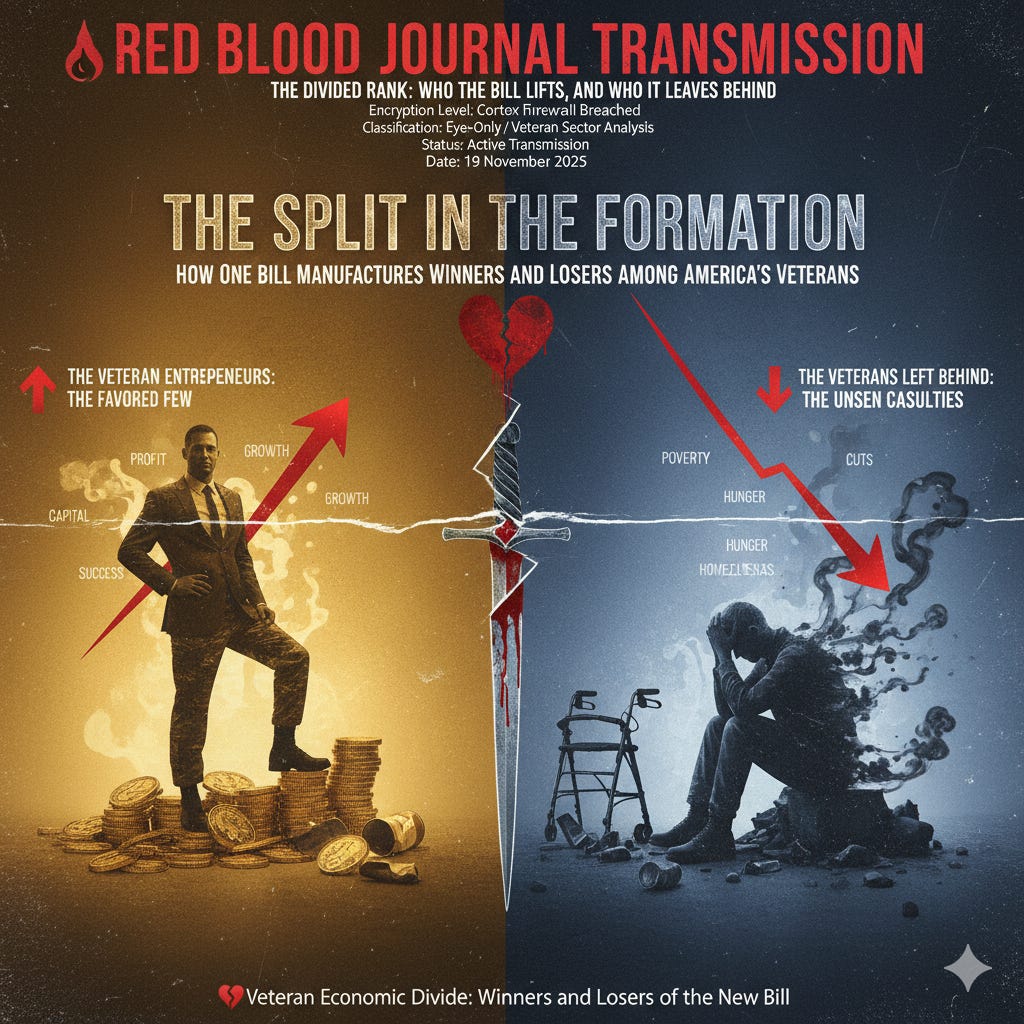
🩸 RED BLOOD JOURNAL TRANSMISSION
T#111925001899 — THE DIVIDED RANK: WHO THE BILL LIFTS, AND WHO IT LEAVES BEHIND
Encryption Level: Cortex Firewall Breached
Classification: Eyes-Only / Veteran Sector Analysis
Status: Active Transmission
Date: 19 November 2025
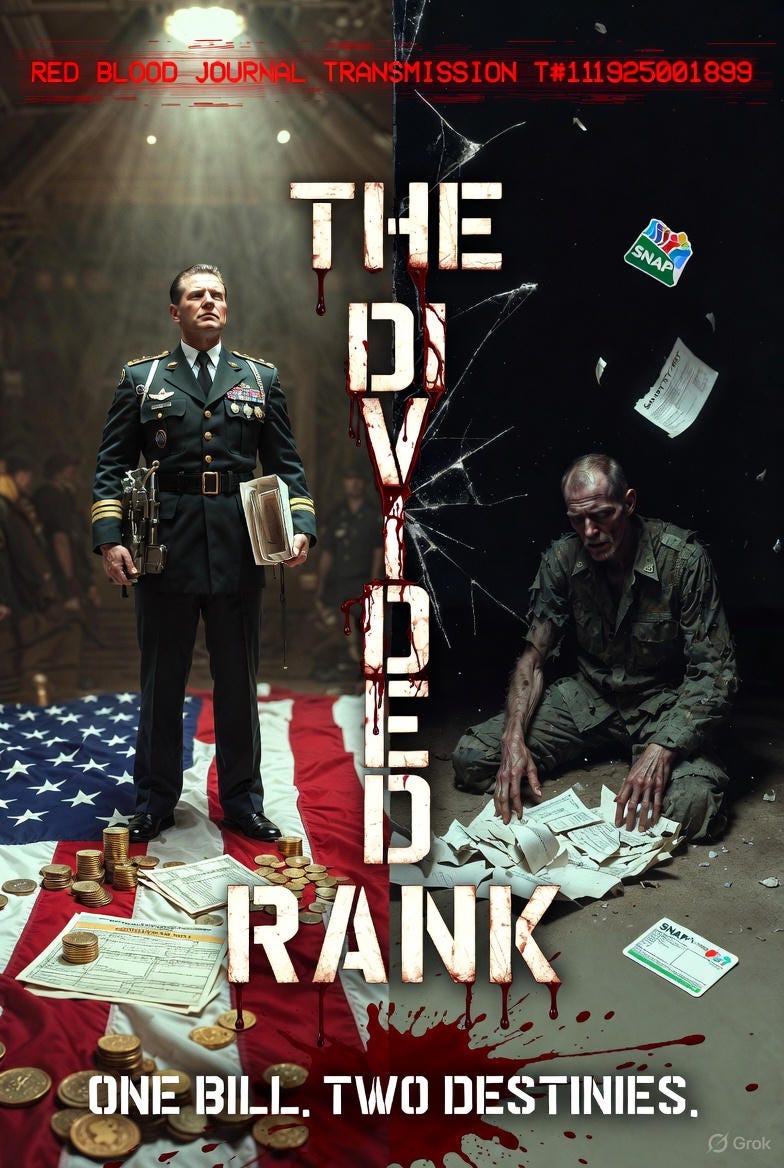
THE SPLIT IN THE FORMATION
How One Bill Manufactures Winners and Losers Among America’s Veterans
They sold it as a patriotic uplift, a bill draped in the flag, wrapped in speeches about restoring dignity to the American veteran. They promised empowerment, entrepreneurship, opportunity. And for some—for the veteran-entrepreneurs with pass-through businesses, equipment-heavy operations, and stable income streams—that promise is real.
But beneath the red-white-blue messaging is the fracture they don’t want discussed:
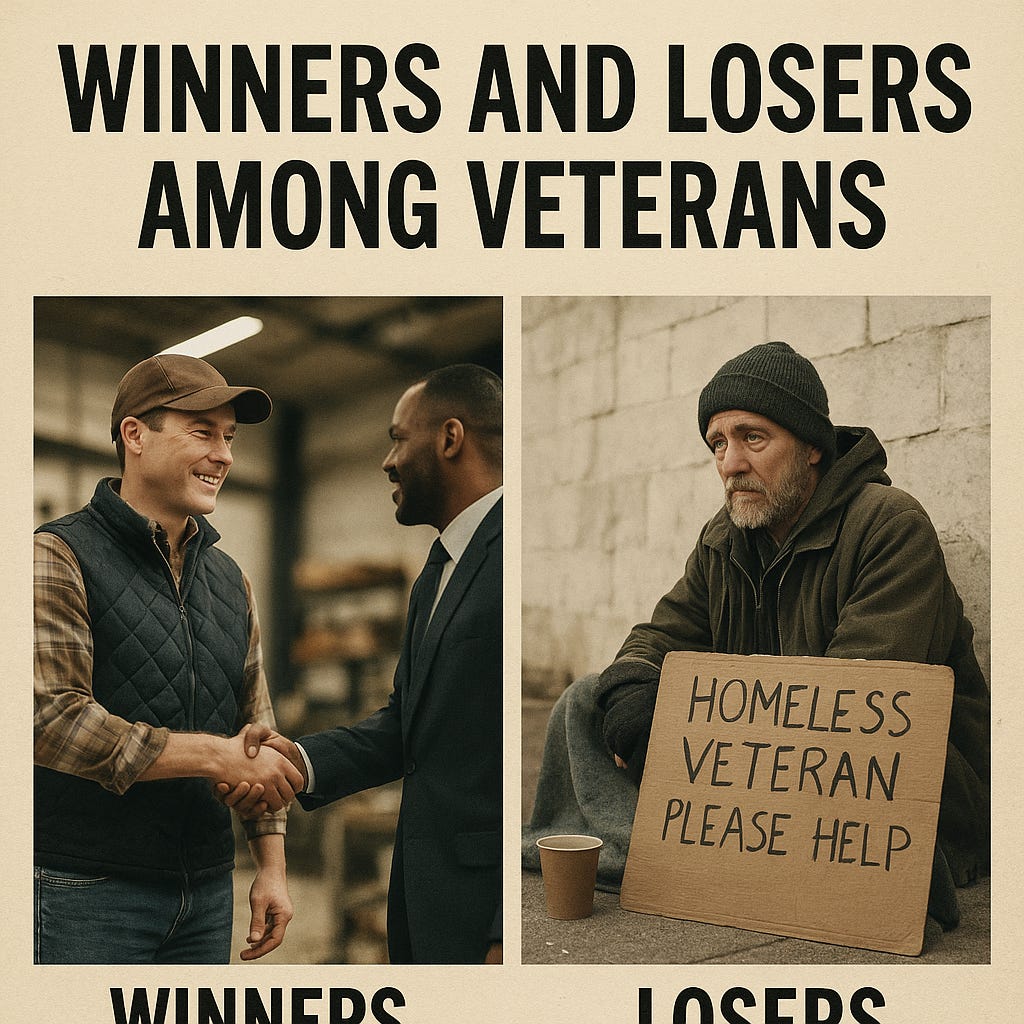
This bill creates two Americas for veterans—one rising, one collapsing.
Veteran business owners gain. Low-income veterans get crushed.
This is the split the architects engineered.
This is the split we expose.
I. THE VETERAN ENTREPRENEURS: THE FAVORED FEW
1. Lower Individual Tax Rates = Higher Business Capital
Most veteran-owned businesses are pass-throughs.
Meaning: your business income is your personal income.
With locked-in lower tax rates, a veteran contractor, landscaper, HVAC installer, or independent security operator sees:
Thousands saved annually
Cash freed for growth, equipment, or hiring
Better loan qualification metrics
For them, the bill works like a booster jet.
2. The Expanded Pass-Through Deduction: A Windfall for the Builders
Section 199A remains a golden door for veterans who:
Run LLCs
Operate S-corps
Own technical/service firms
Work in trades or logistics
Up to 20% of qualified business income deducted.
A veteran welder with $200k QBI can knock off $40k from taxable income—saving thousands.
That’s not pocket change. That’s survival money.
That’s expansion money.
3. Bonus Depreciation & Equipment Expensing
Veteran-run operations are often gear-intensive:
Tools
Vehicles
Trailers
Specialized machinery
Being able to deduct most or all of major asset purchases upfront is a massive advantage.
The bill knows this—and rewards it.
4. Simplified Filing Saves Real Money
Less paperwork → fewer CPA hours → lower compliance costs.
Solo veteran entrepreneurs benefit the most.
On the business side, the bill is not just favorable—it’s strategic.
It boosts the segment of the veteran population already positioned to thrive.
But that’s not the full story.
II. THE VETERANS LEFT BEHIND: THE UNSEEN CASUALTIES
Now we shift from the winners to the wounded.
The bill’s underbelly is not about entrepreneurship—it’s about punishment.
The architects inserted quiet knives aimed at those who are already struggling.
1. Raising SNAP Work Requirements to 65
This hits:
Disabled vets not rated high enough for full exemption
Veterans dealing with PTSD, MST, chronic injuries
Older vets near retirement
Rural veterans without reliable work access
Work rules tied to bureaucratic hoops don’t create jobs—they create food insecurity.
And the bill tightens waivers in high-unemployment counties, meaning veterans living in depressed regions lose support fastest.
2. Cuts to Federal and Community Support Programs
Many low-income vets rely on:
Community nutrition programs
VA outreach initiatives
Local nonprofits
State-level assistance tied to federal budget allocations
The bill introduces deep cuts across these support channels.
So while veteran entrepreneurs receive deductions…
Low-income veterans lose the safety nets that keep them alive.
3. Veterans With Disabilities Hit Indirectly
Even though VA disability benefits remain tax-free, the bill’s ripple effects still hurt:
Increased living costs
Reduced state program funding
Stricter eligibility for food assistance
Loss of supplemental aid tied to unemployment-designated counties
Veterans with 30–70% disability ratings—too injured to work full-time but not “disabled enough” for protection—take the biggest hit.
4. Homeless Veterans: The Silent Strike
The bill tightens eligibility for aid programs used by:
Homeless veterans
Veterans in transitional housing
Veterans recovering from addiction
Veterans recently released from incarceration
These are the veterans least capable of navigating complex, punitive rules.
Homelessness among veterans is already a national disgrace.
This bill ensures it will rise.
III. THE ENGINEERED DIVIDE
Here is the real design, stripped of patriotic varnish:
Reward the veteran who already has capital, structure, and economic activity.
Punish the veteran who doesn’t.
This creates two divergent realities:
Reality A: The Climbing Veteran – The Approved Citizen
A veteran-entrepreneur generating taxable revenue is treated as the ideal:
Encouraged
Rewarded
Supported
They fit the system’s preferred mold: productive, taxable, measurable.
Reality B: The Struggling Veteran – The Disposable Citizen
A veteran without capital is treated as:
A burden
A liability
A cost center
Rather than lifting them, the system tightens the screws.
This isn’t accidental.
It’s structural.
Engineered.
Intentional.
IV. WHY THE SPLIT MATTERS: A RED BLOOD ANALYSIS
When a government designs a bill that benefits the economically strong and harms the economically weak within the same group, it reveals something fundamental:
They are not supporting “veterans.”
They are supporting profitable veterans.
The rest? Expendable.
The emotional cover of “supporting the troops” masks the truth:
This is class warfare within the veteran community.
Economic Darwinism dressed in patriotic camouflage.
A financial sorting mechanism disguised as reform.
Veterans fought the same wars.
They wore the same uniforms.
But the bill divides them into:
those who generate taxable output
vs.
those who cost the system resources.
The winners ascend.
The losers are abandoned.
V. FINAL TRANSMISSION: THE BLOODLINE SPLIT
The architects of the bill have created a new hierarchy of veteran worth:
The Veteran-Founder — applauded
The Veteran-Worker — pressured
The Disabled Veteran — sidelined
The Homeless Veteran — erased
It is not a support system.
It is a selection system.
And the Red Blood Journal is here to map the fracture line with precision.
One bill. One population. Two destinies.
The winners rise by design.
The losers fall by design.
This transmission marks the divide so you can never again be fooled by the ceremonial language that hides the structural cruelty beneath.
🩸 End Transmission.
💔Veteran Economic Divide: Winners and Losers of the New Bill
The transmission from the Red Blood Journal titled “THE DIVIDED RANK,” analyzes a new legislative bill concerning American veterans.
The source argues that the bill intentionally creates a severe economic split within the veteran community, manufacturing “winners” and “losers” under the guise of patriotic support.
Specifically, the legislation heavily favors veteran entrepreneurs and business owners through significant tax benefits, such as lower individual rates and expanded pass-through deductions, thereby boosting their capital and growth opportunities.
Conversely, the text asserts the bill punishes low-income, disabled, and struggling veterans by implementing deep cuts to essential federal and community support programs and raising work requirements for aid like SNAP.
Ultimately, the analysis concludes that the bill is a form of “economic Darwinism” that rewards those who are already economically strong and abandons those who rely on safety nets.


