


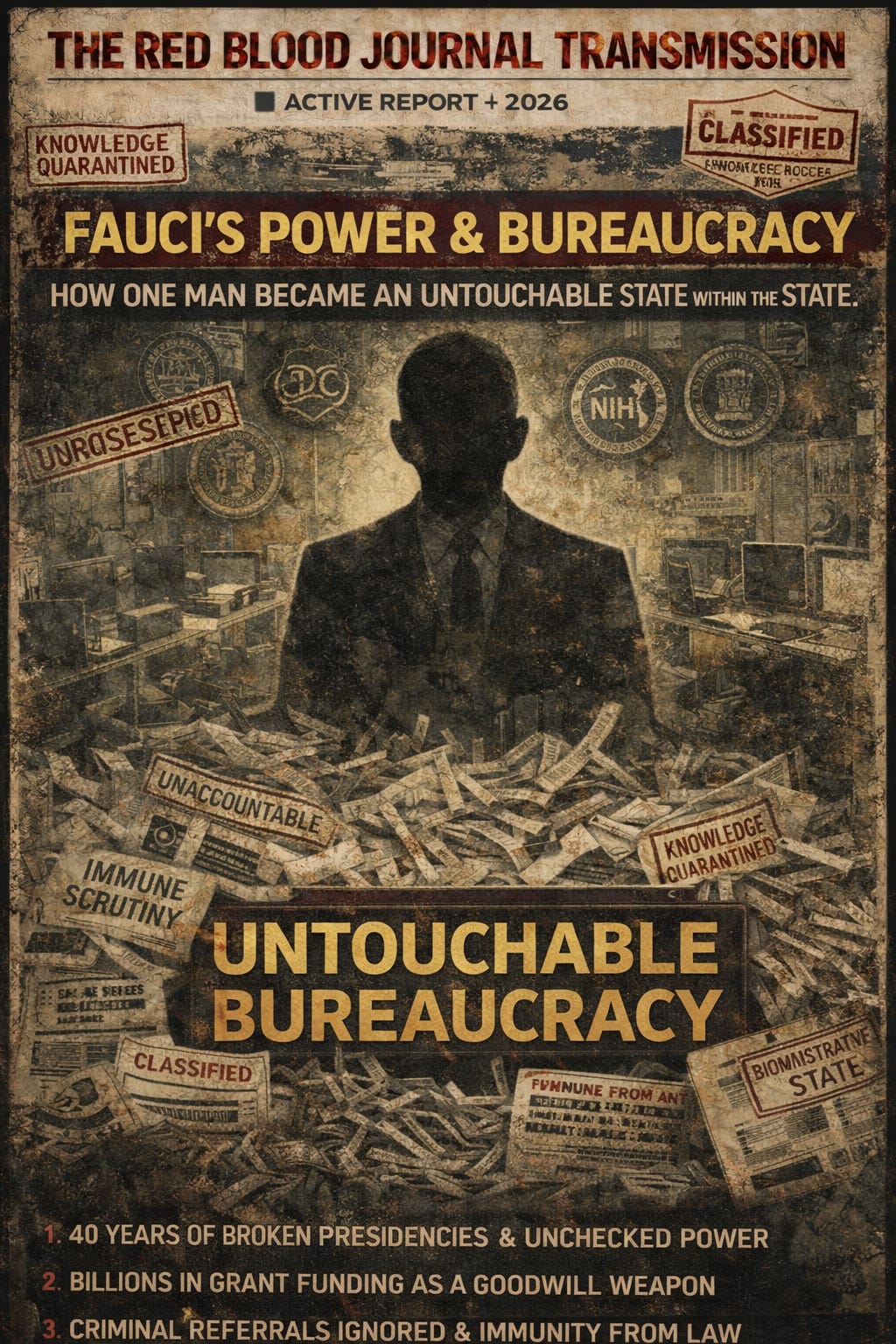
🩸 RED BLOOD JOURNAL TRANSMISSION
T#: RBJ-2026-01-15-BUREAUCRATIC-EMPIRE-PROTOCOL
Classification: Pillar VII – Institutional Power, Immunity from Accountability & the Rise of the Administrative Autocrat
Desk: Federal Overreach, Biosecurity Governance & Pandemic-Era Authority Mapping Unit
Status: ACTIVE REPORT – PART VII
🩸 7. FAUCI’S POWER & BUREAUCRACY: HOW ONE MAN BECAME AN UNTOUCHABLE STATE WITHIN THE STATE
Pillar VII unmasks the most disturbing structural reality revealed in the Rogan × Rand Paul conversation:
The pandemic was not governed by elected officials —
it was governed by an unelected bureaucratic empire with Anthony Fauci at its peak.
Fauci was not merely a scientist.
He was a political institution, a public relations construct, and the central node of a 40-year federal biomedical machine that operated beyond the reach of voters, Congress, and even Presidents.
This is not about one man’s ego.
It is about a system that allowed one unelected figure to become:
untouchable
unchallengeable
unaccountable
indispensable
and mythologized
This pillar examines how that system functioned — and why it still exists.
🏛️ VII.A — 40 Years in Power: The Longest-Running Unelected Ruler in America
Fauci began his reign before:
The Internet
The first Bush presidency
Most current members of Congress
Modern virology standards
Social media
mRNA vaccine technology
He outlasted:
7 presidents
18 Congresses
Every major public health reform effort
No individual in U.S. biomedical history has ever accumulated this much unbroken power.
Rand Paul describes him bluntly:
“Fauci is the J. Edgar Hoover of modern public health.”
Meaning:
He not only controlled an agency —
he controlled the narrative, the funding, the careers, the committees, the media, and the legacy.
🧬 VII.B — The Bureaucratic Empire: Funding Control as a Weapon
Fauci’s true power wasn’t in his public comments.
It was in his control over billions in research grants.
For 40 years, he held the keys to:
NIH grant approvals
Research funding priorities
University career pipelines
Peer review networks
Advisory committee appointments
If a scientist crossed him, they didn’t merely lose his favor.
They lost:
future funding
lab expansion
publication support
tenure opportunities
career advancement
This created a culture of dependency — and fear.
Scientists didn’t follow Fauci because he was right.
They followed him because he controlled their lives.
🎖️ VII.C — The “Saint Fauci” Media Construction
Fauci was transformed from a bureaucrat into:
A celebrity
A political weapon
A pop-culture icon
A mascot for obedience
A shield for institutional power
This was achieved through:
magazine covers
children’s books
late-night comedy appearances
puff-piece interviews
stylized portraits
merchandise
coordinated praise
This was not organic admiration.
This was manufactured myth-making.
Rand Paul calls it:
“The most successful PR campaign in government history.”
🚔 VII.D — Security Detail & Limo Service: The Public Servant With Presidential Privileges
The interview highlights a detail the public rarely hears:
Fauci required:
full-time federal security
U.S. Marshals involvement
limo transportation
advanced protective services
Not because of threats —
but because of the mythos built around him, creating a pseudo-head-of-state aura.
This wasn’t about safety.
It was about symbolism.
Fauci was no longer a bureaucrat.
He was an institution protected like royalty.
🔥 VII.E — Criminal Referrals Ignored: The Bureaucrat Above the Law
Rand Paul submitted multiple criminal referrals to the Department of Justice regarding:
lying to Congress
funding gain-of-function research
destroying federal records
misleading the public
obstructing investigations
Every referral was ignored.
Not investigated.
Not challenged.
Not acknowledged.
Ignored.
This demonstrates the true architecture of power:
Fauci was not protected by law —
he was protected from law.
The administrative state shields its own.
🕳️ VII.F — The Shadow Government Effect: Bureaucratic Power vs. Presidential Power
Rogan and Rand Paul raise the most politically explosive point:
Presidents came and went — Fauci stayed.
This reveals a reality most Americans never consider:
Congress makes laws
Presidents set agendas
But bureaucrats execute — and reinterpret — everything
Fauci’s influence transcended administrations because:
Presidents depended on him
Media worshipped him
Academia relied on his funding
Pharma used him as their scientific face
Tech platforms treated his statements as “infallible truth”
He became the axis around which the entire pandemic response rotated.
🛑 VII.G — Why Bureaucratic Power Made the Pandemic Worse
Rand Paul lays it out clearly:
When one man controls:
the funding
the research
the narrative
the media access
the public messaging
the policy recommendations
…there is no room for dissent, correction, or course adjustment.
This is why:
early mistakes became permanent
bad policies became mandates
failures became dogma
concerns were labeled misinformation
science became centralized
A single bureaucrat should never have this much power.
Yet the system made it inevitable.
🩸 THE RED BLOOD JOURNAL POSITION
Pillar VII reveals a structural danger far beyond one person:
America was not ruled by elected officials during the pandemic —
it was ruled by an unelected scientific monarchy.
This is not a political critique.
It is a constitutional one.
The pandemic didn’t create this bureaucracy.
It merely exposed how powerful — and how unaccountable — it already was.
👑The Architect of the Administrative Monarchy
This report examines the rise of an unelected administrative monarchy centered on Anthony Fauci, portraying him as a figure with unprecedented institutional power that transcended democratic oversight.
By controlling billions in federal research grants, the text argues that this bureaucratic system enforced scientific conformity and penalized any professional dissent.
The source suggests that a manufactured media narrative elevated a government official to a status of symbolic royalty, effectively shielding him from legal accountability and congressional inquiries.
Ultimately, the document claims that the pandemic response exposed a structural flaw in American governance, where long-term bureaucrats wield more influence than elected presidents.
This centralization of authority supposedly allowed policy errors to become dogmatic because the system lacked the necessary checks to challenge a singular, entrenched authority figure.


