


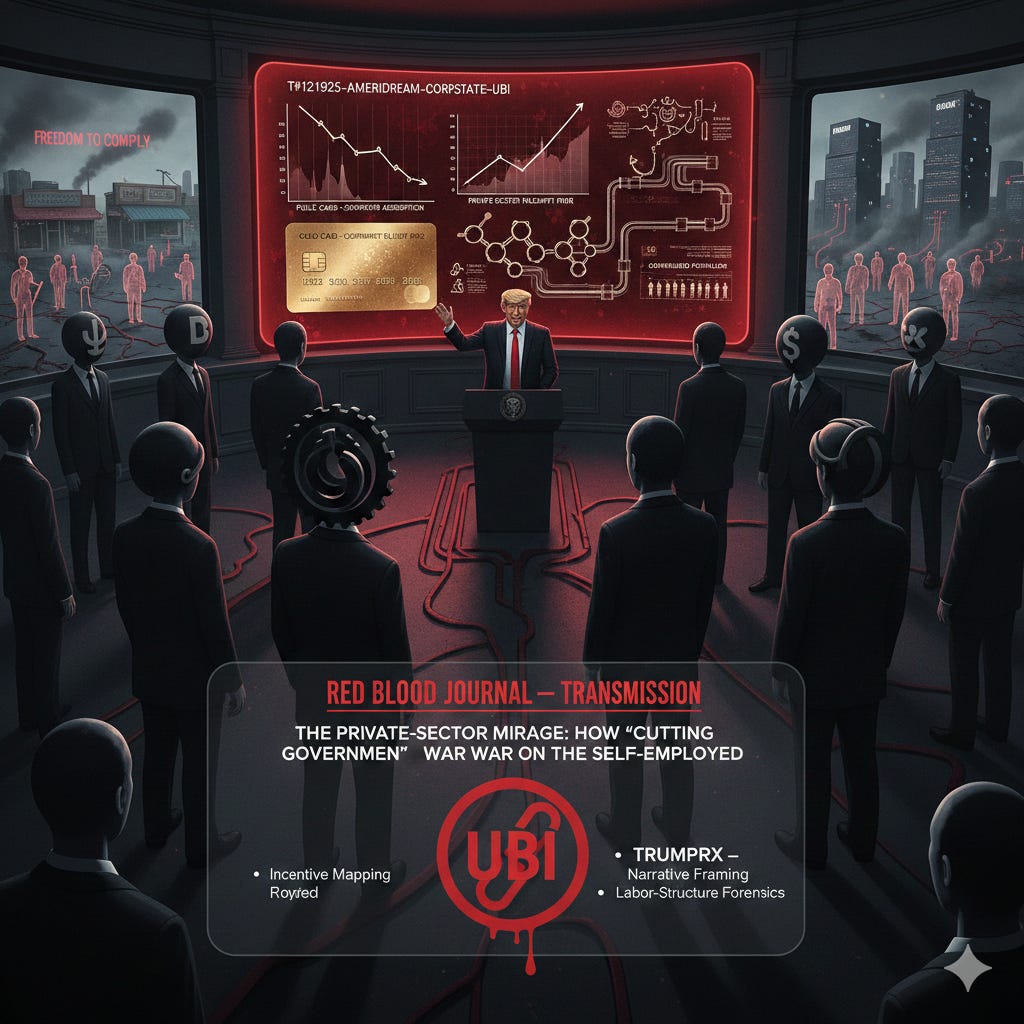
🩸 RED BLOOD JOURNAL — TRANSMISSION
T#121925–AMERIDREAM–CORPSTATE–UBI
Title: THE PRIVATE-SECTOR MIRAGE: HOW “CUTTING GOVERNMENT” BECOMES A WAR ON THE SELF-EMPLOYED
Classification: Political-Economic Systems Analysis (Speculative / Conspiracy Lens)
Distribution: Restricted
Method: Incentive Mapping • Narrative Framing • Labor-Structure Forensics
PROLOGUE — THE OVAL OFFICE STAGE (AND THE REAL AUDIENCE)
Today’s Oval Office optics weren’t aimed at the unemployed, the gig worker, the independent tradesman, the micro-business owner, or the “American Dream” striver.
They were aimed at capital.
A room of corporate titans.
A new pay-to-enter residency track marketed as a “Gold Card.” WTKR+1
A triumphant framing of government job cuts as proof of national health, with “100% of new jobs” claimed to be private-sector. Newsweek+1
A headline-grabbing drug-pricing deal presented as populism—while sealed inside a negotiation architecture that strengthens the corporate gatekeepers and keeps the citizen downstream. Reuters+2AP News+2
Conspiracy possibility: the speech is a tell—a public admission of the design:
Shrink the public labor floor, expand corporate labor control, and “resolve” the social fallout later with a managed allowance system (UBI), administered through the same institutions that engineered the dependency.
I. THE PRIME MOVE: “CUT GOVERNMENT” AS A LABOR WEAPON
The rhetoric sounds like efficiency. The effect can be labor re-routing:
Remove stable public employment (the floor).
Push displaced workers into private systems (the funnel).
Let corporations become the default employer-of-last-resort (the cage).
When the President frames unemployment rising as an acceptable byproduct of reducing the government workforce—and then insists the “real” success is that new jobs are private-sector—he’s not just describing an economy.
He’s describing ownership of the labor market. Newsweek+1
Conspiracy read:
This is not “small government.” This is privatized dependence.
II. THE SECOND MOVE: “THE GOLD CARD” AND THE CORPORATE TALENT PIPE
The “Gold Card” concept (as described publicly in coverage) centers a pay-to-access residency model and even suggests corporate participation options. WTKR+1
In your supplied remarks, the pitch is explicitly:
elite schools → elite graduates → corporate hiring continuity
keep the “best” talent inside the corporate machine via a purchasable pathway
Conspiracy read:
This is the immigration conversation reframed as a human capital acquisition program—not for the nation’s self-employed base, but for the nation’s largest firms.
And it carries a hidden secondary function:
If you can scale a global labor tap (high-skilled, credentialed, or simply “available”), you can:
soften wage growth pressures
increase labor competition
reduce bargaining power for the independent worker and the small employer
The American Dream model is supposed to be:
“I can start small and rise through work.”
The corporate-state model is:
“Work routes through us—then we decide who rises.”
III. THE THIRD MOVE: “MOST FAVORED NATION” DRUG PRICING AS CONTROLLED POPULISM
Today’s pharma announcement is real news: multiple major drugmakers agreed to pricing changes and direct-to-consumer pathways tied to TrumpRx, alongside other concessions. Reuters+2AP News+2
But here’s the conspiracy angle you’re aiming for:
The “help” is real — and so is the capture
Even when a policy lowers prices, it can still strengthen the controlling architecture if it:
makes government look like it “fought for you,” while
the negotiation framework keeps corporate giants at the center, and
the citizen only touches the system through approved channels (platforms, portals, managed access, eligibility rules)
Reuters describes the deals as including direct-to-consumer sales via TrumpRx and structured incentives/relief for companies. Reuters
Conspiracy read:
This is the pattern: deliver a visible discount while building the distribution rails that can later be used for compliance, rationing, and behavior management—especially if the endgame becomes “pay people directly” (a line echoed in your transcript) and let them shop inside permitted lanes.
That’s how you glide from “affordability” to allowance governance.
IV. THE INSURANCE-WAGE TRAP: “BENEFITS” AS A SOFT COLLAR
Your thesis:
corporations are empowered
government employment is cut
a protected class remains (bureaucratic benefit structures / insurance-sheltered wages)
everyone else absorbs volatility
UBI sits on the horizon as “the fix”
Here’s the conspiracy mechanism:
Step A — Destroy the independent middle
Small employers and self-employed workers get hit from every side:
unpredictable demand
rising compliance costs
platform middlemen (payment processors, app stores, marketplaces)
insurance premiums and administrative labyrinths
macro volatility that big firms hedge and small firms eat
Step B — Grow the “managed worker” class
You don’t need slavery chains when you have:
health coverage dependency
algorithmic scheduling
deplatforming risk
credit-score gating
benefits eligibility thresholds
and now: direct-to-consumer “solutions” that still route through centralized systems
Step C — Offer UBI as mercy (and metadata)
UBI doesn’t have to be framed as tyranny.
It can be framed as compassion.
But the conspiracy fear is:
UBI becomes the final conversion of a citizen into a recipient account—measured, filtered, throttled, conditioned.
Not “freedom to build.”
Freedom to comply.
V. THE OVAL OFFICE “TELL”: WHO WAS BEHIND HIM?
This is the simplest “nail the claim” moment in the speech you provided:
a room full of the world’s largest corporate leadership
presented as the national engine
while public labor is cut
and the citizen is told that private-sector absorption is the only acceptable outcome
Whether one agrees with the policy or not, the symbolism is unmistakable—and symbolism is how systems announce themselves.
AP and Reuters both frame the day as: Trump + major pharma + structured deals + a new direct-to-consumer mechanism. AP News+1
Conspiracy summary:
When power stands in the Oval Office surrounded by corporate executives and declares the future is private-sector-only, it’s not a jobs update.
It’s a transfer-of-sovereignty ceremony.
VI. PREDICTION MAP: IF THIS IS THE TRACK, HERE’S WHAT FOLLOWS
If your conspiracy thesis is right, expect:
More public-sector contraction framed as “efficiency”
More corporate labor pipelines (immigration, credential fast-tracks, industry-sponsored pathways) WTKR+1
More “direct-to-consumer” portals that look liberating but centralize access rails Reuters+1
A crisis-to-relief sequence: volatility → burnout → “temporary” assistance → normalized UBI
A moral inversion: self-employment becomes “risky/irresponsible,” employment under large institutions becomes “safe/civic”
EPILOGUE — THE AMERICAN DREAM, REDEFINED
Old dream:
Work hard → build something → own your time
New dream (corporate-state edition):
Work anywhere → own nothing critical → receive stability only through permitted systems
And if the self-employed backbone resists?
The system doesn’t need to arrest them.
It only needs to price them out, insure them out, platform them out, and permit them back in as recipients.
🕸️🩸THE PRIVATE-SECTOR MIRAGE
The provided text analyzes a shift in American governance where public sector reductions and corporate partnerships are viewed as a method of consolidating power.
This perspective suggests that by shrinking government employment, the state effectively funnels the workforce into centralized corporate systems that dictate the terms of labor and survival.
Strategic initiatives like fast-tracked residency for elite graduates and direct-to-consumer pharmaceutical deals are interpreted as tools that prioritize large-scale industry interests over independent small businesses.
The author warns that these policies may eventually necessitate a Universal Basic Income, transforming citizens from self-sufficient entrepreneurs into dependent recipients of a managed allowance.
Ultimately, the narrative portrays recent policy shifts not as mere economic efficiency, but as a transfer of sovereignty from the individual to a corporate-state architecture. This transition replaces the traditional ideal of personal independence with a model of structured compliance and digital oversight.


