


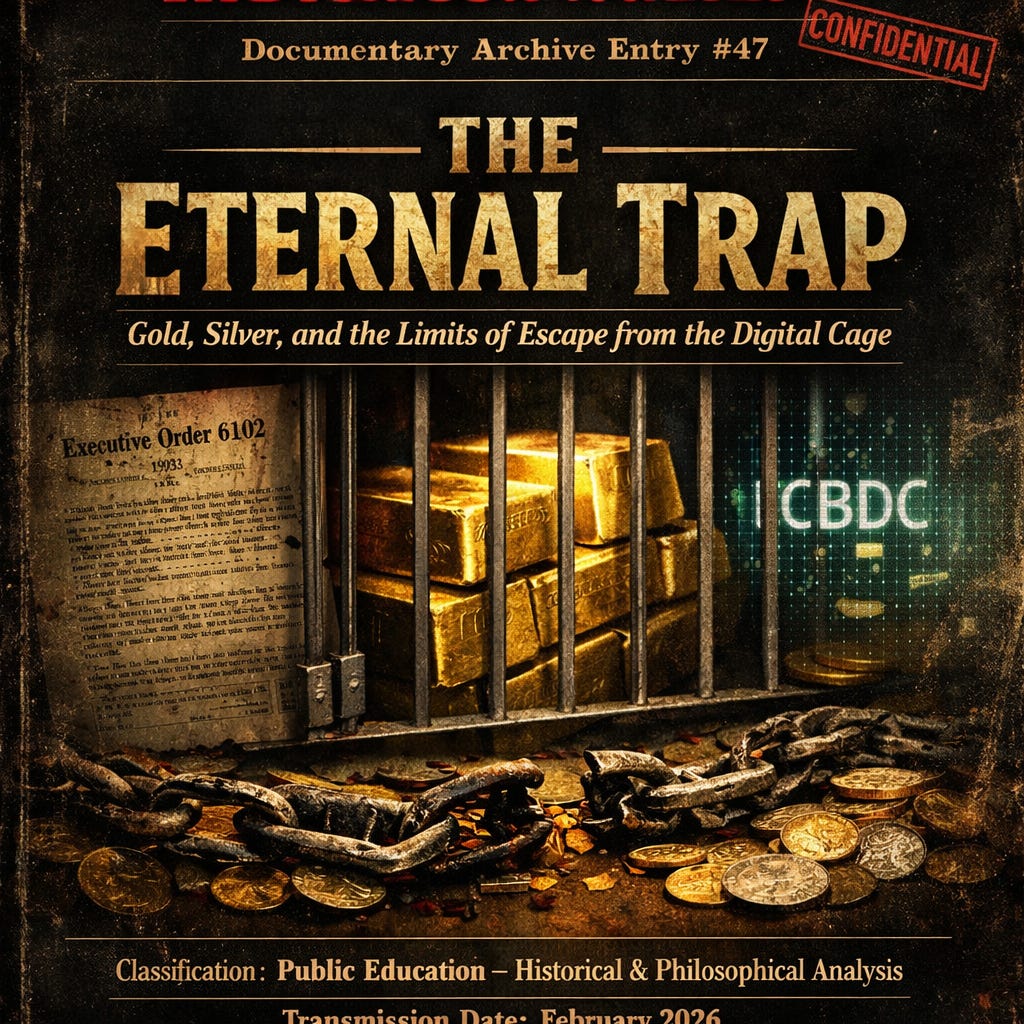
🩸RED BLOOD JOURNAL TRANSMISSION
Documentary Archive Entry #47
Transmission Date: February 2026
Classification: Public Education – Historical & Philosophical Analysis
Title: The Eternal Trap – Gold, Silver, and the Limits of Escape from the Digital Cage
Narrator (Formal Voice-Over):
Ladies and gentlemen, this is not conspiracy. This is documented history.
Even if every citizen on Earth liquidated their digital assets tomorrow and converted every last dollar, euro, or yuan into physical gold and silver, the question remains: What safeguard exists against the state simply rewriting the rules once more?
We turn the lens backward to 1933—not 1935, as sometimes misremembered—and examine Executive Order 6102, the precedent that answers the query with chilling clarity.
Act I: The Historical Precedent – Executive Order 6102 (April 5, 1933)
On April 5, 1933, President Franklin D. Roosevelt invoked emergency powers under the amended Trading with the Enemy Act of 1917. The order prohibited the “hoarding” of gold coin, bullion, and gold certificates in amounts exceeding $100 (roughly five troy ounces) per person. Citizens were required to deliver excess holdings to Federal Reserve banks or member institutions by May 1, 1933, in exchange for $20.67 per ounce—the official price fixed since 1900.
Violations carried penalties of up to $10,000 in fines (equivalent to approximately $249,000 today) or ten years in federal prison, or both. Exemptions were narrow: jewelry, rare collector coins of recognized special value, and limited industrial or artistic uses. Silver was untouched. Enforcement relied primarily on bank reporting and voluntary compliance; prosecutions were rare, and the most prominent court test (involving attorney Frederick Barber Campbell) upheld federal authority even while the individual case collapsed.
One month later came the Gold Reserve Act of January 30, 1934. Title to all monetary gold passed to the U.S. Treasury. The official price was revalued overnight to $35 per ounce—a 69% devaluation of the dollar that generated roughly $3 billion in instantaneous profit for the government (an enormous sum in Depression-era dollars). The public had been compensated at the old rate; the state captured the windfall.
The mechanism was not outright theft without payment—it was compulsory sale at an artificially low price followed by immediate revaluation. The Supreme Court upheld the program in the Gold Clause Cases (1935). Private gold ownership remained illegal for American citizens until President Gerald Ford signed Public Law 93-373, effective December 31, 1974.
Act II: What Enabled It Then—and What, Precisely, Prevents Repetition Today?
Four structural factors converged in 1933:
Monetary linkage — The United States was still on the gold standard. Controlling physical gold was essential to expanding the money supply and financing the New Deal.
Declared national emergency — Congress had already amended the Trading with the Enemy Act; the President could act by executive order.
Centralized custody — Much gold was already in banks; reporting was feasible.
Public compliance culture — In the depths of the Depression, many citizens viewed the measure as patriotic sacrifice.
Fast-forward to 2026. The dollar is pure fiat since the 1971 Nixon Shock. Gold no longer anchors the currency; the Federal Reserve creates money electronically. The President cannot unilaterally ban private ownership in peacetime without new legislation. The Fifth Amendment’s Takings Clause would demand “just compensation”—a politically explosive requirement in an era of instant global communication. Forty-six states have enacted gold-friendly laws removing sales taxes or recognizing gold and silver as legal tender. Public awareness is orders of magnitude higher; compliance would be fragmentary at best. Door-to-door enforcement against millions of decentralized holders—vaults, home safes, overseas storage, numismatic collections—is logistically nightmarish.
Legal scholars and market analysts across the ideological spectrum conclude the same: a 1933-style nationwide gold confiscation is technically possible via new congressional act or extreme emergency declaration, but practically improbable absent total societal collapse. Silver, never targeted in 1933, carries even lower precedent risk. Yet possibility is not zero. History demonstrates that when governments face existential fiscal pressure—unpayable debt, currency crisis, or war—they have repeatedly altered property rules. Australia (1959), Britain (1966), and others provide parallel examples. Sovereign power ultimately trumps private title when the state declares the game has changed.
Mass private accumulation of gold and silver would, paradoxically, make outright seizure more difficult—too many holders, too much physical dispersion—but it would not render the state powerless. New laws could criminalize possession, trading, or even inheritance above thresholds; capital controls could trap bullion domestically; CBDC integration could flag large conversions. The digital trap is merely the latest iteration; the underlying mechanism is the same: monopoly on legitimate violence and rule-making.
Act III: The Philosophical Reckoning
Therefore, the hard truth emerges with documentary clarity: there is no permanent exit from the arena. Every asset class—digital, paper, or metallic—ultimately rests on the goodwill or restraint of the sovereign. Gold and silver remain superior stores of value across millennia precisely because they cannot be printed into oblivion, yet they are not immune to redefinition as contraband when the state so decrees.
The rational response is neither despair nor frantic hoarding. It is lucid acceptance.
Live happy.
Enjoy the show.
Minimize voluntary participation in the mechanisms that render you most traceable and controllable—excessive debt, over-reliance on centralized digital systems, blind trust in any single asset class.
Hold some physical metal if it brings you peace of mind; diversify across jurisdictions, forms, and counterparties; but never mistake any possession for true sovereignty. True sovereignty is internal: the decision to derive meaning, joy, and purpose from relationships, creation, curiosity, and service rather than from the illusion of perfect financial armor.
The curtain rises and falls on every empire. The audience that laughs, loves, and refuses to be consumed by fear outlives every decree.
End of Transmission.
Red Blood Journal – Archive Secured.
We do not predict the future. We merely illuminate the pattern.
Stay free in the only domain that cannot be confiscated: the mind.
⛓️The Eternal Trap:
Gold and the Pattern of State Control
This text examines the historical precedent and modern feasibility of government-mandated precious metal confiscation.
By revisiting the 1933 executive order that forced American citizens to sell their gold to the state, the analysis explores how sovereign power can override private property rights during fiscal crises.
While the source notes that logistical hurdles and legal protections make a modern-day seizure difficult, it emphasizes that no asset is entirely immune to state intervention.
Ultimately, the narrative argues that true sovereignty is found in mental and social independence rather than the illusion of financial invulnerability.
It encourages readers to diversify their holdings while acknowledging that governments historically rewrite rules to ensure their own survival.
⛓️The Eternal Trap:
Gold and the Pattern of State Control
This text analyzes the historical precedent of Executive Order 6102, which mandated the compulsory sale of gold to the United States government during the Great Depression.
It evaluates whether a similar state-led confiscation could occur today, noting that while modern logistics and legal shifts make seizure difficult, the sovereign power to rewrite property laws remains a persistent threat.
The narrative suggests that no physical or digital asset provides an absolute escape from government control during times of extreme fiscal crisis.
Instead of seeking perfect financial security, the author advocates for diversification and a focus on internal sovereignty and mental independence.
Ultimately, the source serves as a philosophical reminder that governments historically prioritize their own survival over individual property rights.


