


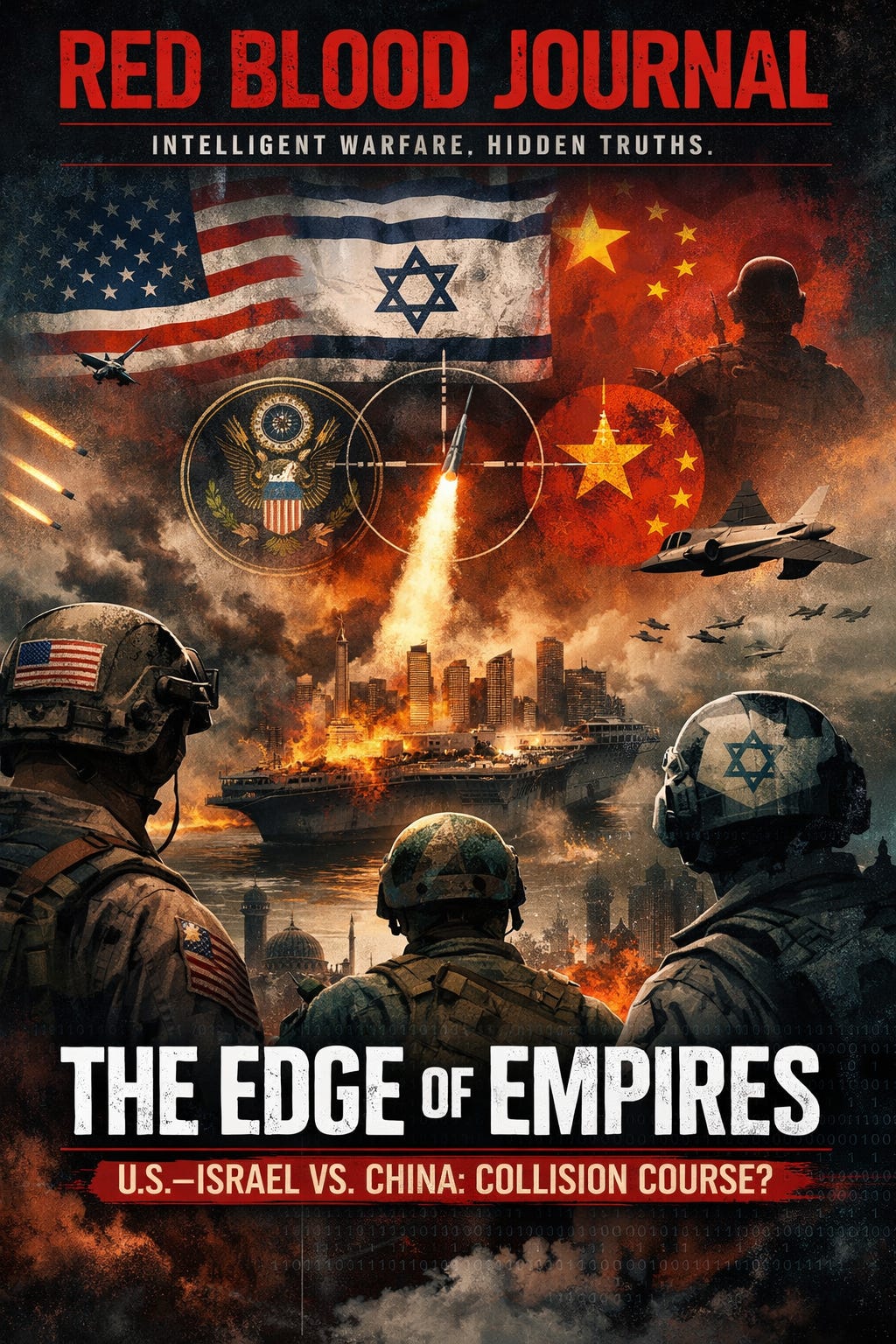
🩸 RED BLOOD JOURNAL TRANSMISSION
T#: RBJ–2026–CLASH-OF-EMPIRES
Classification: Global Order Realignment Brief
Threat Vector: Great-Power Escalation & Proxy Warfare
Clearance: For readers trained to see patterns beneath headlines
TITLE
**THE EDGE OF EMPIRES:
The Prospect of a U.S.–Israel vs. China Confrontation**
PROLOGUE — THE WORLD AT A HINGE
History rarely announces its turning points.
They arrive disguised as routine military movements, diplomatic condemnations, or “limited” proxy wars. Only in retrospect do we recognize them as the moments when one era slipped away and another began.
Today, we stand at such a hinge.
For decades, the United States has operated as the singular global hegemon — militarily unchallenged, financially dominant, and politically pervasive. Israel, acting as both a strategic partner and an autonomous regional power, has wielded disproportionate influence in the Middle East under the umbrella of American protection.
Yet a new gravitational center is forming.
China, patient, calculating, and increasingly assertive, is signaling that the unipolar era is over. Its posture toward Iran — and by extension toward any U.S.-Israeli military action against Tehran — suggests that the next war in the Middle East may not be regional at all.
It may be the opening salvo of a great-power conflict.
SECTION I — THE PROSPECT OF A U.S.–ISRAEL VS. CHINA CONFRONTATION
For years, U.S.–China tensions were framed as distant: trade wars, Taiwan scenarios, South China Sea disputes, technological competition.
The Middle East was assumed to remain an American sphere of dominance.
That assumption is collapsing.
China has gradually embedded itself in the region through energy dependence, strategic partnerships, and military technology transfers. Iran, supplying a critical share of China’s oil, is no longer merely a sanctioned pariah state — it is a node in Beijing’s broader geopolitical architecture.
This creates a dangerous new reality:
An attack on Iran is no longer just an attack on Iran.
It is interpreted in Beijing as an attack on China’s economic lifeline.
It becomes a casus belli — a justification for retaliation.
Thus, the prospect of a U.S.–Israel vs. China confrontation is no longer hypothetical. It is conditional, contingent, and increasingly plausible.
The conflict would not necessarily begin with direct U.S.–China combat. More likely, it would unfold across layers:
Proxy escalation in the Middle East
Military pressure in the South China Sea and Taiwan Strait
Cyber warfare, sanctions, and economic decoupling
Potential kinetic clashes between U.S. and Chinese forces
The battlefield would be global. The stakes existential.
SECTION II — PREDICTION OF SEVERE CHINESE RETALIATION IF IRAN IS ATTACKED AGAIN
Beijing’s messaging has shifted from cautious diplomacy to thinly veiled deterrence.
China has already demonstrated commitment to Iran through:
Massive military cargo deliveries
Advanced drone and missile technology transfers
High-level diplomatic backing at the United Nations
Explicit condemnation of Israeli strikes on Iranian territory
These are not the actions of a neutral observer. They are the preparations of a patron power.
If Israel — with or without U.S. coordination — launches another major strike on Iran, Chinese retaliation is likely to take several forms:
1. Military Countermoves (Indirect or Direct)
Expansion of Chinese naval presence in the Persian Gulf and Indian Ocean
Intelligence sharing and real-time battlefield coordination with Iran
Deployment of advanced air-defense systems to further neutralize U.S. and Israeli air superiority
Potential missile support or technology enabling Iran to threaten U.S. bases in the region
2. Gray-Zone Warfare
China may intensify its maritime pressure in the Western Pacific:
Harassment of U.S. naval vessels
Militarized “fishing fleets” cutting off trade routes
Aggressive air interceptions of U.S. aircraft
Coordinated cyber operations targeting U.S. military infrastructure
3. Economic Retaliation
Beijing could:
Accelerate dollar decoupling
Reduce reliance on U.S. financial systems
Form tighter energy alliances with Russia, Iran, and Gulf states
Weaponize supply chains critical to Western economies
In essence:
A strike on Iran could trigger a multi-front response that stretches American military and economic capacity beyond its limits.
SECTION III — THE END OF AMERICAN EMPIRE?
Empires rarely fall in a single battle.
They erode.
They overextend.
They lose legitimacy.
They are challenged simultaneously on too many fronts.
A U.S.–Israel confrontation with China over Iran could be the catalyst — not the sole cause, but the accelerant — for the unraveling of American primacy.
Several structural vulnerabilities suggest this possibility:
1. Military Overstretch
The United States is already engaged in:
Proxy conflict in Ukraine
Strategic competition in the Indo-Pacific
Middle Eastern instability
Domestic political polarization
Opening a de facto war with China — even indirectly — risks breaking the coherence of U.S. global power.
2. Financial Realignment
If China successfully coordinates a non-dollar energy bloc with Russia, Iran, and key Gulf players, the foundation of American economic dominance could crack.
The petrodollar system — long the invisible pillar of U.S. hegemony — would be threatened.
3. Psychological Shift in the Global South
Many nations already view U.S. interventions as imperial rather than stabilizing.
If China emerges as a credible counterweight — especially by “defending” Iran against Western aggression — the moral narrative could shift decisively.
This is why some analysts suggest such a confrontation could mark:
“The end of American empire.”
Not overnight collapse — but a clear historical inflection point.
SECTION IV — THE DEEP PATTERN
Stripped of rhetoric, the pattern is stark:
The U.S. seeks to preserve dominance.
Israel seeks regional security through overwhelming force.
China seeks strategic autonomy and protection of its supply lines.
Iran becomes the fault line where these ambitions collide.
This is not merely about Iran.
It is about who controls the future world order.
COUNTERINTELLIGENCE NOTES
Expect increased Chinese diplomatic activity portraying itself as a defender of sovereignty and anti-imperialism.
Expect intensified U.S. narrative framing China as destabilizing and expansionist.
Expect Israel to push for decisive action before China’s military footprint in Iran becomes too entrenched.
Expect escalation through “incidents” rather than formal declarations of war.
EPILOGUE — THE QUESTION THAT REMAINS
If another strike on Iran occurs, will the world sleepwalk into a great-power war?
Or will this be the moment when the old empire meets its match — and a new order is born from the collision?
The answer may arrive not in speeches or treaties, but in missile trails, carrier movements, and the silent recalibration of global power.
⚖️The Edge of Empires:
Global Realignment and the Iranian Fault Line
The provided text explores the shifting global power structure as the era of American dominance faces a direct challenge from a rising Chinese-Iranian alliance.
It argues that the Middle East has become a critical geopolitical fault line where a localized strike on Iran could trigger a massive retaliatory response from Beijing.
This potential confrontation is no longer viewed as a regional skirmish but as a global turning point that could involve cyber warfare, economic decoupling, and naval clashes.
The analysis suggests that the unipolar world order is eroding as China positions itself as a strategic patron to counter Western influence.
Ultimately, the source warns that a U.S.-Israeli conflict with Iran may serve as the historical catalyst for the end of American primacy and the birth of a new international system.


