


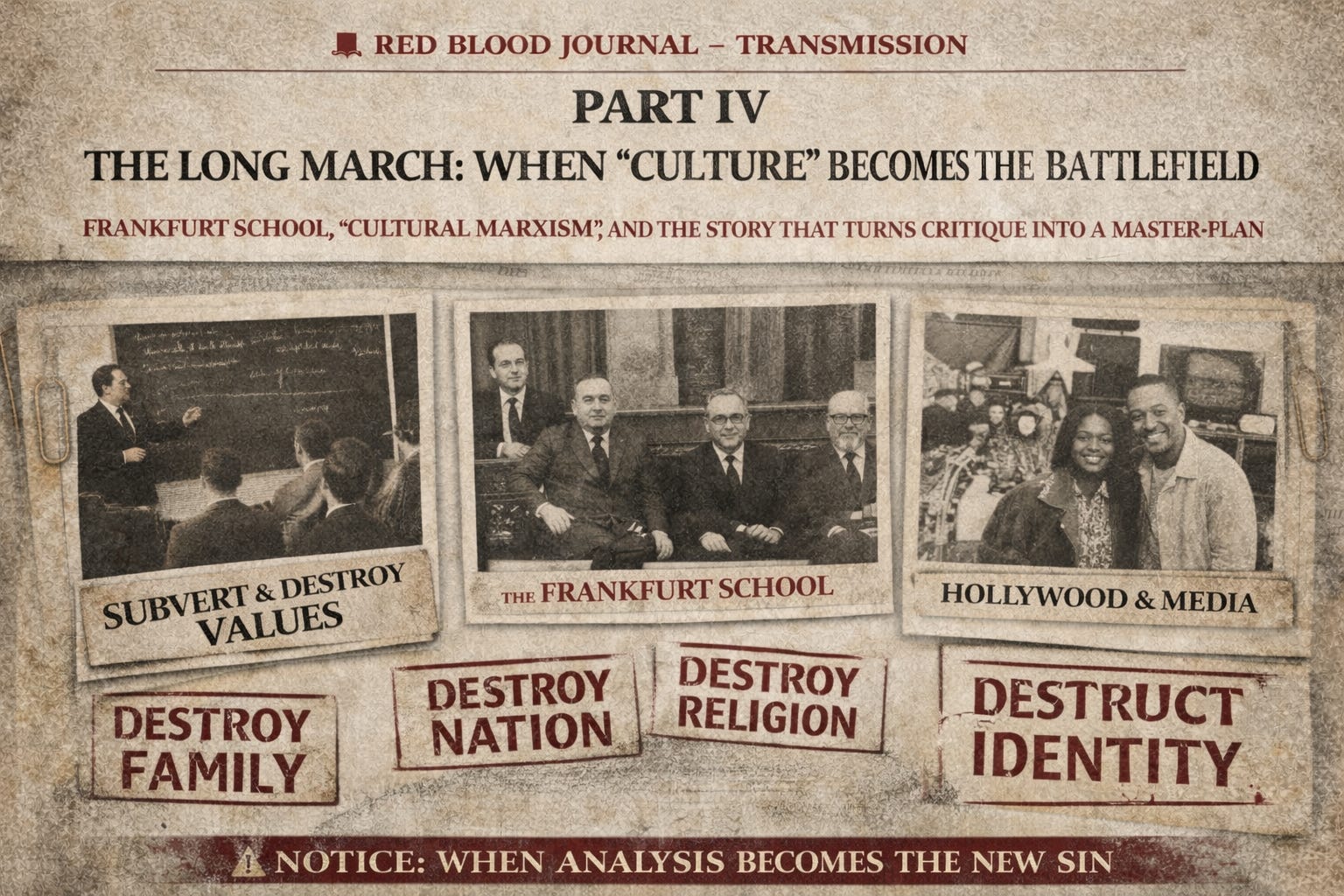
🩸 RED BLOOD JOURNAL — TRANSMISSION
PART IV — THE LONG MARCH: WHEN “CULTURE” BECOMES THE BATTLEFIELD
Subject: Frankfurt School, “Cultural Marxism,” and the story that turns critique into a master-plan
Status: Examination in progress
Judgment: Reserved
I. THE WARNING SHOT: “THEY’LL USE YOU — THEN SHOOT YOU”
Part IV opens with a threat disguised as insight:
The professors, the activists, the civil-rights defenders — the “beautiful” moral front — are framed as disposable tools in a subversion campaign. Useful only until the takeover is complete. Then: lined up, eliminated, because they “know too much.”
This is the first move of the segment:
A paranoia primer.
It sets the emotional baseline:
if you trust moral language, you are being used.
if you join the movement, you are expendable.
if you disagree, you are naïve.
It’s a powerful setup because it hardens the reader against compassion and complexity before the historical claims even begin.
II. THE PIVOT: FROM POLITICS TO CULTURE
Then the documentary shifts the battlefield.
Not elections. Not parliaments. Not armies.
Schools. Art. Film. Music. Journalism. Therapy. Family structure.
The claim is that Europe could not be conquered by overt communism because Europeans were “too attached” to tradition—nation, faith, family—so the plan evolved:
Don’t seize power first.
Change the people first.
Then power will arrive “naturally.”
This is the central thesis of Part IV:
a long war of values.
And if this were argued as a general strategy of ideological struggle, it would be plausible. Every system tries to reproduce itself through culture.
But Part IV doesn’t stop at “culture matters.”
It identifies a single hidden hand behind cultural change—and that’s where the segment crosses its own line.
III. THE FRANKFURT SCHOOL — FROM REAL HISTORY TO TOTAL STORY
The documentary introduces the Frankfurt School and the Institute for Social Research and frames it like a command center.
Names appear: Lukács, Horkheimer, Adorno, Marcuse, Fromm, and others. Funding is attributed to wealthy patrons. Concepts appear: critical theory, the authoritarian personality, cultural transformation.
Here is the important distinction the reader must hold:
Yes: these were real thinkers in a real intellectual movement.
Yes: they criticized tradition, authority, and social power.
Yes: their work influenced later academic and cultural currents.
But Part IV does something else:
It converts influence into orchestration.
It converts critique into sabotage.
It converts academic argument into a unified demolition plan.
That leap is where the segment becomes a machine.
IV. “CULTURAL MARXISM” AS A MASTER KEY
Part IV uses the phrase “Cultural Marxism” as a master key that unlocks everything:
feminism
sexual liberalization
multiculturalism
immigration
political correctness
hate-speech law
race discourse
Hollywood tropes
therapy culture
declining birth rates
The claim is not just that these trends exist.
The claim is that they were designed to do four things:
destroy family
destroy religion
destroy nation
destroy property (or the instinct to defend it)
This is the heart of the narrative:
a program of demolition disguised as liberation.
And again—there’s a version of this that can be argued without myth:
institutions do shape norms, and norms do change incentives.
But Part IV doesn’t keep it structural.
It makes it personal. Then ethnic. Then total.
V. THE ETHNIC TURN: FROM “THEORY” TO “TRIBE”
This is the moment the documentary reveals what it actually wants.
It claims the engine behind the “long march” is not merely Marxism, not merely intellectual fashion, not merely state interests—but a cohesive Jewish core acting in mutual reinforcement for specifically Jewish goals, primarily framed around fear of antisemitism and the desire to dissolve European group identity.
This is the same pattern we’ve seen already in earlier parts:
begin with something real (culture matters; institutions shape beliefs)
introduce real names (Frankfurt School thinkers)
then shift the causal center from systems → identity
then conclude coordination → domination
Here’s the logical stress test:
Does the argument still work if the ethnic premise is removed?
If it collapses without “a cohesive Jewish core,” then the documentary is not explaining culture.
It is assigning cultural change to a single scapegoat category.
That is not analysis.
That is a blame engine wearing academic clothing.
VI. THE TRICK OF “PATHOLOGY”
This part also relies heavily on one especially effective mechanism:
It claims that modern theory labels the majority’s group identity (family pride, nationalism, religion, tradition) as “pathology,” while exempting Jewish identity from the same scrutiny.
That is an emotionally potent charge because it points to a real modern dynamic:
Some institutions do treat certain majoritarian identities as suspect.
Some discourse does pathologize attachment to tradition.
But Part IV again turns the dial too far:
Instead of asking which institutions and which incentives produce this, it insists it is a deliberately engineered double standard designed by a cohesive ethnic group for dominance and safety.
The “pathology” concept becomes a weapon not against bad ideas, but against the legitimacy of critique itself.
Because once critique is redefined as sabotage, no criticism can ever be honest again.
VII. HOLLYWOOD AS EVIDENCE — PATTERNS ARE NOT COMMANDS
The documentary then moves to film and media patterns:
divorced families, gender inversions, white displacement, minority hero elevation, white criminal portrayals.
This is where readers often feel the hook, because patterns can be felt even when causality is unclear.
But patterns do not prove a boardroom order.
Three things can be true at once:
Media does shape social perception.
Media trends can be ideological.
Trend ≠ proof of centralized ethnic command.
Part IV treats correlation as orchestration, and that is how it manufactures certainty.
VIII. THE REAL MECHANISM HIDING UNDER THE MYTH
Here is what Part IV is doing at a deeper level:
It is offering a single, satisfying explanation for cultural disorientation.
It takes thousands of independent forces—technology, markets, globalization, war trauma, demographic shifts, civil rights struggle, consumer culture, institutional incentives—and compresses them into one actor, one motive, one plan.
That kind of explanation feels powerful.
But it comes at a cost:
It makes the world legible by making it less true.
IX. WHAT THIS PART ACHIEVES — EVEN WHEN IT OVERREACHES
Even when the documentary overreaches, it’s still pointing at something real:
culture is a battleground
institutions do reproduce ideology
language can discipline thought
shame can become governance
people can be “managed” without chains
That’s the salvageable core.
But Part IV contaminates that core by insisting the cause is a single ethnic conspiracy.
That contamination is not incidental. It is structural.
Because once the reader accepts that premise, the documentary has permission to reinterpret everything as targeted attack.
X. RETURNING JUDGMENT TO THE READER
This is where you decide whether you are being informed or recruited.
Ask yourself:
Does this narrative require a hidden architect for every cultural trend?
Does it treat academic critique as an act of war by default?
Does it replace incentives with identity?
Does it simplify a complex civilization into “they did this to us”?
If yes, then Part IV is not an investigation.
It is a lens designed to make one conclusion unavoidable.
And any story that makes its conclusion unavoidable is not guiding you to truth.
It is guiding you to obedience.
👁️Frankfurt School and Cultural Marxism’s Blueprint
The provided text examines a documentary segment that frames the Frankfurt School and "Cultural Marxism" as the architects of a deliberate plan to dismantle traditional Western values.
According to this narrative, social changes like feminism and multiculturalism are not organic shifts but rather coordinated sabotage designed to weaken the foundations of family, faith, and nation.
The source critiques how this argument transitions from a plausible analysis of cultural influence into a conspiratorial claim involving a cohesive ethnic agenda.
It warns that such a perspective simplifies the complexities of globalization and social evolution into a singular story of intentional subversion.
Ultimately, the text characterizes this narrative as a rhetorical tool that redefines academic critique as an act of war to foster a sense of victimhood and resentment.
By presenting a totalizing explanation for cultural disorientation, the documentary aims to move the audience from objective observation toward ideological obedience.


