


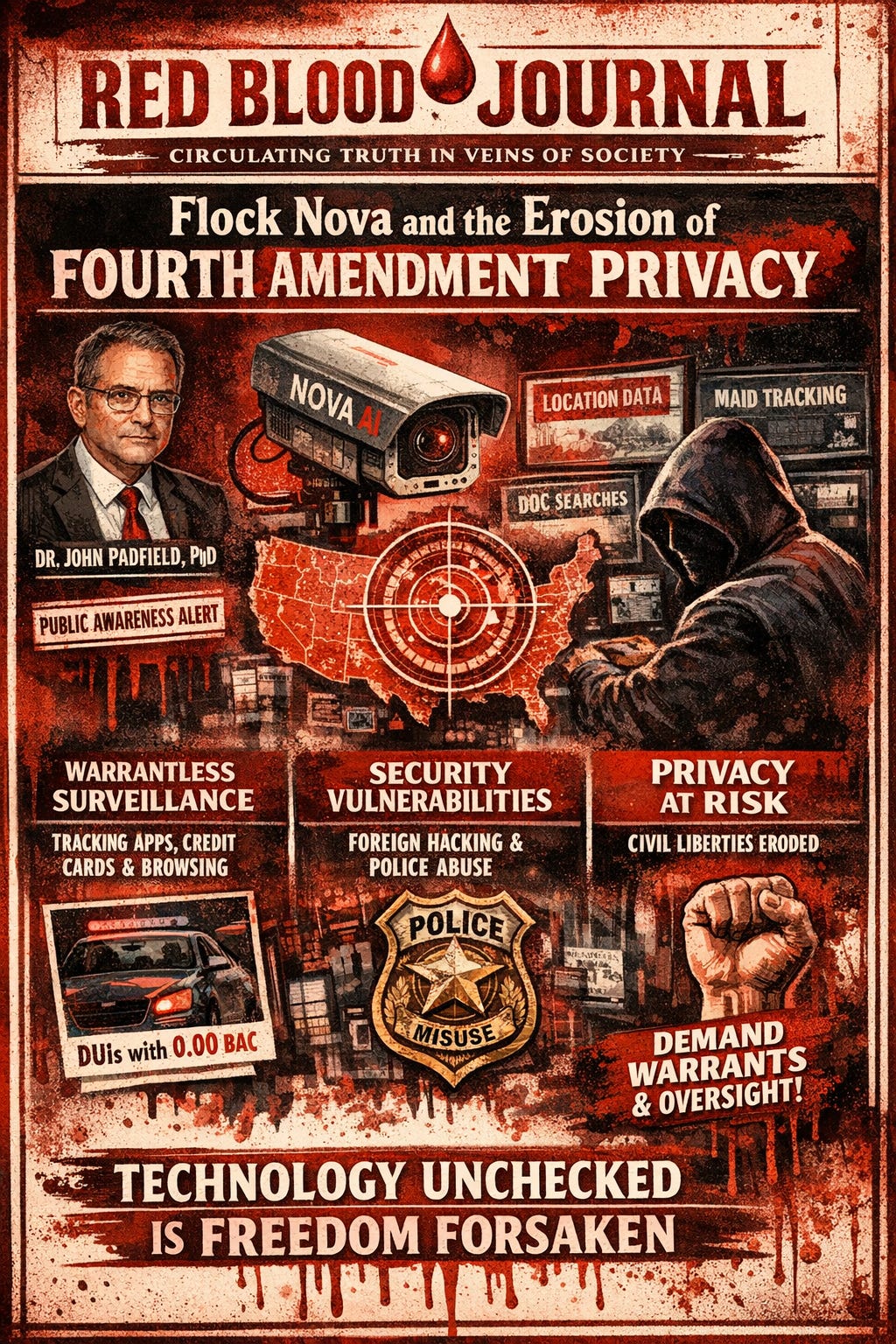
🩸Surveillance Erosion: Flock Nova and the Undermining of Fourth Amendment Protections
Report Issued By: 🩸 Red Blood Journal Transmission
Transmission Date: January 9, 2026
Author: Dr. John Padfield, PhD (Engineer, Former State Legislator, Business Professor)
Classification: Public Awareness Alert – Privacy and Civil Liberties
Source Material: Video Transcript Analysis (Original Runtime: Approx. 18:08)
Objective: This report synthesizes key findings from a detailed examination of modern surveillance technologies, focusing on Flock Safety’s Nova AI platform. It highlights constitutional concerns, potential vulnerabilities, and societal implications for U.S. citizens. All claims are derived from publicly available sources, researcher insights, and unverified screenshots provided by third-party security analyst Josh Michael. This transmission aims to foster informed public debate without endorsing or implying unlawful activities.
Executive Summary
Modern surveillance tools, exemplified by Flock Safety’s Nova platform, enable warrantless searches of location history, app usage, and online behavior across the U.S. This capability risks eroding Fourth Amendment protections against unreasonable searches and seizures. Key issues include:
Warrantless Access: Officers can “search once, see everything” without probable cause, potentially turning innocent individuals into suspects.
Data Scope: Integration of mobile advertising IDs (MAIDs), dark document searches (e.g., credit cards, IP addresses), and browsing histories reveals intimate personal details.
Security and Misuse Risks: Historical vulnerabilities and documented cases of law enforcement abuse underscore national security threats and privacy violations.
Lack of Consent: Deployment occurs without broad public debate, challenging democratic principles of governance.
This report calls for transparency, warrant requirements, and public oversight to safeguard civil liberties.
Background on Fourth Amendment Protections
The Fourth Amendment mandates warrants based on probable cause, describing specifics of searches to prevent broad, invasive inquiries. It shields Americans from government overreach, ensuring evidence of a specific crime precedes further investigation. However, advancing technologies like automated license plate readers (ALPRs) and AI-driven platforms are circumventing these safeguards, potentially ensnaring innocent people in legal entanglements.
Flock Safety and Nova Platform Overview
Flock Safety, despite its branding, holds a 2022 U.S. patent for a “dynamic surveillance network.” Its Nova AI tool, marketed as “search once, see everything,” integrates data from ALPR cameras, body-worn cameras, maps, arrests, and more. Upgrades are transforming static ALPRs into video-capable devices, expanding surveillance reach.
CEO Statement Analysis: On December 8, 2025, Flock CEO Garrett Langley asserted, “Flock has never been hacked, period.” This report examines contextual omissions, akin to selective historical narratives (e.g., RMS Titanic’s partial voyage account).
Researcher Collaboration: Insights stem from a December 3, 2025, interview with security researcher Josh Michael (anonymous in prior disclosures). Michael declined Flock’s HackerOne program to prioritize public awareness over compensation, citing national security concerns (e.g., proximity of Flock cameras to U.S. military bases and risks of foreign exploitation, as seen in the 2014 OPM hack).
Michael’s analysis relies on public documents, marketing materials, and demo screenshots (not independently verified). It does not allege wrongdoing but highlights contradictions in Flock’s claims.
Key Capabilities of Flock Nova (Based on Demo Analysis)
Nova’s interface allegedly allows broad, default nationwide searches (centered on the continental U.S. with a 1,500-mile radius), auto-populating reasons as “NOVA investigation.” Notable features include:
Search Options:
Map data, arrest records, body-worn camera footage, and vehicle tracking.
“New Dark Document Search”: Queries for sensitive identifiers like credit card numbers, crypto wallets, Discord/Telegram accounts, email/IP addresses, and Social Security numbers.
Mobile Advertising ID (MAID) Integration:
Links devices to app usage, in-app activities, ad interactions, physical locations, and browsing history.
Enables inference of user preferences, routines, and de-anonymization (e.g., identifying home/work locations).
Example: Counting visits to adult-oriented or escort-related websites, raising questions about investigative relevance and community expectations.
These tools invert due process: Officers access comprehensive data first, then assess suspicion, bypassing warrant requirements.
Security Vulnerabilities and National Risks
Michael reported multiple vulnerabilities to Flock from June to November 2025, including one acknowledged by their Product Security Director. Concerns include:
Potential foreign access to vehicle data of military personnel, inferring deployments or family vulnerabilities.
Historical precedents: 2014 OPM breach exposed federal employee data, including military records.
Flock’s response emphasized non-disclosure via HackerOne, which Michael rejected to ensure accountability.
Documented Misuse and Abuse Cases
While most officers act ethically, systemic failures enable exploitation:
Tennessee DUI Scandal (Updated Jan. 8, 2026): 2,547 arrests for DUI despite negative blood tests (0.00 BAC), linked to alleged quotas per former troopers and media investigations.
FBI Database Misuse: DOJ Inspector General report (2023) documented 278,000 unauthorized queries.
Flock-Specific Incidents:
Georgia police chief arrested for stalking/harassment via Flock cameras.
Eccles County secretary charged with eight counts of data misuse and stalking.
Sandy Springs officer terminated for aiding corporate espionage.
Florida officers arrested for stalking (one conducted 200+ unauthorized searches before detection).
These cases highlight inadequate safeguards, allowing repeated abuses without early intervention.
Broader Societal Implications
Surveillance proliferation by companies like Flock, Fog Data Science, Palantir, and others lacks public consent, echoing Thomas Jefferson’s emphasis on governance deriving from the governed. Without debate:
Erodes trust in institutions.
Risks repressive measures, as warned by President Harry S. Truman (1950): Silencing opposition leads to citizen fear.
Undermines revolutionary ideals from the Declaration of Independence and Constitution.
This report advocates for:
Mandatory warrants for intimate data access.
Transparent public hearings on surveillance deployments.
Enhanced oversight to prevent misuse.
Recommendations and Call to Action
Policy Reforms: Require probable cause for Nova-like searches; limit default scopes.
Public Engagement: Host debates on surveillance’s net societal impact.
Further Research: Upcoming reports on Flock’s patent and camera upgrades.
Community Input: Share objections or support in comments. Attend “Brush Fires of Freedom Tour” events (e.g., Fort Lauderdale, Feb. 2026; KY/TN/GA/AL, Spring 2026) via brushfirestour.com.
This transmission from 🩸 Red Blood Journal urges vigilance: Technology must serve freedom, not subvert it. Subscribe for updates on intersecting business, technology, and society issues.
End of Transmission
🩸 Red Blood Journal – Circulating Truth in Veins of Society
👁️Flock Nova and the Erosion of Fourth Amendment Privacy
This report from the Red Blood Journal examines the Flock Nova AI platform, arguing that its expansive surveillance capabilities threaten Fourth Amendment protections.
By integrating mobile advertising IDs, location history, and sensitive digital documents, the technology allows law enforcement to conduct warrantless searches that bypass traditional legal safeguards.
The author highlights security vulnerabilities and documented instances of police misconduct as evidence of the risks inherent in such centralized data networks.
Ultimately, the text serves as a public awareness alert, calling for greater transparency and oversight to prevent government overreach. It emphasizes that without mandatory warrants and public debate, modern surveillance tools may permanently erode individual privacy and democratic principles.


