


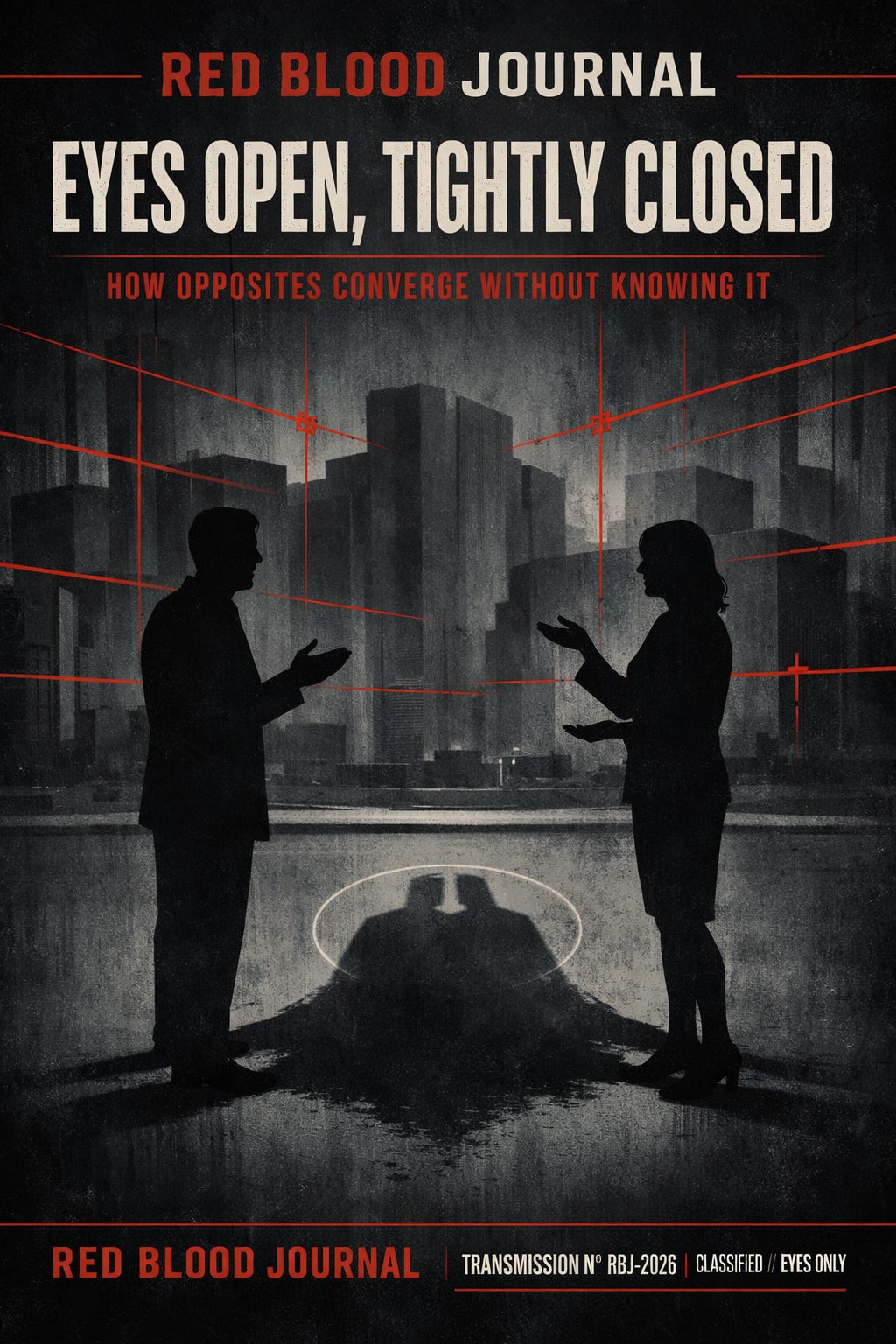
🩸 RED BLOOD JOURNAL TRANSMISSION
T#: RBJ–2026–SYNTHESIS-OF-OPPOSITION
Clearance: Open — For those willing to look without blinking
Desk: San Diego / Counterintelligence & Culture
Author: Red Blood Investigative Collective
EYES OPEN, TIGHTLY CLOSED
How Opposites Converge Without Knowing It
PROLOGUE — THE PARADOX OF OPPOSITION
In contemporary politics, spectacle routinely masquerades as substance. Conflict is broadcast, curated, and amplified — yet beneath the noise, the architecture of power remains remarkably consistent.
The dominant framing insists on a binary drama:
Left versus Right.
Globalist versus Populist.
Establishment versus Anti-Establishment.
The critical question is not who appears to be fighting, but what system ultimately benefits from the fight.
This transmission examines a disquieting convergence: prominent voices identified with “anti-establishment” conservatism — specifically Candace Owens and Tucker Carlson — often reproduce themes, assumptions, and political instincts that are structurally compatible with what is commonly labeled the “New World Order.”
The claim is not that these figures act with intent or coordination. The concern is structural alignment, not personal loyalty.
Eyes open.
Tightly closed.
Tucker Carlson and the Architecture of Control
SECTION I — THE SURFACE WAR
Owens and Carlson are widely perceived as insurgents within the American media ecosystem. They criticize corporate power, political elites, managerial liberalism, cultural engineering, and legacy institutions.
For large audiences, they function as:
Dissenting truth-tellers
Gatekeepers of acceptable rebellion
Guardians of tradition
Spokespeople for a besieged middle class
On the surface, their work appears to challenge centralizing, homogenizing, technocratic governance.
Yet surface politics is rarely where power ultimately operates.
SECTION II — THE DEEPER ALIGNMENT
When analysis shifts from rhetoric to direction — from what is said to what is implicitly legitimized — recurring patterns emerge.
1. Order Above All
Both figures consistently frame social disorder, cultural fragmentation, and institutional decay as existential threats. The implicit remedy, even when unstated, leans toward stronger centralized authority.
This logic aligns with the same foundations that justify:
Expanding surveillance regimes
Permanent national security infrastructure
Technocratic governance models
Behavioral regulation in the name of stability
The language may differ. The destination remains familiar.
2. Fear as a Political Technology
Modern politics across the spectrum relies heavily on managed anxiety. Owens and Carlson frequently invoke scenarios of:
Civilizational collapse
Cultural erasure
Moral extinction
Internal subversion
A population in constant apprehension becomes more governable, more deferential, and more willing to trade autonomy for reassurance. This dynamic is systemic, not incidental.
3. Centralized Morality
Both commentators advocate a return to “traditional values,” but often through frameworks that privilege top-down enforcement rather than organic community renewal.
This parallels a broader pattern in contemporary governance: a benevolent authoritarianism that defines permissible thought, acceptable speech, and legitimate dissent under the banner of moral order.
SECTION III — WHERE LEFT AND RIGHT MEET
The convergence of modern political factions does not occur at the level of ideology. It occurs at the level of function.
The mainstream left tends to expand:
Bureaucratic authority
Regulatory power
Technocratic oversight
The mainstream right tends to expand:
Security apparatuses
Surveillance mechanisms
Emergency powers
Distinct justifications mask a shared trajectory: the steady consolidation of centralized control.
Within this framework, figures like Owens and Carlson can oppose global elites rhetorically while still reinforcing the psychological and political conditions that make a globally integrated control system viable.
This is not betrayal. It is convergence.
SECTION IV — THE MASSAYAH PROBLEM
The invocation of the “Massayah” (Messiah) operates not merely as religious metaphor but as an enduring structural pattern in political life.
Across history, societies under stress have gravitated toward savior figures — divine, political, or technological. In the present moment, the “Messiah” takes a secular form: a system that promises safety, coherence, and unity in exchange for diminished autonomy.
This emerging order offers:
Stability over freedom
Security over independence
Unity over individuality
Media figures across ideological lines — whether aware or not — can prepare the public for this bargain by normalizing:
Total visibility
Total accountability
Total governance
The architecture of control does not require universal agreement. It requires managed opposition — resistance that appears real while remaining safely contained.
Controlled resistance remains control.
SECTION V — WHY THIS MATTERS
If this analysis holds, the defining struggle of the present era is not Left versus Right.
It is Human Autonomy versus Systemic Totality.
Owens and Carlson, within this frame, are not villains. They are influential nodes in a larger ecosystem — intelligent, charismatic, persuasive, yet ultimately constrained by the gravity of the system they inhabit.
They articulate opposition to power.
They do not fully escape its pull.
That tension defines the trap.
SECTION VI — COUNTERINTELLIGENCE NOTE
The most effective form of domination is not overt coercion. It is consent engineered through controlled opposition.
When both sides of a public conflict move the chessboard in the same direction, the game remains fixed.
Identifying that convergence — the joint in the armor — marks the beginning of serious analysis rather than partisan reflex.
EPILOGUE — EYES OPEN
Most citizens approach politics with alert eyes and closed frameworks. This transmission takes the opposite posture: scrutinizing structure rather than spectacle, outcome rather than narrative.
The task is not allegiance to left or right, but vigilance toward the system they collectively sustain.
👁️The Architecture of Controlled Opposition
“The Architecture of Controlled Opposition” argues that figures like Tucker Carlson and Candace Owens reinforce centralized power.
By using fear-based rhetoric and prioritizing social order, they normalize systemic control and erode human autonomy despite their dissent.


