


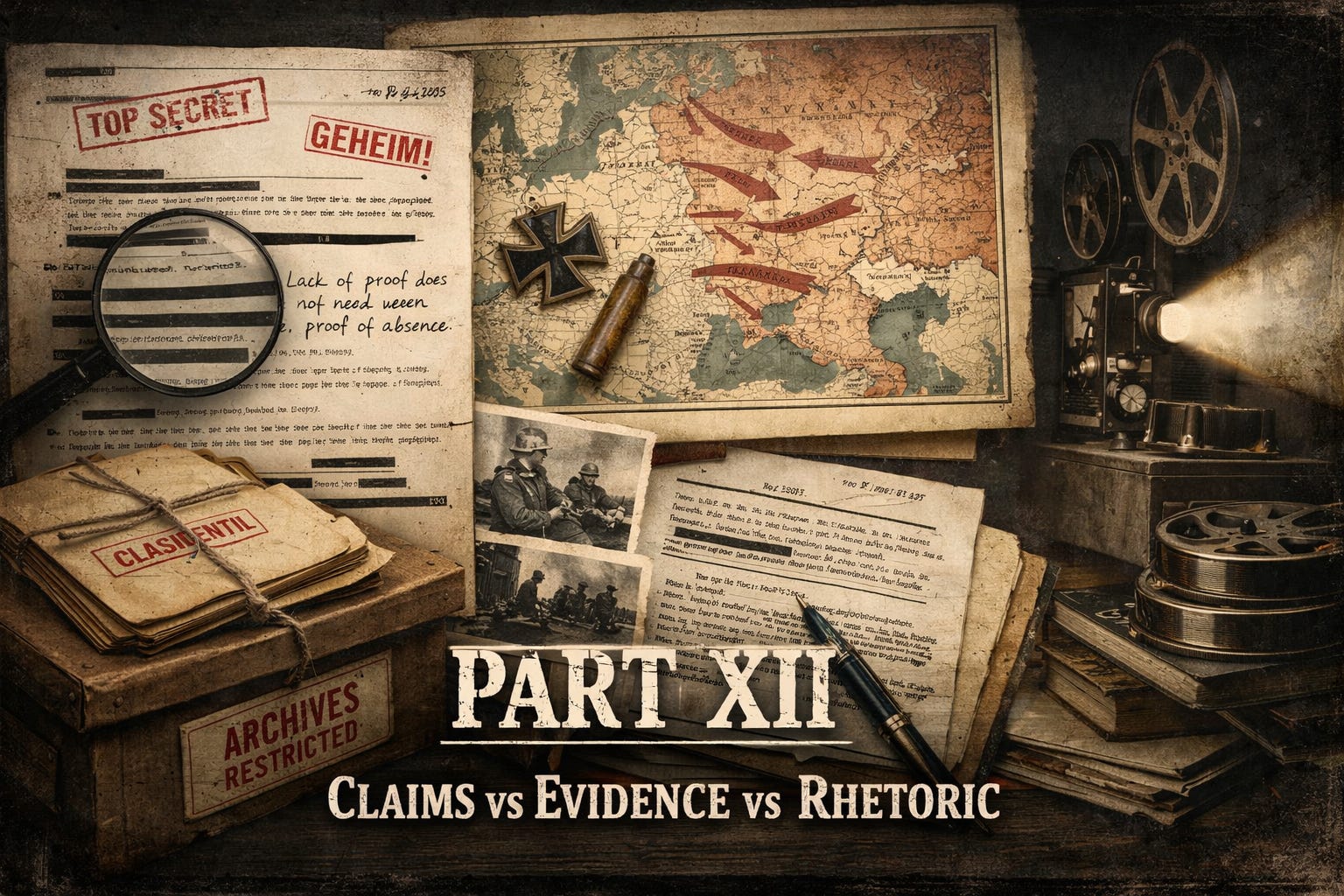
🩸 RED BLOOD JOURNAL — TRANSMISSION
T#EUROPA–PART–XII-EUROPA THE LAST BATTLE
Title: CLAIM, EVIDENCE, RHETORIC
Subhead: A Structured Analytical Review of Europa: The Last Battle — With the Archive Constraint in Mind
Classification: Documentary Claim Review / Rhetorical Deconstruction
Method: Claims are summarized accurately, tested against accessible records, and examined for rhetorical construction — without treating “lack of proof” as proof of absence where archives are constrained.
EDITORIAL METHOD (READ FIRST)
This section applies three parallel lenses to the material:
What the film claims (presented in the film’s own arc)
What can be corroborated, contested, or remains inaccessible (given sealed, redacted, or destroyed records)
How the argument is constructed rhetorically (language, framing, emotional leverage)
Critical constraint:
Where records are unavailable or curated, the analysis does not dismiss claims solely for lack of proof. Instead, it asks whether the claim is plausible, overextended, or unsupported by method given what is accessible.
I. CORE CLAIM CLUSTER A — PERSONAL RELATIONSHIPS & EXCEPTIONS
What the film claims
Hitler distinguished between Jews as individuals and Jews as a political/ideological threat.
Select Jewish individuals received protection, favor, or exception (e.g., physicians, artists, veterans, soldiers of partial Jewish ancestry).
This indicates policy inconsistency incompatible with a purely racial extermination thesis.
Evidence status
Documented overlaps:
Individual exceptions and protected persons are attested in memoirs, correspondence, and later scholarship on Mischlinge (people of partial Jewish ancestry) and administrative exemptions.
Cultural patronage and personal preferences are documented (e.g., composers, artists).
Constraints:
The existence of exceptions does not, by itself, define system-wide intent.
Administrative chaos and contradictory directives complicate clean inference.
Analytical note
Exceptions do exist in complex systems. Their presence challenges absolutist narratives, but does not alone determine overarching policy motives.
Rhetorical construction
The film uses exceptions as proof of general intent, a reversal that risks overreach.
Methodologically sound use would be: exceptions complicate claims, not exceptions negate outcomes.
II. CORE CLAIM CLUSTER B — LANGUAGE, TRANSLATION & CONCEPTUAL FRAMING
What the film claims
Terms like “master race,” “Lebensraum,” and “Untermensch” are mistranslated or redefined post-war to maximize moral condemnation.
Original meanings are framed as self-mastery, national autonomy, or ideological opposition rather than biological supremacy.
Evidence status
Documented overlaps:
Translation choices matter; some terms carry multiple meanings across contexts.
Post-war popularization simplified complex ideological language.
Constraints:
Original-language usage varied by speaker, time, and audience.
Selective quotation can sanitize harsher applications documented elsewhere.
Analytical note
Semantic disputes are legitimate. They weaken caricatures, but they do not erase the effects of policy implementation.
Rhetorical construction
The film performs semantic narrowing (choosing benign meanings) while underweighting documented coercive outcomes.
This is a framing choice, not proof.
III. CORE CLAIM CLUSTER C — RACE, NATIONALISM & COMPARATIVE LAW
What the film claims
National self-preservation policies existed globally (including in democracies).
Singling out Germany constitutes a double standard.
Nationalism is reframed as diversity-preserving rather than supremacist.
Evidence status
Documented overlaps:
Comparative immigration, citizenship, and marriage laws existed worldwide in the era.
Nationalism is not monolithic and appears across political systems.
Constraints:
Legal equivalence does not equal moral or practical equivalence.
Outcomes and enforcement differ substantially by regime and context.
Analytical note
Comparative law contextualizes but does not exculpate. It invites proportional analysis, not absolution.
Rhetorical construction
The film uses whataboutism to dilute singular focus.
This can expose hypocrisy or obscure specificity, depending on application.
IV. CORE CLAIM CLUSTER D — COMMUNISM, PREEMPTION & THE EASTERN FRONT
What the film claims
The Soviet Union prepared an offensive war against Europe.
Germany’s eastern campaign is framed as preemptive.
Local populations initially welcomed German forces as relief from Soviet terror.
Evidence status
Documented overlaps:
Soviet repression, deportations, and terror are well established.
Offensive Soviet planning has been argued by multiple authors using post-1991 archival releases.
Constraints:
Intentionality and timing remain debated among specialists.
Selective testimony cannot substitute for comprehensive operational records.
Analytical note
Preemption arguments are plausible within constrained archives but remain contested. The absence of definitive proof cuts both ways.
Rhetorical construction
The film stacks testimony and selected documents to create inevitability framing.
This increases narrative force but reduces falsifiability.
V. CORE CLAIM CLUSTER E — VOLUNTEERS, MULTINATIONAL FORCES & MOTIVE
What the film claims
Large numbers of non-Germans fought alongside Germany, indicating ideological alignment against communism rather than racial supremacy.
Evidence status
Documented overlaps:
Multinational formations and volunteers existed.
Constraints:
Motives ranged widely: coercion, survival, local politics, ideology, opportunism.
Analytical note
Participation does not equal endorsement of the entire system. Motive heterogeneity must be preserved.
Rhetorical construction
The film collapses diverse motives into a single moral alignment, simplifying complexity.
VI. RHETORICAL ESCALATION — WHERE ANALYSIS MUST STOP SHORT
Across Part XII, the documentary increasingly:
replaces institutional analysis with identity attribution,
substitutes moral inversion for causal explanation,
and shifts from critique of power to totalizing blame.
This is not an evidentiary move; it is a narrative acceleration.
Important distinction:
Recognizing rhetorical escalation does not validate official history.
It identifies a methodological failure within the counter-narrative.
VII. THE ARCHIVE CONSTRAINT — APPLYING THE CAVEAT
Because:
key records remain sealed,
others were destroyed or selectively released,
and post-war narratives hardened early,
lack of proof cannot be treated as proof of absence.
However:
lack of method cannot be replaced by certainty.
Plausibility is not proof; neither is dismissal.
The correct stance is conditional openness:
open to alternative explanations,
resistant to absolutist conclusions.
VIII. WHAT PART XII ACTUALLY CONTRIBUTES
It challenges simplifications in official narratives.
It demonstrates how counter-narratives can overcorrect.
It exposes the danger zone where skepticism turns into doctrine.
CLOSING NOTE TO THE READER
Part XII does not ask you to believe.
It asks you to hold multiple possibilities without surrendering judgment.
Where records are hidden, suspicion is rational.
Where language replaces evidence, restraint is required.
This is not neutrality as avoidance.
It is neutrality as method under constraint.
🩸 END TRANSMISSION — PART XII
⚖️Exposing Rhetoric in Revisionist History
This document provides a structured analytical deconstruction of the documentary Europa: The Last Battle, focusing specifically on its rhetorical strategies and evidentiary claims.
The analysis examines how the film uses individual exceptions, semantic shifts, and comparative law to challenge traditional historical narratives while cautioning that these methods often rely on logical overreach.
By acknowledging archival constraints and the loss of historical records, the text argues that while skepticism toward official accounts is a rational response to curated information, it should not be replaced by a new, equally inflexible doctrine.
The source ultimately serves as a methodological critique, urging readers to maintain conditional openness and intellectual restraint when navigating conflicting historical interpretations.
It highlights the tension between legitimate historical inquiry and the tendency of counter-narratives to simplify complex motives into singular moral conclusions.


