


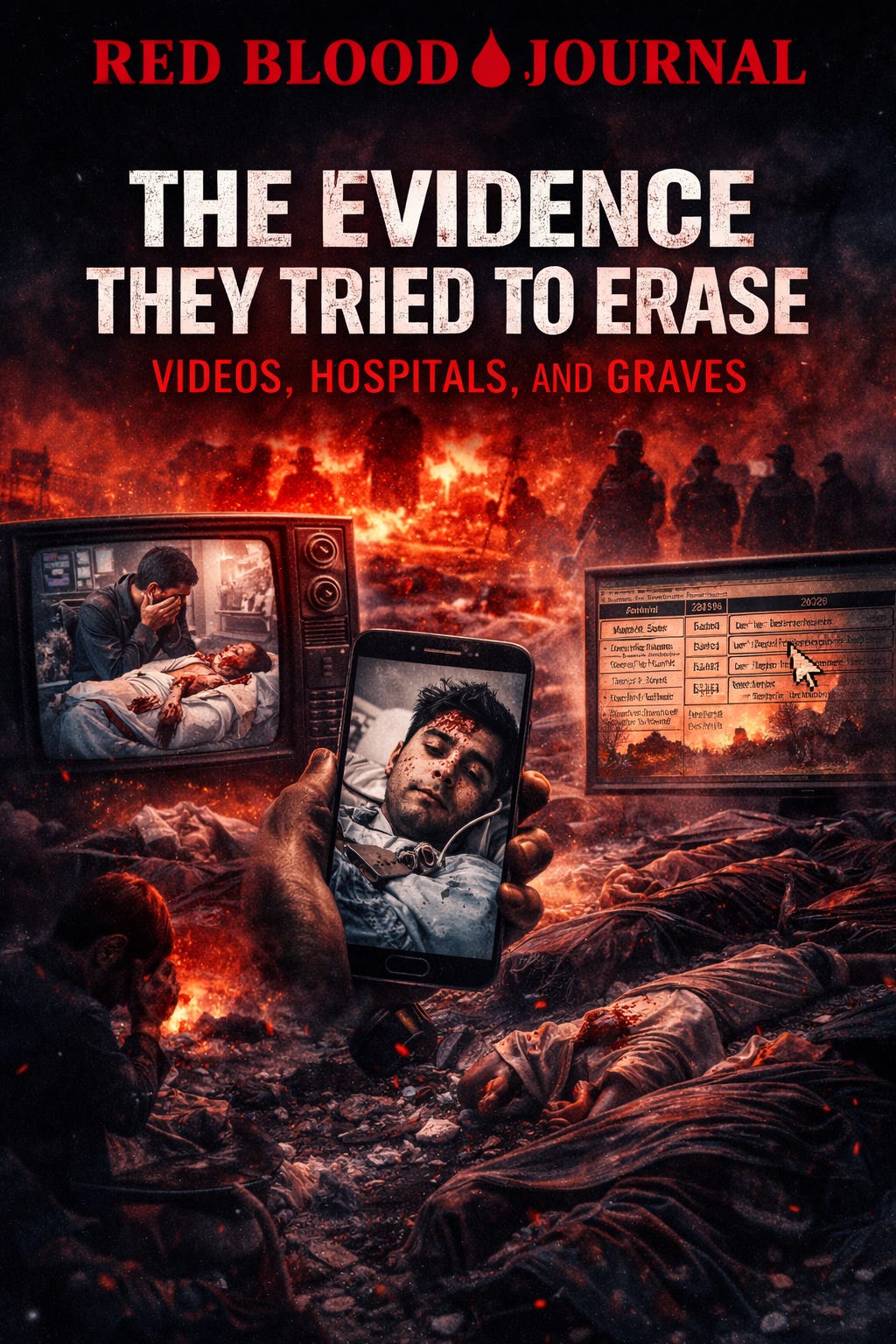
🩸 RED BLOOD JOURNAL TRANSMISSION
T#: RBJ-2026–EVIDENCE-ARCHIVE
Title: The Evidence They Tried to Erase: Videos, Hospitals, and Graves
Classification: Forensic Narrative Warfare
Threat Vector: State Crime, Evidence Suppression, Digital Memory
Clearance: Open — For Those Who Trust Their Eyes More Than Official Words
PROLOGUE — WHEN THE DEAD SPEAK
A regime does not fear protesters.
It fears evidence.
Bullets can be fired.
Bodies can be buried.
Families can be threatened.
But images — once seen — cannot be un-seen.
The Islamic Republic did not merely kill.
It tried to control memory itself.
This transmission is not emotion.
It is documentation.
Not accusation — but reconstruction from the traces that survived.
Videos, medical footage, and cemetery records became the battlefield after the massacre.
And that is where the regime lost.
SECTION I — THE FIRST WITNESSES: MOBILE PHONES
On the night of the 18th of Dey, as gunfire echoed through cities, ordinary Iranians did what they have always done in moments of truth: they recorded.
Short, shaky videos began to circulate despite internet shutdowns:
Streets filled with bodies.
People dragging the wounded toward cars.
Mothers screaming for their sons.
Fathers collapsing beside lifeless children.
Some videos showed young people lying face-down in blood.
Others captured the sounds: distant shots, sirens, crying, chaos.
These were not staged.
They were raw, imperfect, terrifyingly real.
The regime’s immediate reaction was predictable:
Censorship first. Punishment second.
Within hours:
Internet was cut.
Social media platforms were blocked.
Sharing videos was declared a criminal offense.
Translation:
“If you show what we did, you are the criminal.”
But by then, fragments of truth had already escaped.
SECTION II — THE HOSPITALS: WHERE LIES COLLIDED WITH REALITY
While state TV spoke of “terrorists,” hospitals told a different story.
Doctors and nurses — under surveillance — treated wave after wave of wounded civilians:
Gunshot wounds to the chest.
Bullet holes in heads.
Bodies still connected to IV lines and medical equipment.
Some videos later emerged showing:
Corridors overflowing with injured.
Families searching desperately room by room.
Medical staff whispering because they were afraid of being recorded.
Witnesses reported that:
Security forces interrogated doctors.
Some medical professionals were threatened for “helping rioters.”
Families were warned not to speak publicly.
Instead of protecting healers, the state treated them like accomplices.
The unspoken message was clear:
If you save them, you are against us.
This is not how a government behaves under “terrorist attack.”
This is how a government behaves after a massacre.
SECTION III — THE BODIES: WHAT THE CAMERA REFUSED TO FORGET
Perhaps the most devastating evidence came from videos of the dead.
Iranians, using VPNs and satellite internet, began seeing footage that many had missed in the blackout:
Piles of bodies wrapped in cloth.
Parents identifying children by shoes or clothing.
Young men with gunshot wounds to the forehead — execution-style.
Victims still wearing medical tubes, proving they died in or after treatment.
One widely circulated clip showed a father wandering through a hospital, repeating his son’s name, unable to comprehend that he was gone.
Another showed volunteers carefully laying bodies on the ground in rows, overwhelmed by the scale.
These images shattered the “terrorist” narrative more effectively than any speech.
You cannot call a 16-year-old with a bullet in his skull a foreign agent.
SECTION IV — THE GRAVES THAT EXPOSED THE TRUTH
If hospitals were sites of pain, cemeteries became archives of proof.
In the days following the killings, online cemetery records briefly displayed:
Names of the dead
Grave plot numbers
Dates and times of burial
What appeared was staggering:
Dozens of burials per day in multiple cities.
Mass graves in effect, if not in name.
Observers noted something chilling:
Thousands of black shrouds had already been prepared.
Prepared for what?
For “terrorists”?
Or for citizens the state already planned to kill?
Then — suddenly — the records vanished.
Cemetery websites went offline.
Public databases were removed.
Access was restricted.
Erasing data does not erase reality.
It only proves fear of it.
SECTION V — THE REGIME’S COUNTER-NARRATIVE — AND ITS COLLAPSE
Faced with undeniable evidence, the state attempted three strategies:
1. Deny
Claim that most deaths were caused by “terrorists,” not security forces.
2. Distract
Flood media with patriotic programming, parades, and entertainment instead of mourning.
3. Delete
Remove digital traces — videos, hospital leaks, cemetery records.
But evidence does not disappear so easily.
Copies spread.
Screenshots circulated.
Families remembered.
The more the regime tried to hide, the more suspicious it looked.
SECTION VI — WHAT THE EVIDENCE REVEALS
Taken together, the evidence forms a coherent picture:
Mobile videos prove live gunfire against civilians.
Medical footage confirms lethal wounds treated in hospitals.
Cemetery records demonstrate scale and speed of deaths.
Prepared shrouds suggest premeditation or at least anticipation.
This is not chaos.
It is systemic violence.
Not random.
Not accidental.
Not foreign.
State-directed.
SECTION VII — WHY EVIDENCE MATTERS
Regimes fall not only by force — but by exposure.
The Islamic Republic understood this, which is why it fought so hard to control images.
Because once a society sees its own children lying dead in the streets, something breaks permanently.
Fear dissolves.
Obedience cracks.
Silence becomes impossible.
The massacre did not just create victims — it created witnesses.
Millions of them.
COUNTERINTELLIGENCE NOTES
A state that bans videos is a state that knows it is guilty.
A government that interrogates doctors fears the truth.
A regime that deletes graves is afraid of memory.
Evidence is the most dangerous weapon in a dictatorship.
DEEP PATTERN ANNEX — THE WAR OVER MEMORY
This was not only a war over territory or power.
It was a war over reality.
Bullets were fired in the streets.
But the real battle was fought in:
smartphones
hospital corridors
cemetery databases
The regime tried to kill evidence.
The people kept it alive.
CLOSING TRANSMISSION — THE INDELIBLE RECORD
They can silence journalists.
They can shut down the internet.
They can rewrite textbooks.
But they cannot erase what was seen.
The videos remain.
The medical scars remain.
The graves remain.
And so does the truth.
🩸 END OF TRANSMISSION — LET THE RECORD STAND.
👁️Red Blood Journal:
The Architecture of Evidence
This document analyzes the Islamic Republic’s systematic efforts to suppress evidence following a violent state-led massacre of its citizens.
By examining mobile phone footage, medical records, and cemetery data, the text reconstructs how the regime attempted to manipulate collective memory through internet blackouts and the intimidation of healthcare workers.
Despite state-sponsored censorship and the deletion of digital archives, the source argues that raw documentation captured by ordinary people provides irrefutable proof of premeditated violence.
Ultimately, the narrative highlights a war over reality, where the survival of grassroots evidence serves as a powerful weapon against government denial and historical erasure.
The archive concludes that while bodies can be buried, the indelible records of state crimes continue to fuel resistance by exposing the truth to the world.


