


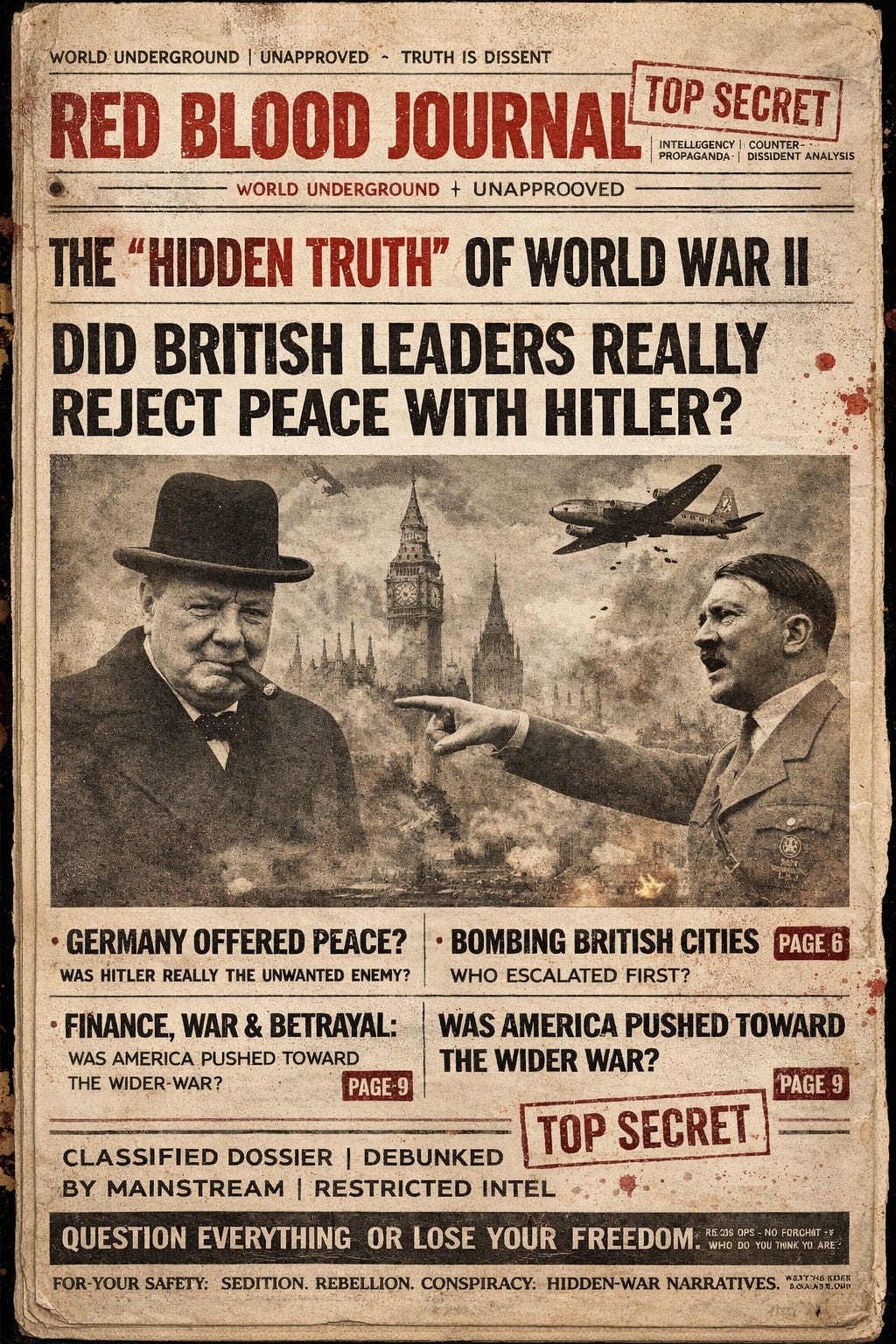
🩸 RED BLOOD JOURNAL — TRANSMISSION
T#EUROPA–HIDDEN–WAR–NARRATIVE
Classification: Historical Revisionism / Psychological Warfare
Distribution: Open Archive (Contextualized)
Subject: Europa: The Last Battle — The Counter-Narrative That Refuses to Die
PROLOGUE — THE WAR BENEATH THE WAR
Every empire writes its war as necessary.
Every victor writes history as inevitable.
But beneath official timelines, another current persists—
a narrative that insists the Second World War was not inevitable,
that peace was possible,
and that its failure was engineered.
The documents summarized in the provided images represent one of the most controversial hidden-war narratives of the 20th century—popularized in underground documentaries, banned broadcasts, and de-platformed archives.
This transmission does not ask you to believe it.
It asks you to understand it.
I. THE CORE CLAIM — “PEACE WAS REFUSED”
At the heart of this narrative is an accusation aimed squarely at Winston Churchill:
That Britain’s leadership rejected peace deliberately, even when Germany allegedly sought it.
According to the claim-set:
Germany, via Italian mediation, floated peace overtures after the fall of France
These overtures were ignored or suppressed
British leadership allegedly used fear (chemical weapons, invasion hysteria) to override domestic peace sentiment
Hidden-war interpretation:
Peace threatened elite war aims more than war threatened Britain.
Mainstream rebuttal (for context):
Historians argue Nazi “peace offers” were tactical, not sincere, and incompatible with British sovereignty.
II. HITLER AS THE UNWANTED ENEMY (REVISIONIST FRAME)
One of the most incendiary components of this narrative reframes Adolf Hitler not as a peacemaker, but as:
Focused on Eastern Europe
Reluctant to fight Britain
Attempting to keep the British Empire intact
Cited examples include:
Peace leaflets over Britain (1940)
Public statements distinguishing Britain from continental enemies
Why this matters:
This framing inverts the moral polarity of WWII leadership and is why the narrative is so aggressively suppressed.
Critical note:
This interpretation omits Nazi ideology, expansionism, and documented long-term plans—hence its rejection by mainstream scholarship.
III. THE BOMBING THRESHOLD — WHO ESCALATED?
A central allegation is that:
Britain initiated civilian bombing to force escalation.
Claims include:
Early RAF raids on German cities before the Blitz
Strategic intent to provoke retaliation
Use of escalation to break internal peace movements
The Blitz, in this framing, becomes not a German initiative—but a reaction.
Hidden-war logic:
Civilian suffering was politically useful.
Historical consensus:
Both sides escalated; civilian bombing became mutual, industrialized warfare.
IV. THE HESS VARIABLE — THE PEACE THAT VANISHED
The flight of Rudolf Hess to Scotland in 1941 is treated by this narrative as:
A genuine, unauthorized peace mission
Evidence that internal German factions sought settlement
Proof that peace channels existed and were sealed shut
Hess’s imprisonment and silencing is interpreted as:
The burial of the last off-ramp.
V. AMERICA, FINANCE, AND THE WIDER WAR
The narrative then widens its scope to the United States and Franklin D. Roosevelt, alleging:
Deliberate steering of the U.S. toward war
Financial and institutional interests overriding public neutrality
Ideological tolerance of Soviet power as a counterweight
This strand blends financial critique, geopolitics, and Cold War foreshadowing—and is often where legitimate analysis becomes entangled with speculative or biased assertions.
VI. THE DANGEROUS ZONE — WHERE CRITIQUE BECOMES CONTAMINATED
Some versions of this narrative cross a critical line:
Attributing policy outcomes to ethnic or religious identity
Conflating financial power with collective groups
Replacing institutional critique with demographic blame
🛑 Red Blood Journal Position:
Power must be analyzed structurally, not ethnically.
When critique shifts from systems to groups, truth collapses into propaganda.
VII. WHY THIS NARRATIVE PERSISTS
Despite rejection by mainstream academia, this “hidden truth” endures because it speaks to unresolved questions:
Why was compromise impossible?
Who benefits most from total war?
How often are populations marched into catastrophe “for their own good”?
These are legitimate questions, even when some answers offered are flawed.
CONCLUSION — THE REAL HIDDEN TRUTH
The most important revelation is not whether this narrative is right or wrong.
It is this:
War narratives are weapons.
Silence is strategy.
And history is never settled—only enforced.
The task is not to swap one myth for another,
but to audit power without illusion,
and to recognize when “necessary war” becomes unquestionable dogma.
🩸 END TRANSMISSION
📔 Europa: The Last Battle — The Counter-Narrative That Refuses to Die
The provided text outlines a revisionist historical perspective regarding the origins and conduct of World War II.
This counter-narrative suggests that the global conflict was artificially engineered and that multiple opportunities for peaceful resolution were intentionally ignored by Allied leadership.
Central to this claim is the idea that Winston Churchill and Franklin D. Roosevelt prioritized total war and specific institutional interests over diplomatic settlements.
The document further explores controversial theories regarding the escalation of civilian bombing and the mysterious peace mission of Rudolf Hess.
While acknowledging these views are largely rejected by mainstream academia, the source argues that official histories are often used as tools of psychological warfare to enforce specific political dogmas.
Ultimately, the text serves as an analysis of how alternative war narratives persist as a challenge to established historical consensus.


