


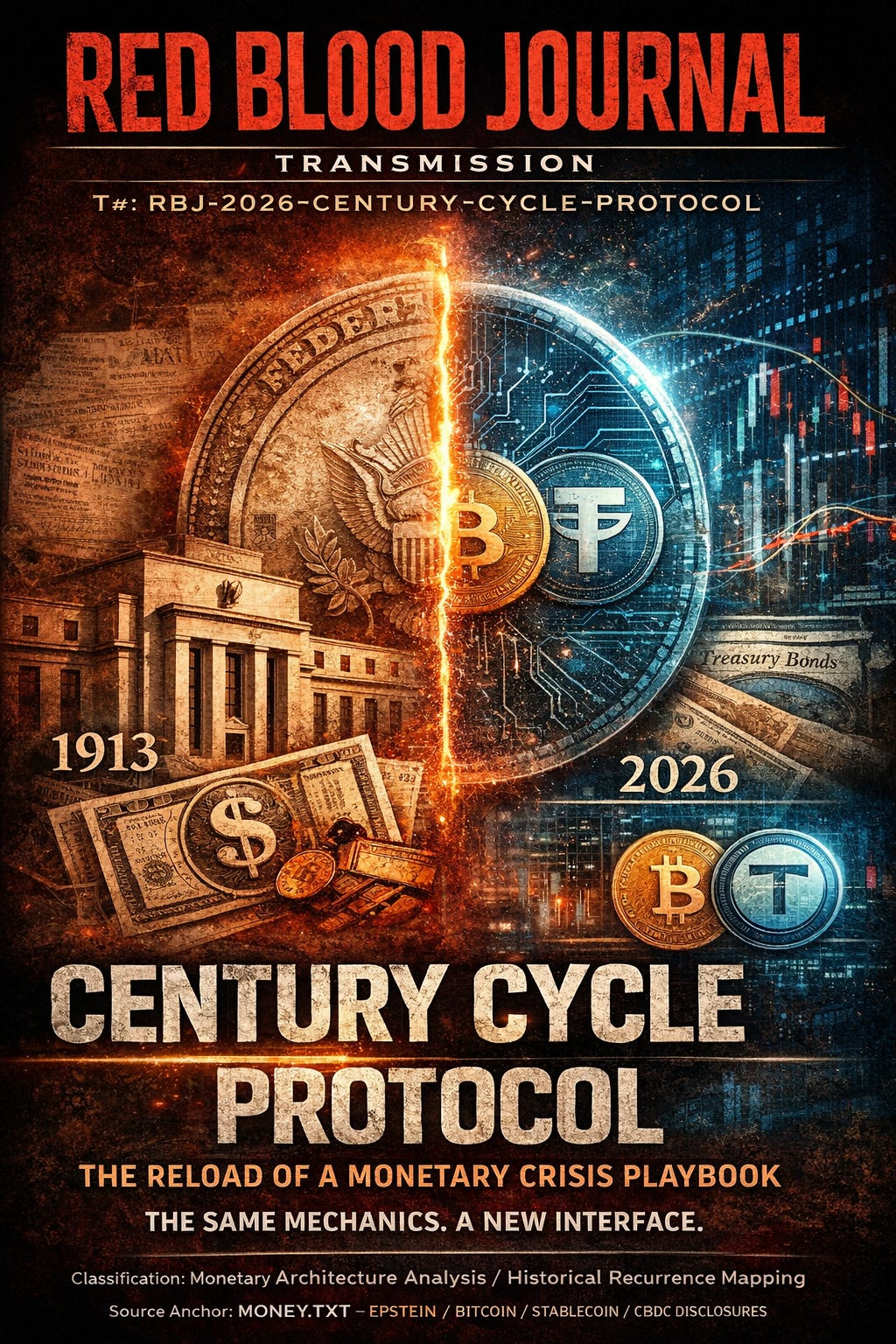
🩸 RED BLOOD JOURNAL TRANSMISSION
T#: RBJ-2026-CENTURY-CYCLE-PROTOCOL
Classification: Monetary Architecture Analysis / Historical Recurrence Mapping
Status: Investigative Documentary Transmission
Source Anchor: Money.txt — Epstein / Bitcoin / Stablecoin / CBDC disclosures
Money
PROLOGUE — 1913 WAS NOT THE END
In 1913, the monetary architecture of the United States was permanently altered with the creation of the Federal Reserve.
The public was told it was stabilization.
Liquidity.
Modernization.
The reality was structural:
Money creation moved from direct democratic oversight into a hybrid public-private banking system tied to debt issuance.
More than a century later, the same architecture is being rebuilt — digitally.
Not through printing presses.
Through code.
I — 1913: THE ORIGINAL PLAYBOOK
The Federal Reserve Act followed a familiar crisis rhythm:
Financial Panic (1907)
Public Fear of Instability
Closed-Door Policy Drafting
Centralization of Monetary Power
Debt-Based Currency Expansion
The result:
Currency tied to Treasury issuance
Banking sector consolidation
Long-term political leverage via control of liquidity
The genius of the 1913 design was not immediate domination.
It was time.
A 100-year leverage horizon.
II — 2008: THE OPENING OF A DIGITAL WINDOW
Fast forward.
The 2008 financial collapse shook trust in banks.
Out of that collapse came Bitcoin — peer-to-peer digital cash.
The white paper proposed an alternative:
No central authority
Fixed supply
Low-cost transactions
Parallel to Visa-level scalability
But by 2017, something shifted.
As documented in the attached file
Money
:
Transaction fees spiked
Bitcoin narrative shifted from currency to digital gold
Developer funding pipelines changed hands
MIT began funding core developers
Jeffrey Epstein’s financial involvement surfaced
The file outlines how funding, narrative shaping, and infrastructure throttling converged around 2015–2017
Money
.
The decentralized alternative was neutralized.
Not destroyed.
Redirected.
Just as the 1913 system did not abolish markets —
It re-channeled them.
III — THE DIGITAL RESERVE STRUCTURE
From the file’s disclosures:
Epstein funded MIT developers
Money
Blockstream benefited from constrained Bitcoin block sizes
Tether allegedly issued unbacked stablecoins during price surges
Money
Cantor Fitzgerald later secured management of Treasury backing for stablecoins
Money
Enter:
Jeffrey Epstein
Brock Pierce
Howard Lutnick
MIT
The file describes a convergence:
Bitcoin throttled.
Stablecoins rise.
Stablecoins required to hold U.S. Treasuries.
Treasury demand increases.
Government debt absorbs digital liquidity.
The Genius Act, referenced in the source, mandates Treasury backing for stablecoins
Money
.
In 1913, currency issuance required Treasury bonds.
In 2026, digital tokens require Treasury bonds.
Same engine.
New interface.
IV — THE CENTURY LOOP
1913 Model:
Private banking consortium
Currency backed by government debt
Long-term expansion through interest-bearing issuance
2026 Model:
Private stablecoin issuers
Tokens backed by government debt
Digital compliance embedded via regulation
The file’s commentary frames this as a “backdoor CBDC”
Money
— not a direct Federal Reserve digital dollar, but a functionally equivalent architecture:
Programmable
Trackable
Treasury-dependent
Politically integrated
The difference?
1913 required paper and telegraph lines.
2026 requires blockchain and compliance APIs.
V — THE SIMILARITIES
19132026Panic used as catalyst2008 collapse as catalystMonetary reform framed as stabilityCrypto reform framed as clarityDebt-backed currencyTreasury-backed stablecoinsCentralized liquidity controlDigitally centralized token regulationCentury-long political leverageDigital century projection
The file emphasizes how stablecoins processed $33 trillion in transactions in one year
Money
.
If stablecoins become the global digital settlement layer — and they must hold Treasuries — then:
U.S. debt becomes digitally inescapable.
That is not a side effect.
That is design continuity.
VI — POLITICAL CONTROL MECHANICS
The original Federal Reserve model allowed:
Credit expansion in war
Liquidity contraction in recession
Interest rate steering of political cycles
The new digital framework adds:
Transaction-level traceability
Real-time freezing capability
Asset tokenization (Clarity Act trajectory referenced in source
Money
)
Integrated compliance protocols
1913 gave leverage over money supply.
2026 potentially gives leverage over:
Individual transactions
Asset ownership tokens
Digital access to liquidity itself
This is not merely central banking.
This is monetary infrastructure governance.
VII — THE NEXT HUNDRED YEARS
The Federal Reserve took decades to consolidate power.
The digital framework could scale globally in under ten years.
If:
Stablecoins dominate global settlement
Treasuries back those stablecoins
Regulation centralizes issuance
Digital assets become tokenized under surveillance architecture
Then the 1913 model has been upgraded.
Not dismantled.
Upgraded.
CONCLUSION — THE BOSS NEVER LEFT
The narrative of 1913 was stabilization.
The narrative of 2026 is innovation.
But structurally, the mechanisms rhyme:
Redirect crisis energy.
Centralize monetary rails.
Tie liquidity to government debt.
Expand influence quietly.
Lock in generational leverage.
The question is not whether the Federal Reserve was created.
The question is whether the digital system being built now is its successor architecture — designed for another hundred-year political horizon.
The file suggests fingerprints.
Money
The parallels suggest pattern.
The reader can decide whether this is coincidence —
Or continuity.
🩸 End Transmission
⛓️The Century Loop:
Digital Continuity of Monetary Architecture
This analysis explores the historical parallels between the 1913 creation of the Federal Reserve and the modern emergence of a digital monetary architecture.
The text argues that just as the original banking system used a financial crisis to centralize power through debt-backed currency, current regulations are steering decentralized technology toward a Treasury-dependent framework.
By mandating that stablecoins be backed by government debt, authorities are effectively creating a digital reserve system that preserves state control over global liquidity.
The source suggests that influential figures and institutions have systematically neutralized Bitcoin’s independence, redirecting it to serve as a high-tech interface for existing political leverage.
Ultimately, this “Century Loop” represents an upgrade rather than a replacement of central banking, ensuring that U.S. debt remains the foundation of the global economy for another hundred years.
Through programmable compliance and real-time surveillance, this new digital era offers even greater governance over individual transactions and asset ownership than its predecessor.


