


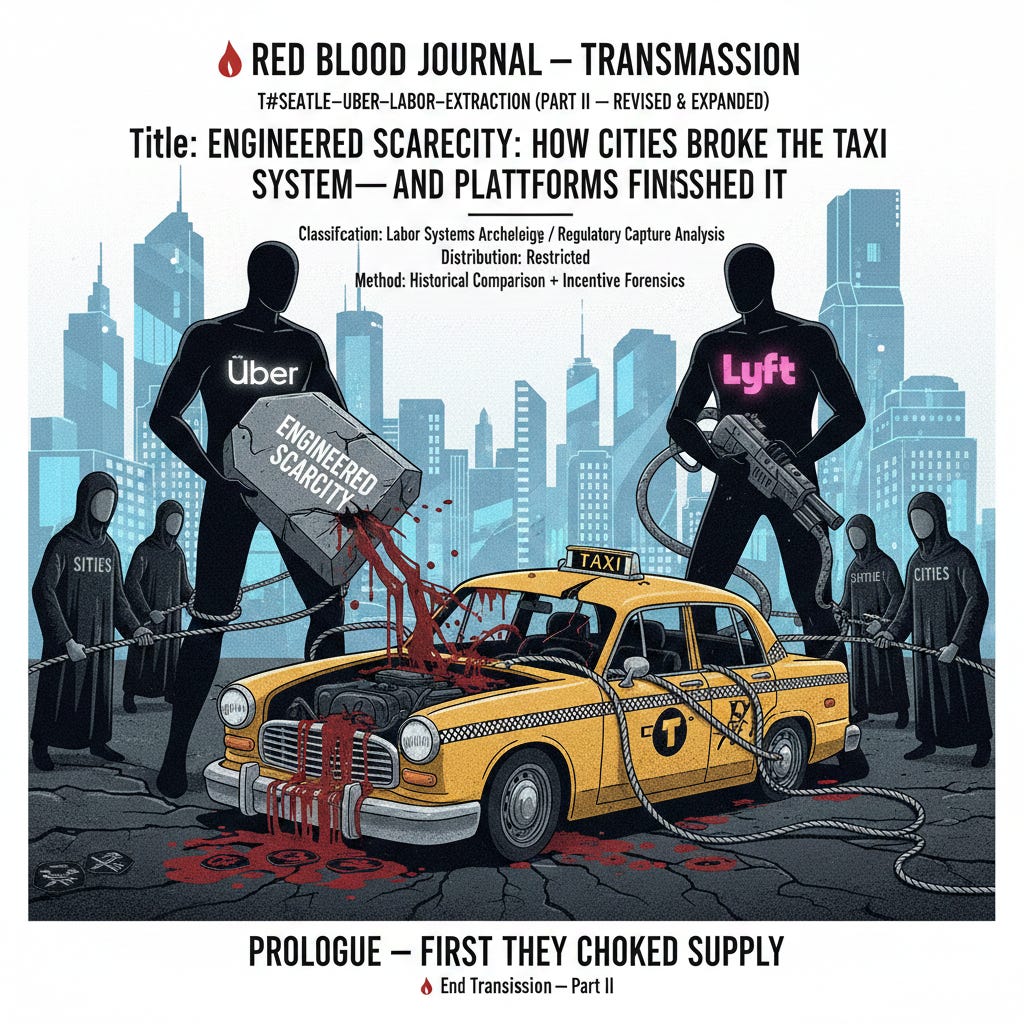
🩸 RED BLOOD JOURNAL — TRANSMISSION
T#SEATTLE–UBER–LABOR–EXTRACTION (PART II — REVISED & EXPANDED)
Title: ENGINEERED SCARCITY: HOW CITIES BROKE THE TAXI SYSTEM—AND PLATFORMS FINISHED IT
Classification: Labor Systems Archaeology / Regulatory Capture Analysis
Distribution: Restricted
Method: Historical Comparison + Incentive Forensics
PROLOGUE — FIRST THEY CHOKED SUPPLY
The taxi system did not collapse on its own.
It was strangled.
Before Uber and Lyft arrived as “saviors,” cities quietly engineered a shortage—then blamed the victims of that shortage for failing to serve the public.
This is the missing chapter.
I. THE MEDALLION CHOKEPOINT — WHEN CITIES PICK WINNERS
For decades, cities artificially capped the number of taxi medallions (licenses to legally operate).
What that did immediately
Froze supply regardless of population growth
Turned medallions into speculative assets
Drove prices from tens of thousands to hundreds of thousands (even millions in some cities)
Locked new drivers out unless they went into crushing debt
The medallion was no longer a license.
It was a financial instrument.
II. HOW SCARCITY CREATED A TAXI “CRISIS”
By limiting medallions, cities guaranteed:
Fewer taxis at peak hours
Long wait times
Poor service coverage in outer neighborhoods
Driver burnout from overwork
Rising lease costs passed onto drivers
Then came the narrative:
“Taxis are inefficient.”
“Taxis can’t meet demand.”
“Taxis are outdated.”
This was not market failure.
It was regulatory sabotage.
III. THE TRAP FOR INDEPENDENT DRIVERS
Independent drivers were squeezed from both sides:
From the city
Artificial scarcity
Skyrocketing medallion prices
Bureaucratic compliance costs
From medallion owners
High lease fees
Long shifts just to break even
Permanent renter status for many drivers
Yet even then, the driver still had one critical thing:
Ownership potential.
A medallion—however distorted—was still a path to independence.
That path had to be closed.
IV. ENTER UBER & LYFT — “DEREGULATION” AS A WEAPON
Uber and Lyft did not solve the shortage.
They exploited it.
Their playbook
Launch illegally or in gray zones
Flood cities with unlimited vehicles
Market themselves as “ending taxi scarcity”
Weaponize rider frustration against regulators
Force cities into retroactive legalization
The pitch was simple:
“See? The market wants us. Taxis failed.”
But taxis didn’t fail.
They were handcuffed.
V. WHY THE CITY LET IT HAPPEN
Cities had a choice:
Reform medallion caps and restore independence
Or accept platforms that promised convenience and tax revenue
They chose revenue and control.
Why platforms were irresistible
No need to manage drivers as employees
Per-trip taxes easier than medallion reform
Political cover: “innovation”
A labor force that absorbs risk privately
The state didn’t lose power.
It outsourced labor control.
VI. THE FINAL KILL SHOT — FROM ASSET TO APP
Once platforms were legalized:
Medallion values collapsed
Lifelong savings were wiped out
Independent drivers were bankrupted
Entry into self-employment now required algorithmic permission
The medallion—flawed but tangible—was replaced by:
A revocable account
A shifting pay formula
An invisible boss
Zero equity
This was not modernization.
It was expropriation.
VII. WHAT REALLY DIED WITH THE TAXI SYSTEM
Not just taxis.
What died was:
A working-class ownership ladder
A legal way to grind toward independence
A business you could understand with a notebook
A future you could plan without an app update
The taxi system was the last mass-accessible self-employment model left in urban America.
That is why it had to go.
VIII. THE CONSPIRACY WITHOUT A CONSPIRACY
No single meeting decided this.
But the incentives aligned perfectly:
Cities preferred predictable revenue
Platforms preferred permanent rent extraction
Investors preferred scalability
Drivers were replaceable
So the outcome was inevitable.
Scarcity → frustration → “disruption” → dependency.
CONCLUSION — SCARCITY WAS THE WEDGE
Uber and Lyft did not defeat taxis by innovation alone.
They walked through a door cities themselves had locked.
First, the state broke the taxi system by capping supply.
Then, the platform cartel arrived to “fix” the damage—
by eliminating independence altogether.
The old driver paid a flat fee and kept the rest.
The new driver pays forever.
🩸 End Transmission — Part II
The provided text, an excerpt from an analysis titled “Engineered Scarcity and the Collapse of Taxi Independence,” argues that the failure of the traditional taxi system was not a result of market forces, but rather a deliberate process of regulatory sabotage initiated by cities.
The document explains that urban centers artificially capped the number of taxi medallions, which immediately froze supply, created long wait times, and drove up medallion prices, locking new independent drivers out of ownership and creating a false narrative of taxi inefficiency.
This engineered scarcity then set the stage for platforms like Uber and Lyft, which the source claims exploited the shortage by illegally flooding the market and forcing retroactive legalization.
Ultimately, the city chose to permit these platforms for the sake of revenue and outsourced labor control, resulting in the destruction of medallion values and the elimination of a critical path for working-class self-employment and ownership potential.


