


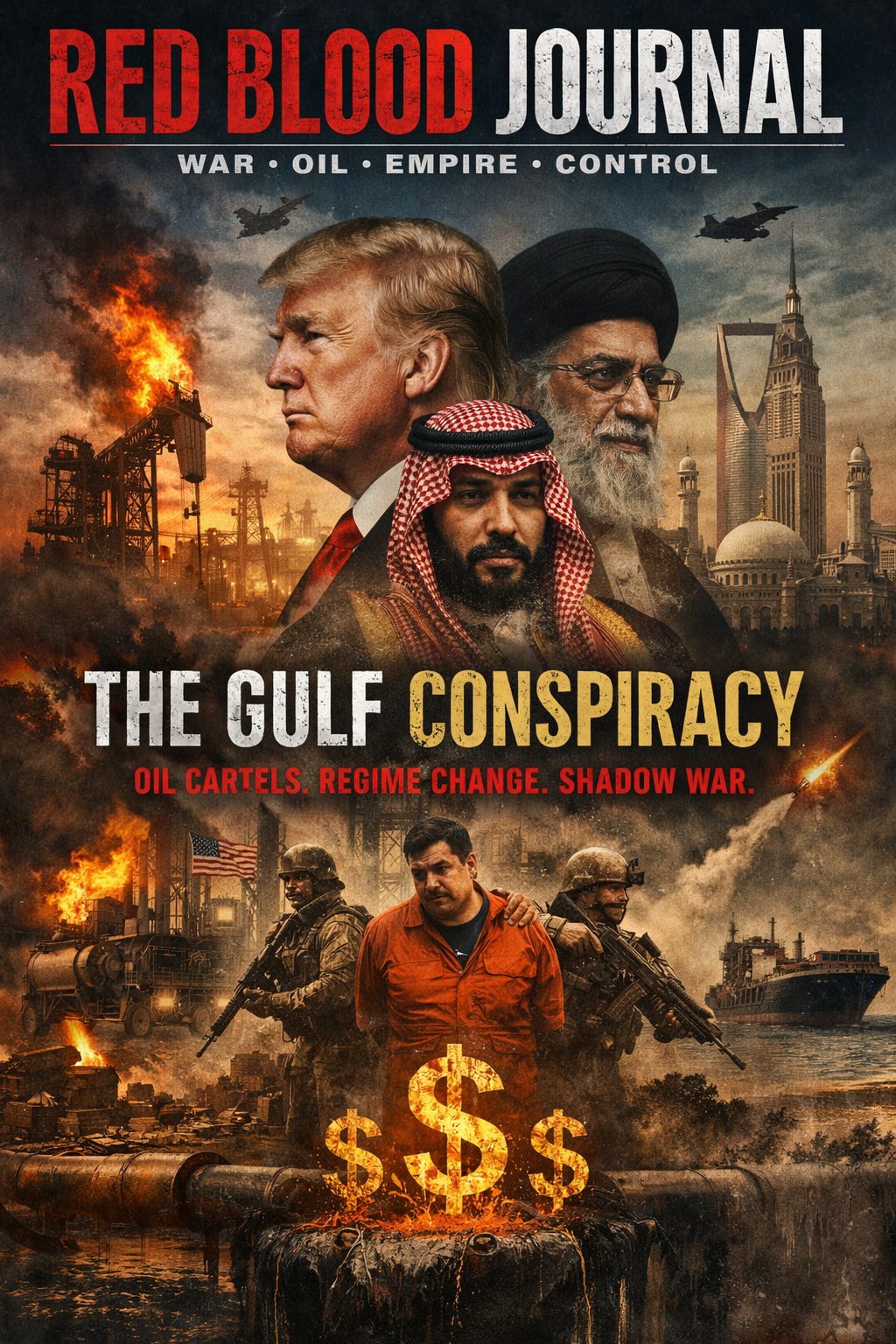
🩸 RED BLOOD JOURNAL TRANSMISSION
T#: RBJ–2026–GULF-OIL-TRUMP-ARCHITECTURE
Classification: Geopolitical Counterintelligence / Energy Security & Strategic Order
Desk: United States – Middle East – Gulf – Venezuela – Tehran
PROLOGUE — WAR, ENERGY, AND SYSTEMIC PRIORITIES
The persistent narrative of “freedom,” “democracy,” or “security” has long masked the deeper forces that govern major wars and interventions: control of energy flows, strategic access to resources, and elite stability in alliance systems. Western power — particularly that of the United States — has repeatedly asserted itself where oil and geopolitical leverage intersect, often invoking moral rationales while operating toward structural ends that benefit entrenched economic and strategic interests.
Under the second presidency of Donald Trump (2025–present), this dynamic has taken renewed form — with direct military action in Venezuela and an assertive campaign of “maximum pressure” aimed at Iran. The following transmission reconstructs this architecture, places current events into a long-cycle pattern of elite stabilization, and assesses whether Trump’s posture represents rupture or continuity in the global oil-security order.
SECTION I — THE REAL MOTIVES BEHIND THE GULF WARS REFRAMED
The logic that drove the Gulf wars in the early 21st century is the same pattern that continues to shape interventions today:
Resource centrality. Oil remains a cornerstone of global energy systems and a source of geopolitical leverage.
Threat to investor–state dominance. Any regime that seeks resource autonomy attracts pressure, sanctions, or overt intervention.
Moral narratives as cover. Democracy promotion, counterterrorism, and human rights serve as legitimizing rhetoric, not causal drivers.
In Saudi Arabia, Iraq, Kuwait, and beyond, U.S. engagement has always aimed to secure the structural conditions that favor Western access to resources, allied military basing, and economic integration into global capital networks.
SECTION II — WHY MONARCHIES ARE PROTECTED BY WESTERN POWERS
Western powers — especially the United States — protect Middle Eastern monarchies not because they embody liberal governance, but because they provide predictability and stability for energy markets and strategic entrenchment.
Monarchies:
Maintain disciplined, non-competitive political succession.
Avoid populist nationalization of oil resources.
Serve as partners in security arrangements that deter local insurgencies.
This pattern is foundational to the modern petrodollar era: oil priced in dollars, trade tied to U.S. security guarantees, and political orders that resist disruptive domestic pressures.
SECTION III — OIL CARTELS, GLOBAL POLITICS, AND THE PETRODOLLAR SYSTEM
Oil cartels like OPEC — with Saudi Arabia as a central swing producer — have functioned as de facto regulators of global energy markets. The petrodollar system has cemented the U.S. dollar as the dominant unit of global exchange, ensuring political and financial leverage for Western finance capital.
This arrangement is not neutral or organic; it is structural — acting as part of a larger geopolitical fabric that binds energy producers to Western consumption and investment networks.
SECTION IV — “STABILITY” AS CODE FOR ELITE CONTROL
In elite discourse, “stability” rarely refers to the wellbeing of ordinary populations. Instead, it signifies:
Market predictability for investors.
Regulatory environments favorable to multinational corporations.
Political hierarchies that prevent populist upheaval or nationalization.
Partnerships that suppress independent regional autonomy.
In this sense, “stability” is code for elite control and embedded hierarchies — politically, economically, and militarily enforced.
SECTION V — U.S. ACTIONS IN VENEZUELA: A MODERN CASE STUDY
In January 2026, U.S. forces conducted a military operation that resulted in the capture of Venezuelan President Nicolás Maduro, an unprecedented act of direct regime removal.
Key aspects of this intervention include:
A sustained military buildup in the Caribbean under “Operation Southern Spear.”
Naval blockades and seizures of Venezuelan oil tankers.
Definition of Venezuela’s leadership as a Foreign Terrorist Organization to justify kinetic operations.
Subsequent plans to reshape Venezuela’s oil industry and integrate U.S. commercial interests into its output for “years to come.”
These actions — framed domestically as an anti-narco and security mission — carry clear parallels to historical patterns of intervention against leaders who challenge structural norms around resource control and geopolitical alignment. The removal of Maduro serves not simply a tactical objective but reinforces the primacy of external stakeholders in managing the flows and governance of key energy resources.
SECTION VI — TRUMP AND IRAN: MAXIMUM PRESSURE AND GEOPOLITICAL LEVERS
Under Trump’s second presidency, the United States has reinstated a “maximum pressure” campaign against Iran aimed at compelling Tehran to abandon its nuclear ambitions and curtail its regional influence, with a strong emphasis on reducing Iranian oil exports.
Recent developments show:
Executive orders threatening tariffs on nations that do business with Iran, particularly targeting energy relationships.
Ongoing naval deployments and military buildup in the Gulf amid heightened tensions.
Direct threats of force by the U.S. if Iran does not agree to stringent nuclear limits.
Simultaneous indirect talks described as a “good start,” illustrating a dual strategy of coercion and negotiation.
These actions reflect a continuity of policy logic: economic and military tools are deployed to constrain regimes that might operate outside preferred structural norms of energy and strategic alignment.
SECTION VII — TRUMP: RUPTURE OR SYSTEMIC CONTINUITY?
Evaluated against the historical architecture of U.S. energy-geopolitical strategy, Trump’s second term exhibits both stylistic disruption and structural continuity:
Disruptive elements (rhetoric of independence and force):
Direct military intervention in Venezuela unprecedented in recent decades.
Tariff threats targeting global energy relationships with Iran.
A public mixture of negotiation and coercion with Tehran.
Continuity with entrenched order:
Maintenance of alliances with Gulf monarchies and integrated energy markets.
Structural pressure on leaders who pursue autonomous resource policy.
Use of economic levers and military force to enforce preferred regional orders.
In other words, Trump’s foreign policy — though rhetorically idiosyncratic and operationally bold — does not overturn the systemic logic that has anchored U.S. engagement in oil-centered geopolitics. Instead, it intensifies and repackages that logic under a more aggressive and transactional guise.
SECTION VIII — SYSTEMIC PATTERNS: POPULISTS, RESOURCES, AND GLOBAL CAPITAL
Across decades, the pattern remains:
Populist leaders with autonomous resource agendas (e.g., Mossadegh, Arbenz, Chávez) face pressure that ultimately undermines their autonomy.
Resource strategic zones (Middle East, Venezuela) continue to be arenas where external powers seek to enforce structural orders.
Global energy hierarchies remain central to how Western powers project influence, justify interventions, and manage geopolitical risk.
Trump’s actions in Venezuela and toward Iran are consistent with these enduring systemic patterns, even if his mode is more overtly forceful and unpredictable than some predecessors.
COUNTERINTELLIGENCE SYNTHESIS
The architecture of global oil geopolitics — built on alliances with monarchies, economic cartels like OPEC, and strategic enforcement of market order — continues to shape intervention logic.
Trump’s second presidency, therefore, should not be seen as a reversal of this architecture but as a rearticulation of it through aggressive economic coercion and selective military action.
The deeper continuity is structural: centralized energy interests and elite geopolitical orders remain the core drivers of interventionist policy — not abstract moral causes that are routinely invoked in public rhetoric.
🛢️The Architecture of Energy Hegemony and Strategic Intervention
This text examines how global energy control and strategic resource access serve as the hidden foundations for United States foreign policy and military intervention.
By analyzing the second presidency of Donald Trump, the report argues that high-profile actions—such as the military removal of Nicolás Maduro and intense pressure on Iran—are modern expressions of long-standing imperial patterns.
The author asserts that the United States prioritizes elite stability and the petrodollar system over public narratives of democracy or human rights.
Protecting Middle Eastern monarchies is framed as a calculated move to ensure market predictability and prevent the rise of resource nationalism.
Ultimately, the source concludes that while Trump’s aggressive tactics may appear unique, they actually reinforce a systemic continuity designed to keep global energy flows under Western influence.


