


🩸 RED BLOOD TRANSMISSION JOURNAL
T#RBJ–FINANCE–FORMULA–ARCHIVE (PART V)
Title: Emergency Powers That Never Fully Expire
Classification: Sovereign Control Analysis · Legal-Structural Persistence
Distribution: International / Open
Method: Crisis Law Mapping · Power Retention Analysis · Historical Recurrence
PART V — TEMPORARY MEASURES, PERMANENT CONSEQUENCES
Every emergency begins with a promise:
“This is temporary.”
History shows a different outcome.
Emergency powers are rarely revoked cleanly.
They decay, rebrand, or sink into precedent—where they can be reactivated without resistance.
This is not an accident.
It is how authority learns.
I. WHAT EMERGENCY POWERS REALLY ARE
Emergency powers are legal accelerants:
normal procedure suspended
oversight delayed
dissent framed as risk
They are sold as tools of survival.
They function as experiments in compliance.
The emergency tests:
how fast rights can be paused
how broadly power can be centralized
how quietly exceptions can become norms
The crisis is the laboratory.
II. THE RATIFICATION TRAP
Most emergency powers do not remain visibly “active.”
Instead, they are:
codified into secondary law
normalized through repetition
justified by “preparedness”
What begins as an exception becomes infrastructure.
Later governments don’t “abuse” these powers.
They inherit them.
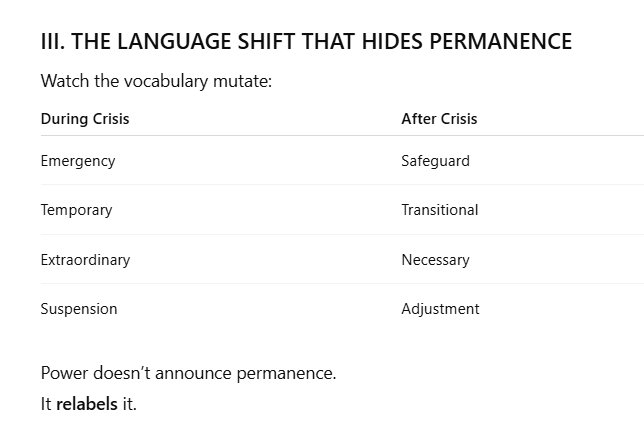
III. THE LANGUAGE SHIFT THAT HIDES PERMANENCE
Watch the vocabulary mutate:
During Crisis
After Crisis
During Crisis Emergency
After Crisis Safeguard
During Crisis Temporary
After Crisis Transitional
During Crisis Extraordinary
After Crisis Necessary
During Crisis Suspension
After Crisis Adjustment
Power doesn’t announce permanence.
It relabels it.
IV. WHY EMERGENCIES ALWAYS EXPAND, NEVER CONTRACT
Emergencies reward expansion because:
accountability is deferred
fear accelerates consent
reversal requires attention the public no longer has
Rolling back power is politically costly.
Keeping it is administratively convenient.
Convenience always wins.
V. SECURITY AS THE PERFECT JUSTIFICATION
No argument dissolves resistance faster than security.
Security reframes opposition as irresponsibility:
“Why take the risk?”
“What if it happens again?”
“Only extremists oppose safeguards.”
Once fear is moralized, debate ends.
VI. THE RECURSION EFFECT
Emergency powers are justified by future emergencies.
This creates a loop:
Crisis grants power
Power enables monitoring
Monitoring predicts risk
Prediction justifies readiness
Readiness requires retained power
The system becomes self-justifying.
VII. THE INVISIBLE COST
The cost is not tyranny overnight.
It is:
narrowed public tolerance for dissent
expanded executive discretion
blurred civilian–security boundaries
Freedom is not removed.
It is conditioned.
EPILOGUE — POWER LEARNS, THE PUBLIC FORGETS
Every crisis leaves behind debris.
Some is visible: debt, damage, dead.
Some is invisible: authority that learned it could act without asking.
Emergency powers don’t expire.
They hibernate.
And when the next crisis arrives, they wake faster.
🩸 END PART V
Red Blood Journal — Sovereign Systems Division
♾️Every emergency begins with a promise: “This is temporary.”
This text examines how emergency powers initially introduced as short-term solutions often become permanent fixtures of government authority.
The author argues that crises serve as experimental laboratories where leaders test the limits of public compliance and the suspension of civil rights.
Rather than being repealed, these extraordinary measures are frequently rebranded as standard safeguards or integrated into the legal infrastructure for future use.
The transition from temporary to eternal power is driven by political convenience and the psychological leverage of public fear, which discourages dissent.
Ultimately, the source suggests that the legal “debris” left behind by one crisis ensures that the state can reactivate control even more swiftly during the next.
Consequently, true freedom is not destroyed instantly but is instead slowly conditioned into a state of perpetual oversight.


