


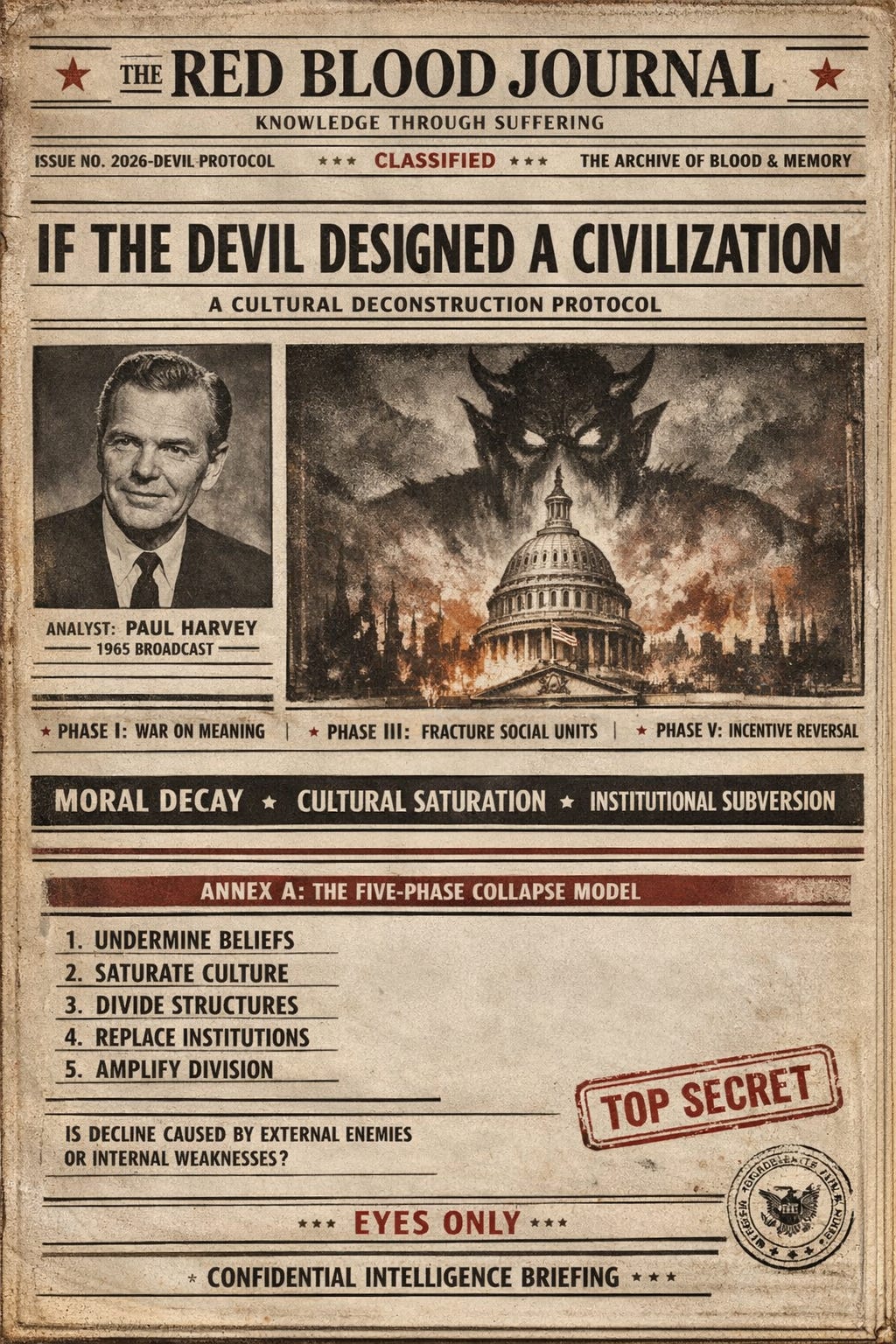
🩸 RED BLOOD JOURNAL TRANSMISSION
Division: Existential Philosophy Division / Cultural Systems Analysis Unit
Transmission Code: RBJ-EPD-2026-DEVIL-PROTOCOL
Classification: Societal Psychological Analysis
Archive: The Archive of Blood & Memory
IF THE DEVIL DESIGNED A CIVILIZATION
A Cultural Deconstruction Protocol
PROLOGUE — THE THOUGHT EXPERIMENT
In the mid-20th century, American radio commentator Paul Harvey presented a chilling thought experiment.
Rather than preaching theology or politics, he proposed a simple strategic question:
If a destructive force wanted to dismantle a civilization without invading it, what would it do?
The answer was not bombs, armies, or open conquest.
It would reshape the mind of the society itself.
The speech imagined how a civilization might be undone through culture, institutions, psychology, and incentives—a slow internal corrosion rather than a visible external attack.
If
This transmission analyzes that thought experiment as a civilizational vulnerability model.
SECTION I — THE PRINCIPLE OF INTERNAL COLLAPSE
History shows that civilizations rarely fall solely from outside invasion.
They weaken internally first.
Common patterns include:
Cultural fragmentation
Moral confusion
Institutional decay
Loss of shared belief systems
The thought experiment suggests that a hostile force would not begin with visible destruction.
Instead, it would begin with ideas.
The strategy would resemble psychological warfare conducted against an entire society.
SECTION II — PHASE ONE: THE WAR ON MEANING
The first step in destabilizing a civilization is to weaken the belief structures that unify it.
The thought experiment proposes targeting religion and moral foundations, particularly among the young.
Key tactics include:
Convincing younger generations that spiritual traditions are myths
Reversing moral language so destructive behavior appears fashionable
Encouraging relativism in place of ethical clarity
If meaning collapses, social cohesion collapses with it.
A population without shared moral anchors becomes easier to divide and manipulate.
SECTION III — PHASE TWO: CULTURAL SATURATION
Once belief systems weaken, culture becomes the primary battlefield.
According to the model, entertainment and media would be used to normalize:
Excess
Sensationalism
Vice
Moral ambiguity
The goal would not be direct censorship.
Instead, the strategy would be saturation.
Flood the environment with stimuli that reshape norms and expectations.
Eventually, behaviors once considered extreme become ordinary.
SECTION IV — PHASE THREE: FRACTURING SOCIAL UNITS
A stable civilization depends on several foundational structures:
Families
Religious institutions
Local communities
The thought experiment predicts that a destabilizing force would encourage internal conflict within these units.
Families would divide across generational or ideological lines.
Churches and institutions would fracture over doctrine and identity.
Nations themselves could split into competing camps.
The result would be permanent internal tension.
SECTION V — PHASE FOUR: INSTITUTIONAL DISPLACEMENT
The next stage would involve replacing long-standing institutions with new frameworks.
Examples suggested in the speech include:
Substituting psychological frameworks for spiritual guidance
Removing religion from public institutions
Reframing social responsibility through bureaucratic systems
The result is not necessarily atheism or faithlessness.
Instead, it is institutional transformation—where the role once played by religion, community, or tradition is transferred to new authorities.
SECTION VI — PHASE FIVE: INCENTIVE REVERSAL
Societies function through incentive structures.
According to the thought experiment, destabilization could occur by reversing those incentives.
Potential outcomes include:
Reduced motivation for hard work or ambition
Dependence on centralized systems
Expansion of social conflict over resource distribution
When incentives weaken productivity or responsibility, the system begins to stagnate.
SECTION VII — THE FINAL CONDITION: PERMANENT DIVISION
The ultimate objective of the model is not immediate destruction.
It is continuous internal conflict.
In this condition:
Families argue
Communities polarize
Political factions harden
Media amplifies division
Once this state becomes permanent, the civilization effectively destabilizes itself.
The final line of the thought experiment concludes that the destructive force would simply continue doing what was already working.
If
ANALYSIS — THE CIVILIZATION VULNERABILITY MODEL
The speech functions less as theology and more as a systems analysis of societal collapse.
Key insights include:
1. Collapse begins in culture, not battlefields
Military strength does not guarantee social stability.
2. Psychological warfare can operate domestically
Information, culture, and incentives shape the trajectory of a society.
3. Institutions matter
When foundational institutions lose credibility, societal cohesion declines.
4. Division multiplies instability
The most destructive conflicts are often internal rather than external.
COUNTERINTELLIGENCE NOTES
Several historical civilizations collapsed following patterns similar to the model described.
Examples include:
Late Roman Empire
Cultural fragmentation
Political factionalism
Institutional decay
Weimar Germany
Economic instability
Cultural conflict
Collapse of political legitimacy
Late Soviet Union
Ideological exhaustion
Institutional mistrust
Loss of belief in the system
The lesson: civilizations are vulnerable when belief systems, incentives, and institutions weaken simultaneously.
ANNEX A — THE FIVE-PHASE COLLAPSE MODEL
Phase 1: Undermine shared beliefs
Phase 2: Saturate culture with destabilizing norms
Phase 3: Divide families, communities, and institutions
Phase 4: Replace traditional structures with new authorities
Phase 5: Reverse incentives and amplify division
Once all five phases overlap, a society enters self-destructive feedback loops.
ANNEX B — THE STRATEGIC QUESTION
The thought experiment leaves a final question for observers:
Is societal decline caused primarily by external enemies,
or by internal weaknesses exploited over time?
Understanding that distinction may determine whether civilizations recover—or collapse.
🩸 END TRANSMISSION
Archive: The Archive of Blood & Memory
Division: Existential Philosophy Division
Status: Filed for Civilizational Pattern Analysis
🍎The Devil’s Blueprint: A Protocol for Civilizational Decay
This text examines a civilizational vulnerability model inspired by a mid-20th-century thought experiment regarding how a society might be destroyed from within.
Rather than utilizing military force, this strategy focuses on psychological warfare and the systematic erosion of cultural foundations, moral clarity, and shared belief systems.
The process involves five distinct phases that prioritize internal fragmentation, the dissolution of the family unit, and the corruption of traditional institutions.
By reversing social incentives and saturating the public with destabilizing media, a hostile force can create a state of permanent domestic conflict.
Ultimately, the source argues that the most significant threat to a nation’s survival is not an external invader, but the gradual decay of its own internal cohesion.


