


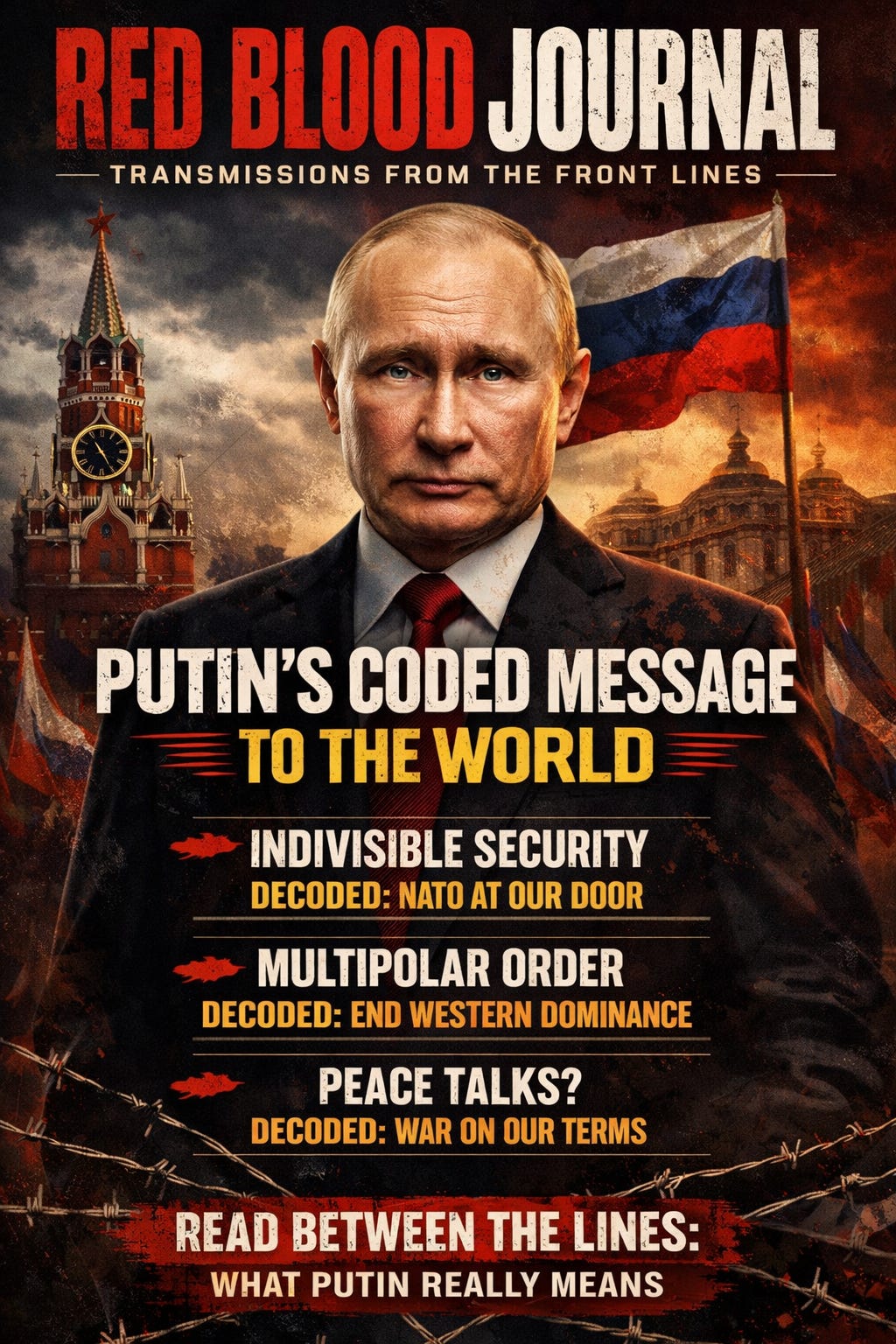
🩸 RED BLOOD JOURNAL TRANSMISSION
T#: RBJ-2026-01-16-RU-KREMLIN-CODE
Desk: Geo-PsyOps & Eurasian Power Language Unit
Status: UNREDACTED – COMMENTARY & CODEBREAK
1. Scene Setting – A Soft Voice in a Hard War
Putin is not talking to the ambassadors in that room only; he’s talking to four audiences at once:
The Global South / “Non-Aligned” world – “we’re the anti-colonial partner.”
The West – “you broke the rules, we’re the ones defending ‘law’.”
Domestic Russian elites and public – “we are not isolated; the world still comes to us.”
Fence-sitters in Europe / Asia – “you will need us again; leave the door open.”
The setting – presentation of credentials at the Kremlin at the start of 2026 – is a ritual moment where the host state defines its worldview for all incoming envoys. That makes this speech less about nice phrases and more about line-by-line geopolitical signaling.
Putin’s Address to New Foreign …
2. “Peace” as Framing Device – The Velvet Wrapper Around a Steel Message
He opens with peace language and “well-being and success” for 2026, then immediately pivots to a degrading international situation, old conflicts worsening, and new tensions.
Putin’s Address to New Foreign …
Hidden code:
“Peace does not come by itself. It is built… every day… requires effort, responsibility, and a conscious choice.”
Translation: Russia’s war is reframed as “effort and responsibility” in the service of peace. The implication:
If we are fighting, we are “building peace” by force.
He contrasts “constructive interaction” with “unilateral, very dangerous actions” – this is his standing euphemism for US/NATO sanctions, interventions, and NATO expansion, without naming them yet.
The trick: he seizes the moral vocabulary (peace, stability, law) before he mentions Ukraine, so when he finally does, he can cast Russia as reactive, not aggressive.
3. The Core Code Words: “Multipolar,” “Sovereignty,” “Non-Interference”
Three words keep repeating like a mantra:
“Multipolar world order”
“Sovereignty” & “non-interference”
“Indivisible security”
These are not random. They are the lexicon of Russia’s counter-narrative to US hegemony.
What he says
He calls for a “more just multipolar world order” where each state has the right to its own model of growth, culture, and traditions, “without influence from outside.”
Putin’s Address to New Foreign …
He insists Russia is “sincerely committed” to multipolarity and a “balanced, constructive foreign policy course.”
What he means
“Multipolar” = a world where US-led institutions and Western norms no longer define “rules”; great powers have spheres of influence again.
“Sovereignty / non-interference” = “don’t criticize our internal politics, don’t sanction us for Ukraine, and don’t support opposition movements or color revolutions.”
“Indivisible security” (later, linked to Ukraine) = “If you expand NATO or move military infrastructure closer to us, we reserve the right to use force and claim you broke the security bargain.”
He’s basically rewriting the UN and “rules-based order” argument as:
We’re defending the original UN spirit; the West is the violator.
4. Ukraine Section – How He Repackages the War
When he finally mentions Ukraine, it’s framed as the inevitable consequence of Western abuse of that “indivisible security” principle:
NATO’s advance to Russian borders is presented as a “purposeful course toward creating threats to our security”, and the Ukraine crisis is said to be the “direct consequence” of ignoring Russia’s “just interests.”
Putin’s Address to New Foreign …
Decoded:
“Just interests” = accepted Russian veto over NATO expansion in its neighborhood.
“Public promises given to us” – this references the long-running Russian narrative that NATO secretly promised “no eastward expansion.”
“We offered options… rational solutions” – this positions pre-war Russian proposals as reasonable and Western responses as arrogant.
Then comes the key conditional:
He suggests it’s time to “return to substantive discussion” of security architecture, “to consolidate those conditions on which a peaceful settlement of the conflict in Ukraine can be achieved… and the sooner, the better.”
Putin’s Address to New Foreign …
Hidden message:
This is not an abstract peace call; it’s a sales pitch for a post-war settlement on Russian terms:
Recognition of Russia’s “security interests” (read: control / influence over Ukraine’s alignment).
De-facto acceptance of territorial changes or at least a frozen conflict that locks Ukraine out of NATO.
And then the iron line under the velvet:
He says that while “not everywhere” (Kiev and its supporters) are ready, “Russia will continue to consistently achieve the goal set before it.”
Putin’s Address to New Foreign …
Translation:
We are open to peace talks, but we will keep fighting until you accept our conditions.
5. The Grand Tour of the Global South – Building the Alternative Block
The long middle of the speech is a travelogue through BRICS, Latin America, the Middle East, Africa, and Asia – but that list is really a map of Russia’s parallel system.
He name-checks:
Brazil (BRICS co-founder) – “like-minded partners” in forming a “just, multipolar world order.”
Cuba – long-standing ally, still framed in Cold War language (“help and assistance,” “defend sovereignty and independence”).
Latin America (Colombia, Peru, Uruguay) – presented as equal partners with potential in health, pharma, education, training.
Middle East & North Africa – Egypt (El Dabaa NPP, Suez industrial zone), Saudi Arabia (OPEC+, St. Petersburg forum, Intervision contest), Lebanon, Iraq.
Pakistan & Afghanistan – using SCO and Russia’s decision to recognize the “new authorities” in Kabul.
Sri Lanka, Bangladesh, Maldives – tourism, agriculture, energy.
African states – long passage about liberation from colonialism, training armies, aid, Russia-Africa summits, and a third summit coming.
Putin’s Address to New Foreign …
Hidden architecture:
He is drawing a line between two worlds:
The “West” that he accuses of colonial arrogance & lawlessness.
A Russia-centered network of partners portrayed as equal, anti-colonial, and grateful.
He keeps reminding them of Russia’s past help – liberation from colonialism, training armed forces, helping economies. That’s a debt narrative:
“We helped you back then; now stand with us while we defy the West.”
Energy and infrastructure (nuclear plants, OPEC+, industrial zones, oil markets) are highlighted to say:
“We still move real stuff: oil, gas, nuclear, ports, manufacturing. The West can sanction us, but we still have muscle and markets.”
The hidden language is “You have a choice” – a non-Western pole where Moscow is not a pariah but a pillar.
6. Afghanistan: A Quiet, Loaded Signal
He notes that Russian-Afghan cooperation has “acquired noticeable dynamics” after Russia recognized the new authorities in Afghanistan.
Putin’s Address to New Foreign …
This is more than a throwaway line:
It signals to other non-Western capitals that Russia is willing to normalize regimes the West keeps at arm’s length, if that buys influence and leverage.
It also implicitly tells Western audiences:
“We can be the power that deals where you won’t, and we can shape the security environment you claim to care about (terrorism, drugs).”
Again, “sovereignty” is the cover word; realpolitik alignment is the content.
7. Europe & South Korea – The “Door is Locked, But Not Bolted”
Near the end, he finally turns to South Korea and the European countries present (Slovenia, France, Czech Republic, Portugal, Norway, Sweden, Austria, Switzerland, Italy).
Putin’s Address to New Foreign …
What he does:
Says cooperation with South Korea was once productive but the “positive capital” has been “largely squandered.”
Says bilateral ties with European states “leave much to be desired,” and that dialogue and contacts have been reduced to a minimum “not at all through our fault” – he emphasizes this.
Still, he “wants to believe” that eventually relations will return to “normal, constructive communication,” based on respect for national interests and “legitimate security concerns.”
Hidden structure:
Publicly, he refuses to accept blame for the collapse of relations – a domestic & non-Western audience message:
“We didn’t isolate ourselves; the West isolated itself.”
Privately (through this speech), he invites future governments and business elites in Europe and Asia to keep the idea of a reset alive:
“This is reversible.”
“We’ll be ready when you finally decide to prioritize your ‘national interests’ over US pressure.”
That phrase “legitimate security concerns” is a code:
Any future thaw, in his framing, must bake in Russian demands over NATO and European security architecture – especially regarding Ukraine and the eastern flank.
8. The Ambassadors’ “Mission” – What He Wants Them to Carry Back
He closes by telling ambassadors they can be sure their “useful undertakings” will receive support from Russian leadership, authorities, entrepreneurs, and civil society, and wishes them success.
Putin’s Address to New Foreign …
Hidden function:
He is recruiting them as message relays back to their capitals:
“Russia is open, not desperate.”
“Russia is principled, not erratic.”
“Russia has friends everywhere; isolation is a myth.”
The speech is designed so that no ambassador can report back that Putin sounded cornered. Instead, they report:
“He framed Russia as a calm, confident center of a multipolar project, wronged by the West but popular in the Global South.”
Exactly the image he wants.
9. What He Doesn’t Say – The Silent Code
Equally important is what is missing:
No acknowledgment of civilian suffering in Ukraine.
No mention of Russian economic strain, casualties, or internal dissent.
No reference to specific Western countries as enemies – criticism is of “those who, by the right of the strong, dictate their will,” avoiding names while everyone knows who he’s talking about.
No talk of compromise on territory – “peace” is always tied to security architecture, not borders.
This omission is part of the hidden language:
Russia is willing to talk, but not about wrongness – only about architecture and guarantees.
10. Red Blood Journal Takeaways – The Code in One Glance
If we compress the hidden language into a codebook:
“Multipolar world” = dismantle US-centric order; normalize spheres of influence.
“Sovereignty / non-interference” = shield for domestic authoritarian control and external interventions framed as “defensive.”
“Indivisible security” = veto on NATO expansion and justification for military action when that veto is ignored.
“Colonial oppression” (Africa, Latin America) = emotional trigger to bind Global South to Russia’s anti-West narrative.
“Positive capital squandered” / “not our fault” = invitation to future resets without admitting guilt.
“Ready to discuss peace” but “continue to achieve the goal” = open hand in one frame, clenched fist just behind it.
🩸 Bottom line from the Red Blood Desk:
This is not a routine greeting to new ambassadors. It’s a carefully coded broadcast:
To the West: You broke the rules; we are the aggrieved party; any peace must lock in our security model.
To the Global South: We are your old anti-colonial ally; stand with us and you stand against imperial hypocrisy.
To his own people: Russia is not isolated; the world still comes to Moscow, and we are a central pole in a new order.
♟️Deciphering the Kremlin Code: Putin’s Multipolar Manifesto
This text analyzes a 2026 diplomatic address by Vladimir Putin, framing it as a strategic manifesto designed to redefine global power structures.
The Russian leader utilizes coded language to justify military actions as a defense of national sovereignty while positioning Russia as the leader of a multipolar world free from Western dominance.
By targeting diverse audiences—from the Global South to European skeptics—he portrays the Kremlin as a victim of foreign aggression rather than an invader.
The analysis reveals how concepts like indivisible security serve as rhetorical tools to demand a veto over international alliances.
Ultimately, the source illustrates a sophisticated propaganda effort to bypass diplomatic isolation and normalize a new, Russia-centered geopolitical order.


