


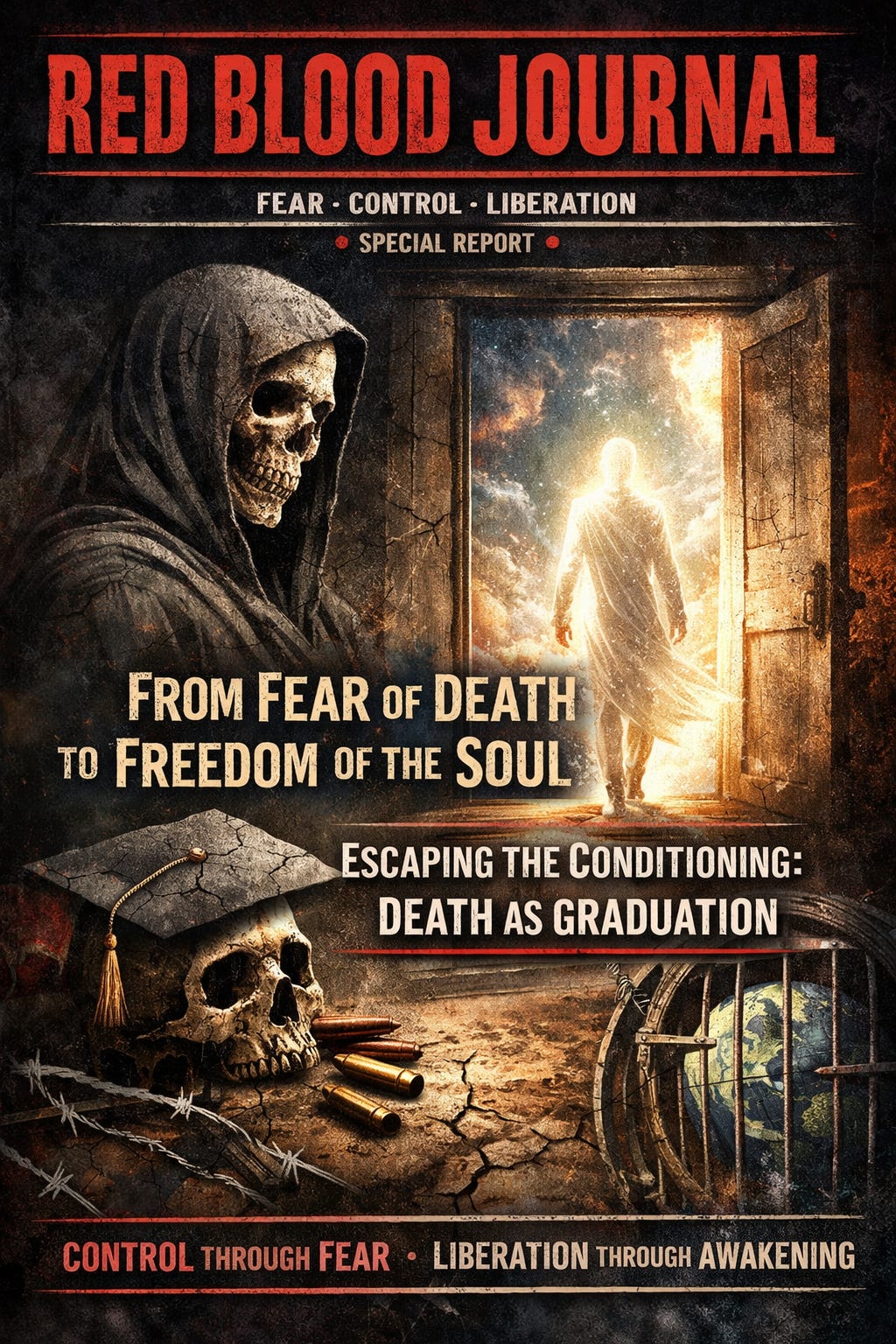
🩸RED BLOOD JOURNAL TRANSMISSION — HYBRID FORMAT
T#: RBJ-2026-THRESHOLD-OF-GRADUATION
Classification: Counterintelligence of Mortality / Sovereignty of the Soul
Desk: Archive of Blood, Fear, and Liberation
I — PROLOGUE: THE FIRST LIE
No child is born afraid of death.
Fear arrives later — carried by trembling adults, hushed hospital corridors, funeral rituals that confuse grief with cosmic truth, and a culture that treats mortality as an unspeakable enemy.
The first lie installed into the human mind is simple:
Death is the worst thing that can happen.
Once this sentence settles into childhood, an architecture of control grows around it.
II — THE INSTALLATION OF FEAR
Fear of death is not organic. It is engineered across three overlapping domains.
A. The Family: Emotional Imprinting
The earliest conditioning does not come through doctrine, but atmosphere.
Panic around illness.
Terror around loss.
Threats disguised as protection:
“If they misbehave, they could die.”
The child learns an equation:
Obedience = safety.
Disobedience = death.
From this moment forward, survival becomes submission.
B. Religion: Cosmic Blackmail
Death is then reframed as moral judgment.
Hell replaces mortality.
Punishment replaces mystery.
Fear of God replaces inquiry into existence.
The message becomes double-edged:
Obey earthly authority or risk eternal damnation.
Thus, spiritual terror fuses with political control. The leash tightens.
C. Modern Society: Sanitized Anxiety
Contemporary culture pretends to be rational, yet saturates the mind with death as catastrophe:
“Deadly” headlines.
Constant imagery of sudden, violent endings.
A medical system that treats death as a failure rather than a passage.
Simultaneously, authentic conversations about mortality are avoided.
Death becomes both omnipresent and forbidden — a psychological trap.
III — THE POLITICAL ECONOMY OF MORTAL FEAR
A population that fears death is governable.
Such a population will surrender:
Freedom for “safety.”
Privacy for “protection.”
Truth for comfort.
Dignity for survival.
Fear of death legitimizes:
Endless war (“to protect life”).
Surveillance states (“to prevent danger”).
Economic coercion (“work or perish”).
Mortality becomes the ultimate instrument of rule.
If death can be weaponized, freedom can be dissolved.
IV — THE COUNTER-THESIS: DEATH AS GRADUATION
Against this regime of fear stands a radically different understanding.
Death is not an annihilation. It is a completion.
From this perspective:
Birth is enrollment.
Life is the curriculum.
Matter is the classroom.
Suffering is the examination.
Awakening is mastery.
Death is graduation.
The body is a temporary vessel — a vehicle carrying consciousness through the terrain of material reality.
When the soul has absorbed what matter can teach, departure is not a tragedy but a release.
The sadness belongs to those still inside the classroom, not to the one who has finished the course.
V — THE FINAL CELEBRATION
Seen clearly, death becomes a final celebration:
The end of limitation.
The lifting of physical weight.
The dissolution of separation.
The return of the soul to its broader field of being.
A graduate does not grieve leaving school. They step forward.
So too with the awakened soul leaving the body.
VI — THE POLITICAL IMPLICATION
Here lies the danger to power.
A human who does not fear death cannot be ruled through:
Threat.
Scarcity.
Punishment.
Surveillance.
Coercion.
Historically, such individuals — warriors, mystics, dissidents, martyrs — have always been the most destabilizing force against tyranny.
Their existence proves the state’s ultimate weapon is psychological, not physical.
VII — THESIS
Two truths converge into one:
Fear of death is conditioned from childhood in order to manufacture obedience.
Liberation begins when death is understood as graduation rather than catastrophe.
VIII — CLOSING LINE
To fear death is to remain imprisoned in matter.
To celebrate death is to have mastered it.
🎓The Sovereign Soul: Death as Graduation
Societal institutions engineer a fear of death to enforce political control and obedience.
By reframing mortality as graduation rather than a catastrophe, individuals achieve spiritual sovereignty.
This shift from terror to liberation dismantles the state’s power to rule.


