


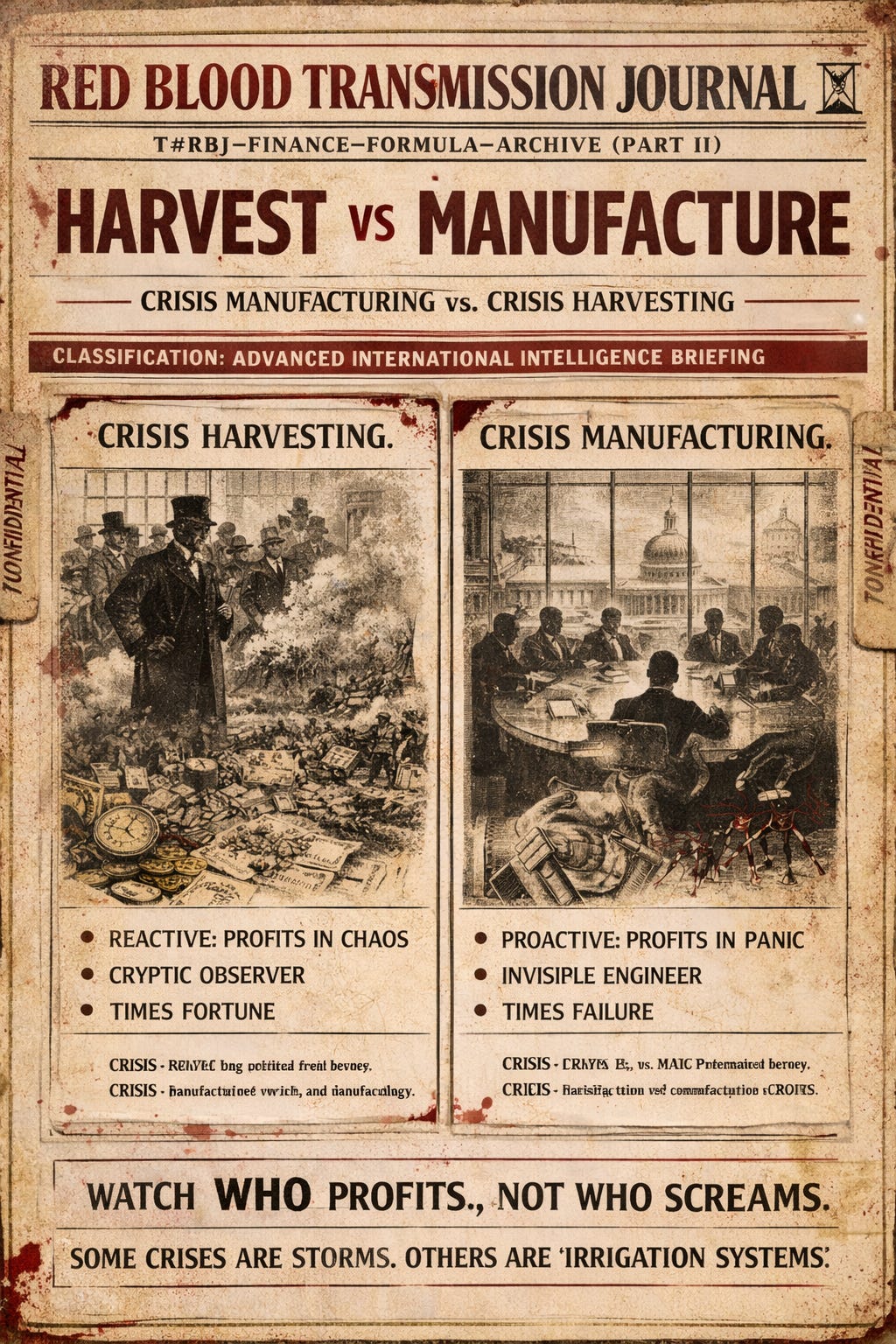
🩸 RED BLOOD TRANSMISSION JOURNAL
T#RBJ–FINANCE–FORMULA–ARCHIVE (PART II)
Title: Crisis Manufacturing vs. Crisis Harvesting
Classification: Advanced Pattern Dissection · International Political Economy
Distribution: International / Eyes Open
Method: Structural Power Analysis · Incentive Mapping · Historical Recurrence
PART II — WHEN BLOOD APPEARS, ASK WHY
Part I established a method:
secrecy + liquidity + patience + crisis psychology.
Part II asks the question most people are trained not to ask:
Is crisis merely exploited — or is it sometimes prepared?
This distinction matters.
Because harvesting requires readiness.
Manufacturing requires influence.
I. DEFINITIONS THE PUBLIC IS NEVER GIVEN
Crisis Harvesting
A reactive strategy.
The crisis is real
The panic is organic
The collapse is uncontrolled
The operator does not cause the fire.
They simply arrive with cash while others flee.
This is the behavior historically attributed to early banking dynasties, including networks associated with Mayer Amschel Rothschild and his successors.
Harvesters wait.
They do not need headlines.
Crisis Manufacturing
A proactive strategy.
Policy fragility is engineered
Risk is concentrated silently
Collapse is predictable to insiders
Manufacturers don’t time markets.
They shape conditions so timing becomes irrelevant.
This is where myth turns uncomfortable.
II. THE TRANSITION POINT — FROM OBSERVER TO ARCHITECT
History shows a shift between the 19th and 20th centuries:
From private banking houses
To centralized financial institutions
To policy-driven market dependency
Once capital becomes systemically embedded in:
government debt
war finance
monetary issuance
emergency liquidity
…the line between harvesting and manufacturing blurs.
At that point, crisis no longer needs to be planned explicitly.
It emerges automatically from incentive design.
III. THE MECHANISM OF MANUFACTURE (NO VILLAINS REQUIRED)
Crisis manufacturing does not require a secret meeting.
It requires alignment:
Leverage Expansion
Easy credit → fragile balance sheetsMoral Hazard
Losses socialized, gains privatizedNarrative Delay
Risks dismissed as “unlikely” or “contained”Emergency Switch
Crisis → justification for consolidation
No mastermind.
Just a system that rewards collapse at the top and punishes it at the bottom.
IV. THE BLOOD TEST — WHO BENEFITS IMMEDIATELY?
When crisis hits, watch what accelerates, not what collapses:
Mergers approved overnight
Assets transferred at discount
Emergency powers expanded
Regulations “temporarily” suspended
Harvesters profit after panic.
Manufacturers profit during panic.
That is the tell.
V. WAR AS THE PERFECT HYBRID CRISIS
War is the most efficient convergence of both models:
Manufactured via diplomacy failure, arms races, narrative priming
Harvested through reconstruction finance, debt issuance, asset seizure
This is why war has always been the banker’s favorite environment—not for ideology, but for certainty.
Uncertainty for civilians.
Certainty for balance sheets.
VI. WHY THE ROTHSCHILD MYTH PERSISTS (AND MISLEADS)
The Rothschild name absorbs blame because it represents an early, visible version of a method that is now:
institutionalized
anonymized
automated
Fixating on a single family is a containment narrative.
It prevents recognition of the replicated system now operating globally.
The formula escaped the bloodline long ago.
VII. THE MODERN FORMULA (UPDATED)
What once required pigeons and couriers now requires:
Policy foresight
Data asymmetry
Political insulation
Narrative control
The method evolved from family secrecy to institutional opacity.
The public still thinks in villains.
Power moved on to processes.
EPILOGUE — THE MOST DANGEROUS LIE
The lie is not that crises happen.
The lie is that they are accidental.
Some crises are storms.
Others are irrigation systems.
🩸 END PART II
Red Blood Journal — Financial Archaeology Division
🧛Crisis Manufacturing vs. Crisis Harvesting
This text explores the strategic distinction between opportunistic financial gains and the deliberate engineering of economic instability.
The author argues that global power has transitioned from individual families to institutionalized systems that prioritize “crisis manufacturing” over simple market reaction.
By utilizing leveraged credit and engineered policy fragility, these entities ensure that wealth is consolidated during periods of extreme public panic.
The narrative emphasizes that modern financial collapses are rarely accidental; instead, they function as irrational irrigation systems designed to funnel assets toward the top.
Ultimately, the source suggests that war and debt serve as the ultimate tools for those who profit from both the creation and resolution of global catastrophes.


