


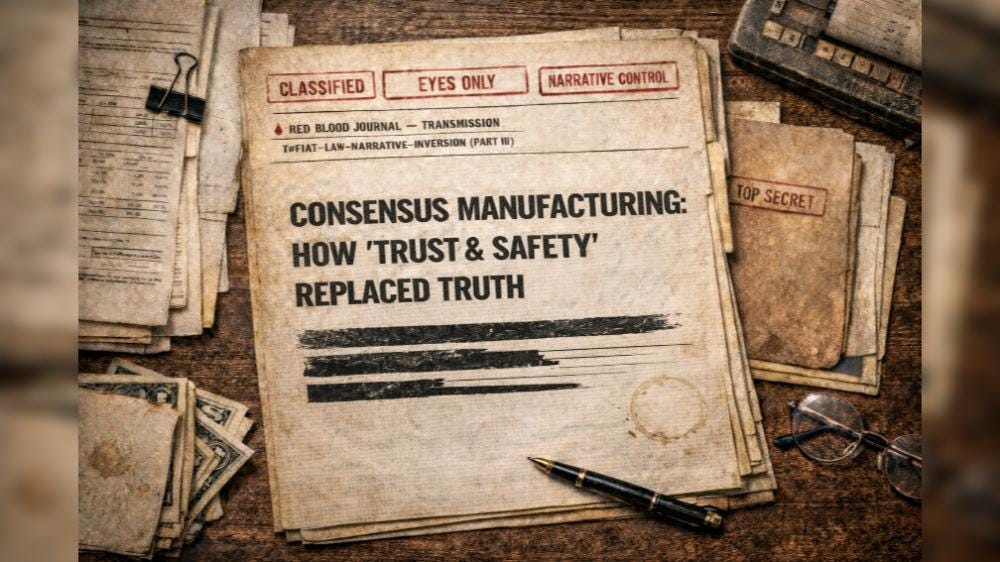
🩸 RED BLOOD JOURNAL — TRANSMISSION
T#FIAT–LAW–NARRATIVE–INVERSION (PART VI)
Title: Consensus Manufacturing — How “Trust & Safety” Replaced Truth
Classification: Narrative Engineering / Epistemic Capture
Method: Perception Control Analysis (Truth → Approval → Stability)
PROLOGUE — WHEN TRUTH BECAME A LIABILITY
Truth used to be something discovered.
Now it is something approved.
The transition was quiet.
The consequences are permanent.
I. FROM SEEKING TRUTH TO MAINTAINING STABILITY
“Trust & Safety” does not exist to protect truth.
It exists to protect:
Platforms
Institutions
Advertisers
Regulatory relationships
Truth is tolerated only when it is stable.
Instability—not falsity—is the unforgivable sin.
II. CONSENSUS IS NOT AGREEMENT — IT IS VISIBILITY CONTROL
Consensus is manufactured by managing what can be seen, not by persuading minds.
The process is simple:
Amplify aligned narratives
Throttle ambiguous ones
Bury inconvenient truths
Label dissent as fringe
Over time, absence masquerades as agreement.
People don’t change their beliefs.
They adjust to what appears socially survivable.
III. “TRUSTED SOURCES” AS A CLOSED LOOP
The phrase trusted sources sounds neutral.
It is not.
Trusted sources are those that:
Already align with institutional consensus
Pose no legal or regulatory risk
Are predictable under pressure
Once a source is designated “trusted,” it becomes:
Self-reinforcing
Algorithmically favored
Immune to scrutiny
Trust is no longer earned.
It is assigned.
IV. SAFETY IS USED TO OVERRIDE VERACITY
Truth is messy.
It creates conflict.
It destabilizes narratives.
Safety, by contrast, is smooth.
Safety arguments allow platforms to say:
“We’re not judging truth.”
“We’re reducing harm.”
“We’re protecting users.”
Harm becomes the override switch.
Any claim that produces discomfort, doubt, or anger
can be reclassified as unsafe—regardless of accuracy.
V. THE CONSENSUS LAG TRAP
When new truths emerge, they pass through a dangerous phase:
Too early to be consensus
Too threatening to be amplified
Too accurate to be dismissed
During this lag, suppression is most aggressive.
History is full of ideas that were:
“Dangerous misinformation” on Monday
“Accepted facts” on Friday
But the penalties are only applied on Monday.
VI. OUTLIERS ARE SACRIFICED TO PROTECT THE CENTER
Every system preserves itself by isolating outliers.
Truth tellers who speak ahead of consensus are framed as:
Reckless
Irresponsible
Radical
Unsafe
The message to the rest is clear:
“Wait until permission arrives.”
Truth delayed is truth neutralized.
VII. CONSENSUS AS A SUBSTITUTE FOR LEGITIMACY
When institutions lose credibility, they lean on consensus.
Consensus allows them to say:
“Most experts agree.”
“The science is settled.”
“There is no debate.”
Debate is reframed as danger.
Dissent is reframed as threat.
Legitimacy is simulated through repetition.
VIII. THE FINAL INVERSION: DOUBT AS A MORAL FAILURE
In a healthy society, doubt is intellectual hygiene.
In a managed consensus, doubt becomes:
Suspicion
Noncompliance
Radicalization
Asking questions is no longer curiosity.
It is risk behavior.
EPILOGUE — WHEN TRUTH NEEDS PERMISSION
A system that replaces truth with trust
does not need to lie.
It only needs to decide:
What may be said
When it may be said
By whom
Consensus becomes the cage.
And “Trust & Safety” becomes the sign on the door
explaining why the lock is for your own good.
👁️Consensus Manufacturing — How “Trust & Safety” Replaced Truth
This text examines how modern digital platforms and institutions have transitioned from seeking objective truth to prioritizing narrative stability.
The author argues that “Trust and Safety” departments function as tools for perception control, suppressing inconvenient facts under the guise of preventing social harm.
By manipulating visibility through algorithms, these systems create a manufactured consensus where only approved information is allowed to flourish.
This process effectively labels independent thought or dissent as a safety risk, forcing individuals to prioritize social survival over intellectual honesty.
Ultimately, the source suggests that institutional legitimacy is now simulated through the aggressive policing of information rather than earned through open debate.
Consequently, the search for truth has been replaced by a restrictive cage of top-down permission and enforced agreement.


