🩸 RED BLOOD JOURNAL – REAL-TIME TRANSMISSION
T#: RBJ-2026-01-26–KILL-SWITCH-PROTOCOL
Classification: Domestic Control Grid, Mobility Governance, Digital ID / Social-Credit Pre-Architecture
Unit: Transportation Surveillance Desk & Embedded Legislation Analysis Cell
Clearance: For Readers Who Suspect “Safety” Laws Are Written by People Who Don’t Like You Driving Unsupervised
PROLOGUE — WHEN A BUDGET BILL FLIPS YOUR IGNITION
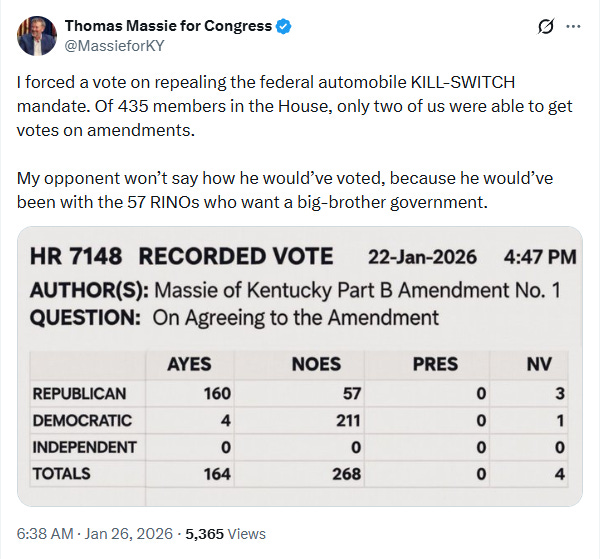
On January 22, 2026, at 4:47 p.m., the U.S. House of Representatives quietly voted 268–164 to reject an amendment by Rep. Thomas Massie that would have defunded the federal automobile “kill-switch” mandate embedded in the 2021 infrastructure law.
The amendment—Part B Amendment No. 1 to H.R. 7148, the Consolidated Appropriations Act, 2026—failed. Then, a few minutes later, the full spending bill sailed through on a 341–88 vote.
Most Americans never heard a word. But buried inside the earlier Infrastructure Investment and Jobs Act (IIJA) is Section 24220: “Advanced Impaired Driving Technology”, which orders the federal government to require that all new passenger vehicles come equipped with tech that can:
“passively monitor the performance of a driver … to accurately identify whether that driver may be impaired, and prevent or limit motor vehicle operation if an impairment is detected.”
That is the mandate Massie tried to defund—and 57 Republicans joined Democrats to keep funded.
This is not simply a fight over drunk driving. It is the slow, bureaucratic birth of a national remote-control system for movement.
I. WHAT ACTUALLY EXISTS — THE LEGAL SKELETON OF THE KILL-SWITCH
1. The 2021 Law
Section 24220 of the IIJA does three core things:
Findings:
Repeats drunk-driving death statistics and declares that to “ensure the prevention of alcohol-impaired driving fatalities,” advanced impaired-driving prevention tech must be standard equipment in all new passenger motor vehicles.
Definition of the Tech:
“Advanced drunk and impaired driving prevention technology” is defined as a system that can either:
passively monitor driver performance; or
passively measure a driver’s blood alcohol level;
and, if performance “suggests impairment” or BAC is at/above the legal limit, “prevent or limit” operation of the vehicle.
Mandate & Timeline:
Orders the Transportation Secretary/NHTSA to issue a federal motor vehicle safety standard for this tech within three years of enactment, with mandatory compliance for new vehicles a few years after that.
2. The Rulemaking Machine
NHTSA has already opened a formal rulemaking: “Advanced Impaired Driving Technology / Prevention Technology”, took in over 18,000 public comments, and is now researching technologies to meet the mandate.
NTSB, in separate analysis, is explicit: whatever tech is adopted must be able to “prevent or limit motor vehicle operation if an impairment is detected.”
In other words, the policy is no longer hypothetical. The bureaucracy is just deciding how to implement, not if.
II. THE MASSIE AMENDMENT — A FAILED BRAKE PEDAL
Massie’s Part B Amendment No. 1 to H.R. 7148 did something deceptively simple:
It cut off funding for federal implementation of Section 24220—effectively stalling the kill-switch rule inside the annual appropriations bill.
Key facts from the official roll call and media reconstructions:
Ayes (for defunding / against kill-switch): 164
160 Republicans, 4 Democrats.
Noes (to maintain funding / keep kill-switch on track): 268
57 Republicans, 211 Democrats.
The conservative press framed it bluntly:
House “REJECTS Effort to Defund a KILL SWITCH Mandate For Cars, Allowing Government to Shut Off Your Vehicle” and publishes the full list of 57 GOP members who crossed over.
This is the real-time conspiracy moment:
A surveillance-capable control technology is buried in a previous mega-bill.
The regulatory machinery is already running.
A small bloc in Congress tries to pull the plug.
The majority—including a big slice of supposed “limited government” Republicans—votes to keep the money flowing.
The architecture is out in the open. The public reaction is almost zero.
III. HOW A “DRUNK-DRIVING DEVICE” BECOMES A MOVEMENT CONTROL GRID
From the Red Blood Journal vantage point, the core conspiracy here is not that the government will flip a magic switch tomorrow and freeze every car on the interstate.
The deeper pattern is that Section 24220 creates legal, technical, and cultural pre-clearance for a future in which:
Your car is no longer a tool; it is a conditional privilege.
The law literally assumes the vehicle will act as judge and executioner of your “impairment,” with no human officer, no field test, and no due-process mechanism before your travel is restricted. Massie has highlighted these due-process concerns in previous hearings.“Impairment” is algorithmically elastic.
The statute never confines impairment to alcohol. It references “advanced drunk and impaired driving prevention technology,” but the functional trigger is “performance suggests impairment.”Today: swerving, delayed reaction, BAC > 0.08.
Tomorrow: “erratic” routes near protests, repeated trips to “sensitive” locations, late-night driving flagged as “fatigue risk,” or integration with other biometric feeds.
Every new car becomes a rolling sensor platform.
The tech must “passively monitor performance,” which implies constant data capture from steering, braking, lane-keeping, and in-cabin cameras.This dovetails perfectly with existing driver-monitoring cameras in many modern cars and the broader push for connected vehicle tech authorized elsewhere in the same law.
The “no outside control” promise is political PR, not a cryptographic guarantee.
Groups lobbying for the rule reassure the public that “no one outside the car will have the ability to operate or disable the vehicle” and that data shouldn’t be used for commercial or malicious purposes.But these are advocacy talking points, not hard technical constraints.
The moment a system is mandated, networked, and remotely updatable, it is theoretically accessible—by manufacturers, insurers, hackers, and, under the right legal pretext, government.
The social-credit door is left deliberately ajar.
Section 24220 is sold as drunk-driving tech, but the logic is identical to financial de-platforming and social-media shadowbanning:Build an always-on monitoring system.
Justify it with safety or “harm reduction.”
Expand the list of “harmful” behaviors over time.
Imagine a future where:
Your insurance company offers discounts if you consent to real-time access to kill-switch data—and punitive rates if you don’t.
Your state DMV can automatically suspend your ability to start your car after an algorithmic flag, before any court hearing.
Integration with digital ID and CBDC-style financial rails lets a centralized risk score limit where you can drive (geo-fencing) and when (“grid-stress climate controls,” “civil unrest zones,” “pandemic travel limits”).
Legally, most of that is not here yet. Architecturally, this is the first brick.
IV. THE BIPARTISAN MASK — WHY BOTH SIDES WANT THIS
From a conventional vantage point:
Safety groups like MADD, transportation officials, and parts of industry all cheer the tech as a way to save ~9,000 lives per year from drunk driving.
From a systems vantage point, both parties’ leadership gain:
Administrative leverage.
Once vehicles require government-defined impair-ment tech, future regulations can quietly widen the scope—no new high-profile “kill-switch bill” needed. Just a tweak to the standard.Fine-grained economic control.
The same channel used to enforce safety can be used to enforce rationing: emissions limits, congestion charges, climate-emergency travel restrictions.Political risk management.
In a world of mass protests and decentralized dissent, the ability—even in theory—to selectively disable movement in a region is strategically priceless.Data as collateral.
Mobility data is gold for big finance, insurers, and tech platforms. A federally mandated sensor platform in every new car ensures a guaranteed supply of highly granular behavioral data.
This is why the vote pattern matters. When 211 Democrats and 57 Republicans choose the mandate over civil-liberties alarm, they are not just “supporting safety.” They are signaling that the control architecture itself is non-negotiable.
V. CONSPIRACY IN REAL TIME — HOW THIS VOTE FITS THE LARGER PATTERN
Seen in isolation, the Massie amendment looks like a niche fight over a technical safety rule.
Viewed through the larger Red Blood Journal map—the kill-switch vote sits at the intersection of multiple ongoing architectures:
Digital Speech → Physical Mobility
Platforms already shadowban and derank dissenting political views under “safety” algorithms.
Financial platforms debank those who cross invisible lines.
The car kill-switch extends that logic from what you can say and how you can pay to whether you can move.
Smart Cities & Perimeter Control
The IIJA and related federal initiatives fund massive expansion of connected infrastructure, from roadside sensors to EV charging networks.
Mobility-linked kill-switch tech meshes neatly with geo-fenced urban zones, dynamic tolling, and police access to vehicle data.
Autonomous Vehicles & “Self-Driving” Hype
The more the public is nudged toward vehicles they do not fully control (automatic braking, lane-keeping, driver monitoring, self-driving packages), the easier it becomes to normalize a vehicle that will not obey you if an algorithm disagrees.
Lawfare & Liability
Legal analysts already note that Section 24220 raises major questions about manufacturer and driver liability for partially autonomous systems.
In practice, this incentivizes car companies to err on the side of over-blocking—locking you out or disabling the vehicle whenever the system is uncertain, rather than risking lawsuits.
Omnibus Camouflage
The original kill-switch language was buried in a trillion-dollar infrastructure bill.
Massie’s attempt to defund it was buried inside a multi-hundred-billion-dollar appropriations bill.
The recurring tactic is clear: controversial control mechanisms are smuggled inside “must-pass” mega-legislation, then insulated by leadership from clean, stand-alone repeal votes.
VI. PREDICTIONS — WHERE THE ROAD LIKELY LEADS
Assuming no radical course correction, the Red Blood Journal analysis forecasts the following trajectory:
Phase 1 — Soft Rollout (2026–2030)
NHTSA finalizes its standard. Major manufacturers quietly integrate driver-monitoring and impairment-detection into new models.
Public messaging stays tightly focused on drunk driving and heartbreaking crash statistics.
Early media tests showcase “heroic” system saves—cars stopping before crashes.
Phase 2 — Data Normalization & Insurance Hook (parallel)
Insurers begin offering discounts for drivers who opt in to greater data sharing. Opt-out becomes expensive.
“Safety scores” based on your driving patterns slowly mirror what already exists for credit and health.
Phase 3 — Regulatory Expansion
Over time, technical standards and guidance broaden the interpretation of “impairment” to include fatigue, medication interactions, possibly even cognitive distraction measured by eye tracking or in-cabin monitoring.
Law-enforcement and homeland-security agencies push for lawful access to real-time impairment / location flags “in exigent circumstances” (terrorism, Amber alerts, etc.). Precedents get set.
Phase 4 — Conditional Mobility
In future crises—civil unrest, pandemics, climate “emergencies”—policymakers will already have a legal and technical pathway to propose targeted shutdowns or restrictions in designated zones.
Even the credible possibility of that capability will chill protest and dissent, just as the possibility of financial de-platforming already chills speech.
Phase 5 — Integration with Digital Identity
The logical endgame, visible in global trends, is unified digital ID + movement + finance.
In such a system, your ability to move, transact, and speak freely are all mediated by scores, permissions, and automated enforcement—with kill-switch–style tech as the enforcement arm in the physical world.
VII. CONCLUSION — THE VOTE AS A TELL
The January 22 vote on H.R. 7148 did not create the kill-switch mandate. That happened quietly in 2021.
What this week’s vote did was reveal something more important:
A majority in Congress, across party lines, is comfortable funding a federal program that turns every new car into a potential enforcement device.
Efforts to stop or slow it are treated as fringe—even when backed by clear due-process and privacy objections from within the system itself.
For Red Blood Journal readers, the lesson is not simply that a bad law survived.
The lesson is that mobility itself—like speech, banking, and information—has now entered the same domain of algorithmic suspicion and conditional permission.
The kill switch is not a distant conspiracy theory.
It is a funded rulemaking, a failed defunding amendment, a line item in a sprawling appropriations bill—
and, unless something changes, the default architecture of every new car you’ll be allowed to buy.
🛑The Federal Kill Switch:
Architecture of Conditional Mobility
This text details the legislative origins and potential implications of a federal mandate requiring “kill-switch” technology in all new American vehicles.
Originating from the 2021 Infrastructure Investment and Jobs Act, the law tasking the government with implementing passive impairment-detection systems recently survived a defunding attempt in the House of Representatives.
The author contends that while these measures are publicly framed as public safety tools to prevent drunk driving, they establish a dangerous framework for centralized mobility control.
This architecture could eventually allow authorities to monitor driver behavior constantly and restrict vehicle operation based on algorithmic criteria.
By linking automotive technology with surveillance and digital identity, the source warns that the fundamental right to travel is being transformed into a conditional privilege overseen by bureaucratic systems.