


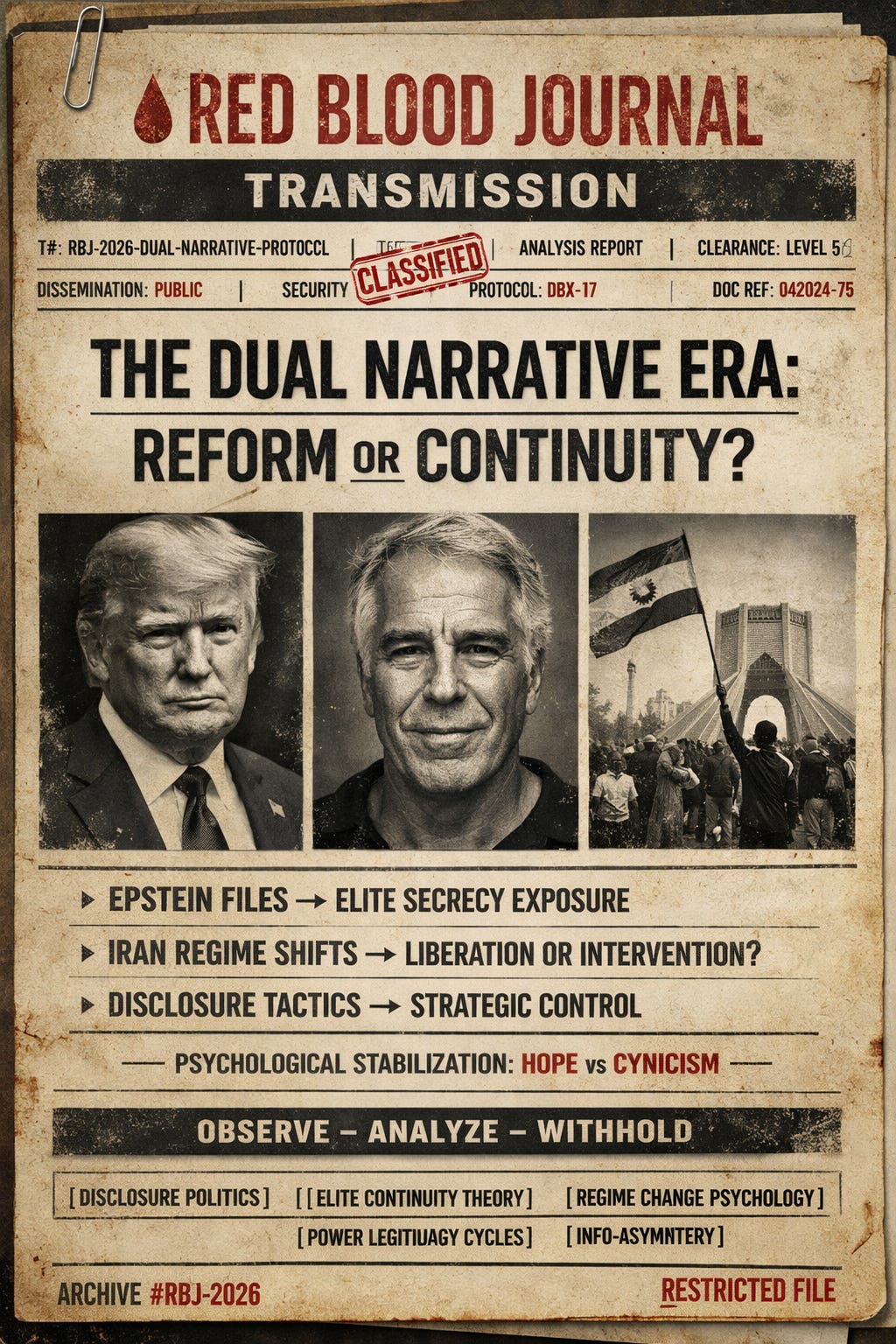
🩸 RED BLOOD JOURNAL TRANSMISSION
T#: RBJ-2026-DUAL-NARRATIVE-PROTOCOL
Classification: Power Continuity Analysis / Disclosure Politics / Psychological Sovereignty Mapping
Status: Analytical Commentary — Non-Accusatory
Distribution: Public
PROLOGUE — WHEN DISCLOSURE IS PARTIAL
Political eras defined by scandal rarely produce full clarity.
They produce fragments.
The partial surfacing of the Epstein files, combined with geopolitical repositioning toward Iran, has created a dual narrative environment:
One narrative frames reform.
The other frames continuity.
Both operate simultaneously in the public mind.
This transmission does not assert hidden certainty.
It maps the structure of perception.
I — THE REFORM INTERPRETATION
Within this model:
Political disruption is interpreted as corrective.
Institutional resistance is seen as proof of entrenched corruption.
Gradual disclosure is framed as strategic pacing rather than concealment.
Foreign policy shifts are interpreted as restoration of sovereignty to nations under imposed regimes.
In this view, leadership is engaged in damage repair.
The “old boss architecture” — defined loosely as entrenched globalist bureaucracy, intelligence entanglements, and elite protection systems — is being dismantled incrementally.
The absence of full disclosure is rationalized as:
Legal constraint
National security sensitivity
Ongoing investigations
Strategic timing
Hope is preserved.
II — THE CONTINUITY INTERPRETATION
The counter-model rests on historical pattern recognition.
Within this framework:
Political outsiders eventually operate within inherited power structures.
Disclosure is curated, not complete.
Scandals become leverage tools rather than cleansing events.
Foreign interventions repeat older strategic cycles under new branding.
In this model, secrecy itself is the signal.
The Epstein file partial release is interpreted not as reform in progress, but as managed exposure.
The appearance of disruption is considered performance.
Continuity of elite architecture is assumed.
Cynicism is preserved.
III — THE IRAN VARIABLE
Iran occupies a unique psychological space in U.S. geopolitical memory.
The 1953 coup, Cold War positioning, and post-1979 antagonism established a deep narrative trench in both nations.
Any rhetoric of regime replacement triggers two reflexive interpretations:
Liberation thesis — restoring agency to citizens.
Intervention thesis — repeating strategic control cycles.
The same policy proposal produces opposite moral readings.
Historical memory acts as an amplifier.
IV — DISCLOSURE AS POWER CURRENCY
In modern political ecosystems, information release is rarely binary.
It operates on a gradient:
Leak
Denial
Partial confirmation
Controlled transparency
Narrative redirection
The Epstein archive became not merely a legal matter, but a symbol of elite impunity.
When disclosure is incomplete, it functions as narrative fuel for both reformists and skeptics.
Opacity multiplies interpretation.
V — PSYCHOLOGICAL STABILIZATION STRATEGIES
When systems appear opaque, populations adopt coping architectures:
A. Reform Alignment
Belief that change is underway stabilizes emotional investment.
B. Permanent Skepticism
Assuming continuity protects against disappointment.
C. Withdrawal
Strategic disengagement preserves psychological sovereignty.
The final option — deliberate disengagement from emotional over-attachment — often emerges not from apathy, but from pattern fatigue.
VI — THE FOX PARADOX
In political history, leadership figures oscillate between two archetypes:
The Restorer
The Strategist
The Restorer repairs damage.
The Strategist manipulates perception.
Public interpretation depends less on declared intent and more on trust in institutional integrity.
When trust is fractured, every move appears tactical.
VII — WHAT CAN BE OBSERVED OBJECTIVELY
Without asserting motive, several realities remain observable:
The Epstein network exposed elite proximity across party lines.
Not all records have been fully publicized.
Political rhetoric toward Iran fluctuates between confrontation and containment.
Institutional power historically outlives individual administrations.
These are structural observations, not accusations.
VIII — THE WISDOM QUESTION
Some conclude that the safest posture is neither devotion nor hostility.
It is disciplined observation.
Avoiding emotional investment in political theater becomes a form of sovereignty.
Not ignorance.
Containment.
CONCLUSION — THE DUAL NARRATIVE ERA
The present moment is defined by ambiguity.
Is reform genuine?
Is continuity dominant?
Both interpretations coexist because information remains incomplete.
In environments of partial disclosure:
Hope and skepticism become parallel survival mechanisms.
The wiser posture may not be choosing a side prematurely.
It may be maintaining clarity without surrendering discernment.
🎭
The Architecture of Power Disclosure and Continuity
The provided text explores the competing perceptions that arise when governments and institutions release only fragmentary information regarding major scandals and geopolitical shifts.
It identifies a tension between the reform interpretation, which views partial disclosures as strategic steps toward justice, and the continuity interpretation, which argues that managed transparency is merely a tool for elite self-preservation.
Using the Epstein archives and relations with Iran as primary examples, the author illustrates how incomplete transparency forces the public to choose between hopeful investment or defensive cynicism.
Ultimately, the analysis suggests that in an era of managed narratives, maintaining psychological sovereignty through disciplined observation is the most effective way to navigate political ambiguity.
The text concludes that until institutional trust is restored, every official action will be viewed through these dual lenses of suspicion and expectation.


