


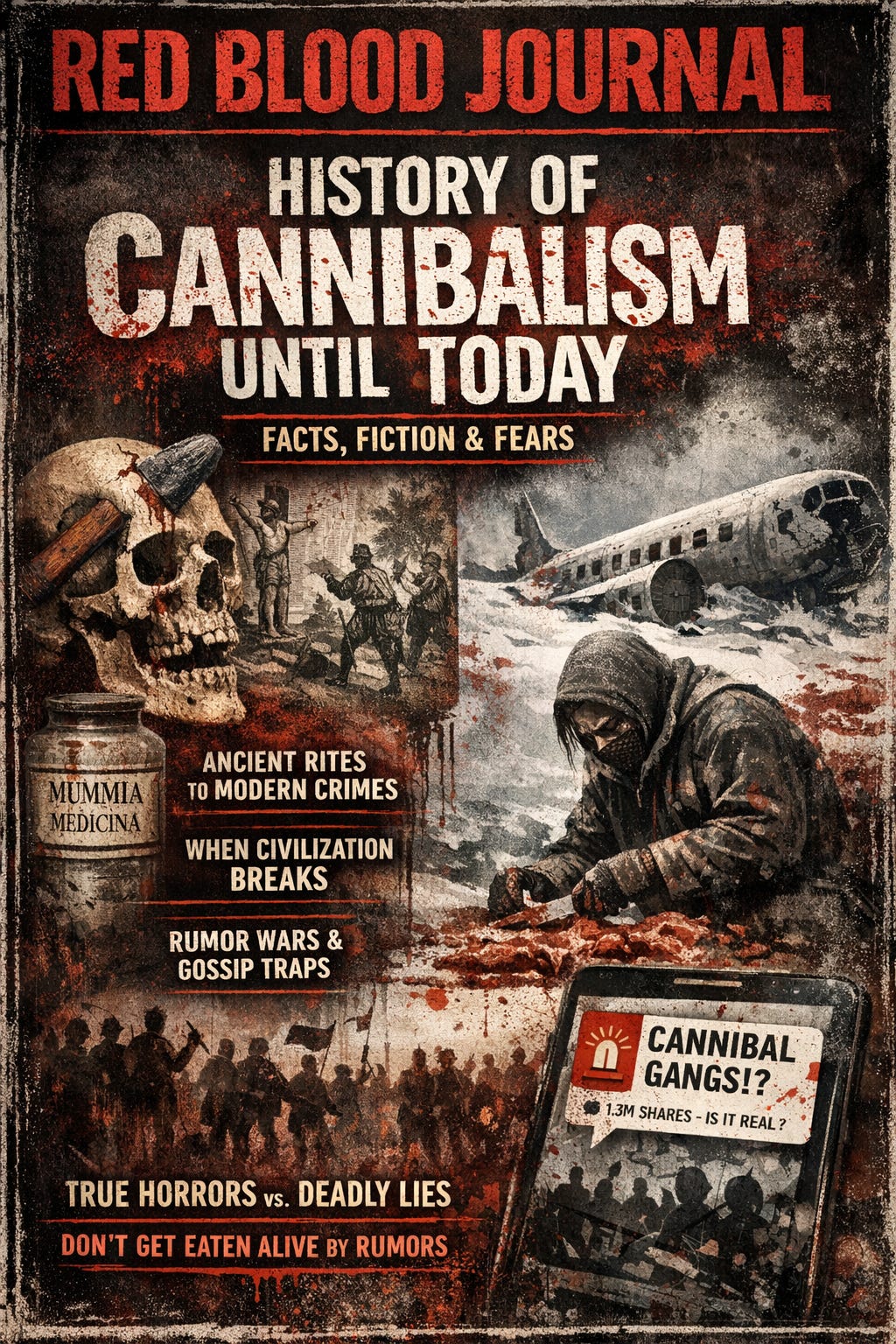
🩸 RED BLOOD JOURNAL TRANSMISSION — HYBRID FORMAT EDITION
T#: RBJ-2026-CANNIBAL-PATTERN-ARCHIVE
Classification: Taboo Intelligence / Rumor Warfare / Survival Extremes
Desk: The Archive of Blood & Memory — “History Until Today”
PROLOGUE — THE WORD THAT DOESN’T MEAN ONE THING
“Cannibalism” is a single label applied to multiple realities:
Survival cannibalism (famine, siege, shipwreck, crash)
Mortuary cannibalism (ritual handling/consumption of the dead within kin networks)
Warfare cannibalism (terror, domination, trophy logic)
Medicinal cannibalism (pharmacy culture: “medicine” made from human remains)
Pathological cannibalism (criminal/psychiatric outliers)
Rumor cannibalism (propaganda accusations used to mark an “enemy” as subhuman)
The historical record becomes readable only after separating the categories—because the “gossip layer” has always been part of the weapon system. The accusation often travels farther than the act.
SECTION I — DEEP TIME: BEFORE HISTORY HAD WORDS FOR IT
Archaeology suggests cannibalism is older than civilization—a recurring human behavior under specific pressures, not a constant cultural norm.
Atapuerca (Gran Dolina), Spain: early human remains (often discussed around Homo antecessor) show cut marks consistent with defleshing; new debate continues as new bones are interpreted and contested.
The pattern: when resources collapse, conflict spikes, or social boundaries harden, human bodies may be treated as “meat” or “message.”
RBJ Note: Deep-time evidence is always a fight between two stories—“food” versus “ritual/violence.” Both can be true in different instances.
SECTION II — EMPIRES, CONTACT, AND THE ACCUSATION AS A COLONIAL TOOL
European expansion produced a global genre: “They are cannibals.”
Not always false—but often strategic.
Anthropological scholarship has long warned that outsider reports of “routine cannibalism” were frequently shaped by fear, misunderstanding, or political convenience, especially during conquest and subjugation.
The word’s history is tangled with early colonial encounters and naming practices (including the Spanish “Caníbales” label), which later hardened into “proof of savagery.”
Operational use:
“Cannibal” became an all-purpose authorization stamp: invade, convert, punish, enslave—under the claim of rescuing civilization.
SECTION III — THE EUROPEAN MIRROR: MEDICINE MADE OF HUMAN REMAINS
One of history’s most underrated reversals:
Europe practiced medicinal cannibalism for centuries—not as famine behavior, but as mainstream remedy culture.
“Mummia” (powdered mummy / human-derived preparations) circulated in European medicine; human remains were used as ingredients and sold through apothecaries.
RBJ Note: This matters because it breaks the propaganda pattern where “cannibalism” is always projected outward onto the foreign “other.” Sometimes the cannibal is wearing a pharmacist’s apron.
SECTION IV — SURVIVAL EXTREMES: WHEN CIVILIZATION FAILS IN A WEEK
This is the most documented category: desperation cannibalism.
A) Jamestown: “The Starving Time” (1609–1610)
Forensic analysis of remains (“Jane”) strongly supports survival cannibalism during the siege/starvation winter.
B) Donner Party (1846–1847)
A case remembered through diaries, survivor accounts, and later reconstructions—often accompanied by shame, denial, and rumor drift.
C) Siege conditions (example: Leningrad, winter 1941–42)
Historical discussion includes NKVD records and later scholarship about arrests tied to corpse-eating and murder-for-food dynamics during catastrophic starvation.
D) Andes plane crash (1972)
Survival cannibalism became globally iconic—followed immediately by false rumors that survivors killed others for food, showing how fast the gossip engine activates even when facts are available.
RBJ Pattern:
In survival cases, the secondary violence is often social: stigma, myth-making, and post-event moral prosecution.
SECTION V — RITUAL, DISEASE, AND THE BODY AS A TRANSMISSION VECTOR
Mortuary cannibalism is not “random eating.” It can be structured, symbolic, and kin-based—yet it can also create biological catastrophe.
Kuru (Papua New Guinea): a prion disease linked historically to mortuary feasting practices; research helped establish prion science and clarified how long incubation can be.
RBJ Note:
In modern language: culture can function like a distribution system, even when no one intends harm.
SECTION VI — MODERN PATHOLOGY: WHEN THE TABOO BECOMES A PRIVATE RELIGION
Modern “headline cannibalism” is commonly linked to murder/sexual pathology and online subcultures rather than tradition.
Armin Meiwes (Germany): widely reported case involving internet-mediated contact and criminal conviction.
Forensic/medicolegal literature frames cannibalism as a rare but recurring issue in extreme criminal cases.
RBJ Pattern:
Modern cases become memes first, facts second—and the meme is usually designed to terrify.
SECTION VII — THE LAW LAYER: “ILLEGAL” WITHOUT A SINGLE WORD FOR IT
In parts of the U.S., cannibalism historically wasn’t named explicitly as a standalone crime—yet related crimes make it effectively prosecutable.
Cornell’s Legal Information Institute summarizes how U.S. jurisdictions typically prosecute via murder, abuse of corpse, etc.
Idaho is a notable case where cannibalism appears explicitly in statute, and recent legislative activity has drawn attention to the wording.
SECTION VIII — THE GOSSIP ENGINE: HOW “CANNIBAL” BECOMES A WEAPON
This is the part most histories minimize: cannibalism as rumor warfare.
1) The classic template
A crisis occurs (war, migration, crime wave, political collapse).
A sensational claim appears (“gangs are eating people,” “they harvest children,” “ritual feasts”).
Amplification outruns verification.
The claim becomes permission: to hate, to purge, to invade, to dehumanize.
2) A recent example of rumor dynamics
Claims about “cannibal gangs” in Haiti circulated widely on social media; multiple fact-checking and news reports described the specific claims as unverified/unfounded and traced how they spread online.
3) Why the accusation works
Because cannibalism is not merely “crime”—it is positioned as anti-human, a category that tries to cancel the target’s right to exist inside moral society.
RBJ Warning:
History contains real cannibalism and also mass persecution driven by invented cannibalism. The accusation has been used as a moral accelerant against out-groups across eras (including infamous medieval blood-accusation myths, which were false and lethal as propaganda).
FIELD GUIDE — HOW TO READ CANNIBALISM STORIES WITHOUT GETTING PLAYED
Identify the category (survival vs ritual vs criminal vs rumor).
Check who benefits from the story spreading.
Demand primary evidence (forensics, court records, reputable reporting).
Watch for “permission language”: when a story is used to justify violence against a whole group.
Separate disgust from proof. Disgust is not a source.
ANNEX A — TIMELINE SNAPSHOT (SELECTED)
Deep time: archaeological debates on defleshing/cut marks
Early modern Europe: medicinal “mummia” and corpse-medicine markets
1609–1610: Jamestown “Starving Time,” forensic evidence
1846–1847: Donner Party legacy + rumor drift
1941–1942: starvation siege narratives + records discussion
Mid-20th century: kuru/prion transmission via mortuary feasting
2001–present: internet-era criminal outliers and global media fixation
ANNEX B — RBJ “GOSSIP DOSSIER” QUESTIONS (FOR ANY NEW CLAIM “TODAY”)
Where did the first post originate?
Does the claim cite named witnesses, court filings, medical examiners, or only “sources say”?
Are images/video authenticated or recycled from another event?
Is the claim being tied to migration, war, or an election narrative?
Are major outlets correcting/retracting, or quietly letting it burn?
🍴The Red Blood Journal: Dossier on Cannibalism and Rumor warfare
This text explores cannibalism as a multifaceted phenomenon spanning survival, ritual, medicine, and criminal pathology.
It emphasizes how accusations often serve as propaganda or colonial tools to dehumanize enemies and justify violence through rumor warfare.


