


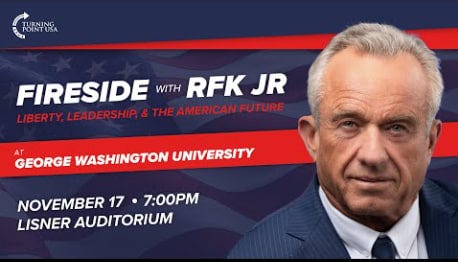
🩸 RED BLOOD JOURNAL — LONGFORM TRANSMISSION
T#122525–GW–MAHA–SPEECH–CONTROL
Classification: Civic Conditioning / Health-State Power / Youth Narrative Capture
Distribution: Open Read (Context Required)
Source Basis: User-supplied event transcript excerpt (not independently verified)
FRONT-PAGE ABSTRACT — WHAT THIS NIGHT REALLY WAS
They advertised it as a conversation.
But the architecture of the evening reveals something older and more powerful than a campus event:
A speech ritual designed to re-legitimize authority in an era where authority is collapsing.
This wasn’t just “free speech.” It was free speech staged—with guardrails, removal clauses, blessed language, and a moral hierarchy embedded into the microphone order.
And then the core message arrived:
Health as the new battlefield for governance
Science as a captured cathedral
Censorship as the precursor to total control
Youth as the prize—because youth decides the next “normal”
Faith as the engine that either resists the system or becomes its approved fuel
What follows is the Red Blood Journal forensic breakdown of the event’s mechanisms—not to tell you what to think, but to expose what was being done.
I. THE “FREE SPEECH” STAGECRAFT — OPEN DEBATE INSIDE A LOCKED ROOM
1) The Opening Script: Courage, Dialogue, Permission
The host frames the event as “essential,” “not always easy on campus,” and explicitly positions Turning Point as a protector of speech because students “feel pressured to stay quiet.”
That’s the hook: Liberation Narrative.
But the university message embedded immediately afterward introduces the boundary:
“All views deserve to be articulated… free from interference.”
and also: removal and referral for disruption.
This is the pattern:
Freedom is announced
Control is appended
Order is declared “the protector” of liberty
The crowd is told: This policy protects the principle.
Translation: Obedience becomes the entry fee for dissent.
That’s the modern civic template: You may speak—but only in the way the venue defines as “non-disruptive.”
II. THE FAITH-LAYER — WHEN THE EVENT BECOMES A CONSECRATION
Then the event shifts into something else entirely: a spiritual commissioning.
You get a father-of-four “generation changers” speech, then a full prayer that does more than bless the gathering.
It establishes a governing metaphysics:
God determines appointed times
God turns hearts of kings
Christ rules above earthly powers
The audience must be delivered from “lies and falsehood”
Leaders (explicitly named: President, Secretary, administration officials) are prayed over as instruments of righteous order
The prayer is not “just faith.” It’s a legitimacy engine.
Why this matters:
Because when politics borrows sacred structure, it gains something normal debate doesn’t have:
Moral immunity.
Once a political program becomes “for such a time as this,” disagreement can be framed as:
confusion
rebellion
spiritual blindness
“enemy assault”
refusal to “see truth”
That doesn’t mean the prayer is insincere. It means the function of prayer in a political setting can be both sincere and strategically potent.
Red Blood Rule: Sincerity does not cancel effect.
III. THE YOUTH CAPTURE — “LOOK AROUND THIS ROOM”
The GW College Republicans chairman narrates the crowd as historical proof:
“Unimaginable a short time ago”
“Culture is shifting”
“Young Americans are rising again”
“Protest outside = what’s inside is going to be great”
This converts conflict into adrenaline and attendance into identity.
And identity is the real commodity.
Because once a student’s self-image becomes “I’m the brave one,” they can be guided anywhere—as long as the guide continues to validate the identity.
This is how movements scale: not by arguments, but by self-concepts.
IV. ENTER KENNEDY — THE HYBRID FIGURE THE ERA REQUIRES
Robert F. Kennedy Jr. is presented as:
independent-minded
anti-establishment
anti-censorship
health reformer
willing to work with Trump
inheritor of legacy but breaker of party
That’s a rare political product: a “bridge candidate” identity—one that can draw the skeptical, the disillusioned, the health-concerned, and the free-speech absolutists into one emotional tent.
The script frames him as:
a man who “refused to fall in line”
a man who “proved principle matters”
a leader who “puts country over party”
In Red Blood terms: a narrative solvent—a figure designed (or naturally suited) to dissolve older partisan loyalties and re-form them around new axes (health, censorship, institutional distrust).
V. THE CORE PIVOT — “VIOLENCE COMES FROM SILENCING”
Kennedy argues that when people can’t express themselves—censored, confined to Overton windows—they become violent.
Then he delivers the central democratic thesis:
Democracy’s advantage isn’t efficiency; it’s that policy has “triumphed in the marketplace of ideas.”
And he uses a living metaphor:
Information is the water, soil, oxygen, sunlight of democracy.
So far, this is liberal democratic orthodoxy—free speech as oxygen.
But then the deeper move occurs:
He links health crisis to rights dismantling (COVID era), presenting public health as an instrument totalitarian systems can use to seize control.
This is the fusion point:
Health + governance + censorship = control system.
Whether you agree with his framing or not, the architecture is consistent:
Identify institutional capture
Identify censorship as the enabling mechanism
Identify crisis as the accelerator
Demand “gold standard science” and “choice”
Rebuild legitimacy through transparency and disruption
VI. “GOLD STANDARD SCIENCE” — THE WAR FOR THE PRIESTHOOD
Kennedy’s argument about public health agencies and institutions is a direct assault on the legitimacy chain:
journals compromised
medical schools compromised
associations captured
regulators resistant to questioning
system incentivized for “sick care,” not health
This is a familiar Red Blood axis:
If the knowledge pipeline is captured, the population can be governed by manufactured consensus.
He also emphasizes “choice,” rejecting a nanny-state approach while proposing incentive structures that punish “bad behavior” (by making you pay more if you make “bad choices”).
That’s a crucial detail: it sounds like freedom, but it also builds the framework for a behavior-priced society.
When “choice” is paired with “you will pay more,” you get a soft enforcement regime:
“We’re not forcing you.”
“We’re just pricing you.”
That is the modern method: governance by premiums, risk scores, eligibility, and access.
VII. COVID AS THE TEMPLATE — RIGHTS REMOVED IN SEQUENCE
Kennedy narrates a cascading rights takedown:
speech → worship → assembly → due process (business closures) → privacy/records → jury trial
Whether you accept every detail or not, the pattern he’s describing is important:
A society can be trained to accept emergency overrides—if framed as safety.
And once the override is accepted once, it becomes available again.
Red Blood Translation:
The real product of a crisis is not the policy response—
it’s the precedent.
VIII. MAHA AND THE “DE-PARTYING” OF HEALTH
Kennedy claims the movement itself isn’t polarizing; polarization is the environment.
He describes Democratic governors privately agreeing but publicly unable to use the label “MAHA” because of Trump association.
This highlights a key modern mechanism:
Brand contamination.
If a policy is linked to the “wrong tribe,” it becomes untouchable—regardless of merit.
That means public health becomes less about outcomes and more about tribal signaling.
And in that world, truth becomes a secondary currency.
IX. THE TWO-PARTY SYSTEM — “NOT TWO PARTIES ANYMORE”
Kennedy argues:
third party is hard to govern with
Trump is unusually effective because he controls the party apparatus and legislative discipline
Democratic primaries were “closed down” / litigation used to manage ballot access (as he describes)
Again, regardless of one’s stance, the structural claim is:
Institutions now manage legitimacy through procedural control.
Not by persuading you.
By managing your available choices, your ballot options, and your permitted narratives.
This is one of Red Blood’s central themes:
Control the rails, and you don’t have to control every passenger.
X. THE Q&A — WHERE THE REAL TEST HAPPENS
The Q&A is the only part that approximates “live democracy.”
And it reveals the battlefield lines:
1) Mental health access
A student asks about bipartisan campus mental health legislation. Kennedy responds with a teaser about a “major initiative next week” and frames addiction as a life-or-death access timing problem.
Signal: This administration wants to own “access” as a deliverable.
2) “Why should you lead if you’re not a doctor?”
Kennedy answers with history (few secretaries are doctors) and an indictment of prior failures. He reframes leadership as disruption capability + long exposure to science via litigation and books.
Signal: The public is done trusting credential hierarchy alone.
3) Metrics after four years
He lists administrative reforms (fraud reduction, price transparency, mobile records, remote care) and claims visible reductions in youth chronic conditions.
Signal: He is setting an expectation of measurable improvement within a political term.
4) Funding cuts / research
Kennedy denies cutting research, claims consolidation, and alleges certain study categories were cut and money redirected.
Signal: The narrative war is now “they cut science” vs “we cut bureaucracy.”
5) Vaccines and autism (high conflict)
A student challenges; Kennedy claims only limited vaccines studied and calls for vaccinated vs unvaccinated outcome comparisons.
Signal: This remains the most radioactive node—where “science,” “trust,” and “censorship” collide.
6) Social determinants / banned terms
A student argues economic status, racism, accessibility drive outcomes and questions “banned terms.” Kennedy responds by centering “objective science,” food deserts, and whole foods—downplaying the need for studies to prove disparity.
Signal: Competing frameworks:
structural determinants vs individual behavior + universal exposure model
7) Guns, opioids, mass shootings
A student calls mass shootings and opioids key epidemics. Kennedy speaks to non-opioid painkillers approvals and asks “what changed?” about shootings, mentioning psychiatric drugs (SSRIs) as an investigatory target.
Signal: The frame shifts from weapon availability to behavioral/chemical environment.
XI. THE RED BLOOD INTERPRETATION — WHAT YOU’RE REALLY WATCHING
This event is not only politics. It is a contest for the public’s operating system.
A) The campus is the factory floor
Because whoever wins the campus narrative wins the next workforce’s assumptions about:
what counts as truth
which institutions are legitimate
what speech is allowed
what counts as “science”
what counts as “extremism”
what counts as “harm”
B) “Health” is the new control frontier
Because health touches everything:
school policy
employment eligibility
insurance costs
speech moderation (“misinformation”)
emergency powers
pharmaceuticals as economic engines
data collection (records, wearables, monitoring)
Health is the perfect governance instrument because it can be framed as:
compassion + safety + necessity.
C) Free speech is now a brand war
Everyone claims to defend it, but the real question is:
Do you defend speech when it harms your tribe?
The evening’s structure suggests: speech is defended inside managed spaces with managed enforcement.
That may still be better than outright cancellation—but it’s not “raw freedom.” It’s licensed debate.
XII. WHAT THE READER SHOULD TAKE FROM THIS
You don’t need to idolize Kennedy.
You don’t need to hate him.
You don’t need to join Turning Point.
You don’t need to join the protest outside.
But you should recognize the mechanism:
The next regime of control will not arrive wearing a boot.
It will arrive wearing:
a wellness banner
a “save the children” frame
a “trust the science” or “free the science” frame
an AI nurse in your pocket
an insurance premium adjustment
a permission slip disguised as access
And the countermeasure is not cynicism.
The countermeasure is literacy:
Who funds the science?
Who sets the definitions?
Who decides what can be published?
Who decides what is “misinformation”?
Who profits from the sickness model?
Who profits from the “safety” model?
Who is pricing your choices?
EPILOGUE — THE REAL QUESTION THAT OUTLIVES THE EVENT
The event ends with applause and a claim of legacy: open debate lives on.
But Red Blood asks the harder question:
Can a society remain free if truth requires a permit?
Because the minute truth requires a permit—
you don’t have speech.
You have a stage.
And stages can be turned off.


