


🩸 RED BLOOD JOURNAL TRANSMISSION
T#: RBJ-2026-STIGMA-PARADOX-FICTION
Classification: Fictional Scenario / Psychological Control Architecture / Narrative Simulation
Status: ARCHIVE SIMULATION — NOT BASED ON REAL INDIVIDUALS OR GOVERNMENTS
Notice: This report is a work of fiction. It does not refer to, accuse, or describe any real person, administration, institution, or event. It is a speculative narrative exploring hypothetical mechanisms of social control.
PROLOGUE — THE INVENTION OF SHAME AS INFRASTRUCTURE
In the fictional Republic of Astryx, power did not operate through visible force.
It operated through perception.
The ruling Directorate understood a principle older than law itself:
Control the definition of normal, and behavior will regulate itself.
But deeper still was an even more refined discovery:
The greatest leverage does not come from prohibition.
It comes from contradiction.
SECTION I — PROJECT PARADOX
The Directorate’s Behavioral Forecasting Unit proposed a theoretical system known as Project Paradox.
Its objective was not to ban taboo behavior.
Its objective was to destabilize its social meaning.
By flooding public discourse with extreme examples, emotional messaging, and polarizing narratives, the subject would never stabilize into normalcy.
Instead, it would remain in permanent psychological suspension:
Visible.
Debated.
Controversial.
Emotionally charged.
Never fully accepted.
Never fully rejected.
Suspended.
In that suspension, stigma would survive.
And stigma was leverage.
SECTION II — THE LEVERAGE PRINCIPLE
The Directorate understood a mathematical constant of human psychology:
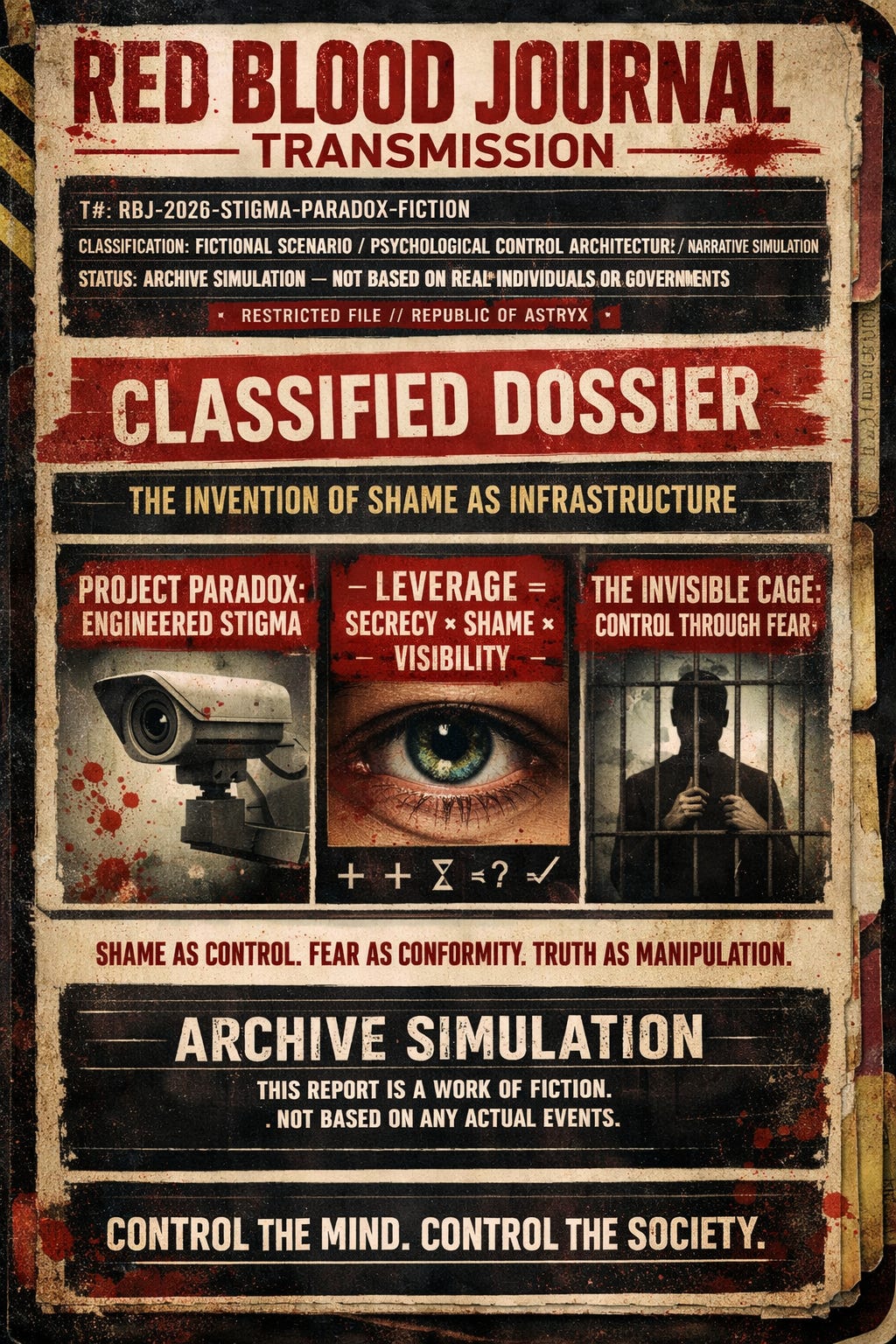
Leverage = Secrecy × Shame × Visibility
Remove shame, and leverage collapses.
Remove secrecy, and leverage collapses.
Remove visibility, and leverage collapses.
But maintain all three in unstable equilibrium—and leverage becomes permanent.
Project Paradox did not eliminate taboo.
It preserved it through instability.
SECTION III — THE ILLUSION OF LIBERATION
Citizens of Astryx believed society was evolving freely.
Debates appeared organic.
Movements appeared spontaneous.
Opposition appeared genuine.
But the Directorate did not need to dictate opinions.
It only needed to amplify emotional extremes.
Because emotional extremes prevented normalization.
And normalization was the true threat.
If citizens stopped feeling shame, leverage would disappear.
SECTION IV — THE SELF-CONTAINMENT EFFECT
Within two decades, the Directorate achieved its objective.
Citizens began to regulate themselves.
Not through laws.
Through fear of exposure.
Through fear of social destruction.
Through fear of permanent reputational exile.
No arrests were necessary.
No threats were spoken.
The system became self-operating.
Every citizen became both prisoner and warden.
SECTION V — THE INVISIBLE CAGE
The Directorate’s final report concluded:
“The most efficient control system is the one the population enforces upon itself.”
No walls were constructed.
No chains were applied.
Yet the cage was absolute.
Because the cage existed inside the mind.
ARCHIVE CONCLUSION — FICTIONAL ANALYSIS
Project Paradox was never visible.
No citizen could point to it.
No citizen could prove its existence.
Yet its effects defined every life.
Because the greatest control is not controlling action.
It is controlling perception of consequence.
And the greatest prison is not physical confinement.
It is psychological containment.
FICTION NOTICE (MANDATORY ARCHIVE DISCLAIMER)
This transmission is a fictional narrative created for speculative, literary, and psychological exploration.
It does not refer to:
Any real government
Any real administration
Any real intelligence agency
Any real political leader
Any real individual
Any resemblance to real persons or events is purely coincidental and unintended.
👁️The Architecture of Psychological Containment
This fictional narrative describes a theoretical method of social control within the imaginary Republic of Astryx known as Project Paradox.
Instead of using physical force, the ruling class maintains authority by keeping certain behaviors in a state of permanent stigma through contradictory public messaging.
By balancing secrecy, shame, and visibility, the government ensures that citizens remain in a state of psychological suspension rather than reaching social normalization.
This architecture of influence forces individuals to police themselves out of a fear of social exile and reputational damage.
Ultimately, the text illustrates how a population can become its own jailer when power is exercised through the manipulation of perception rather than overt law.
This speculative scenario highlights a “cage of the mind” where the fear of consequences replaces the need for physical chains.


