


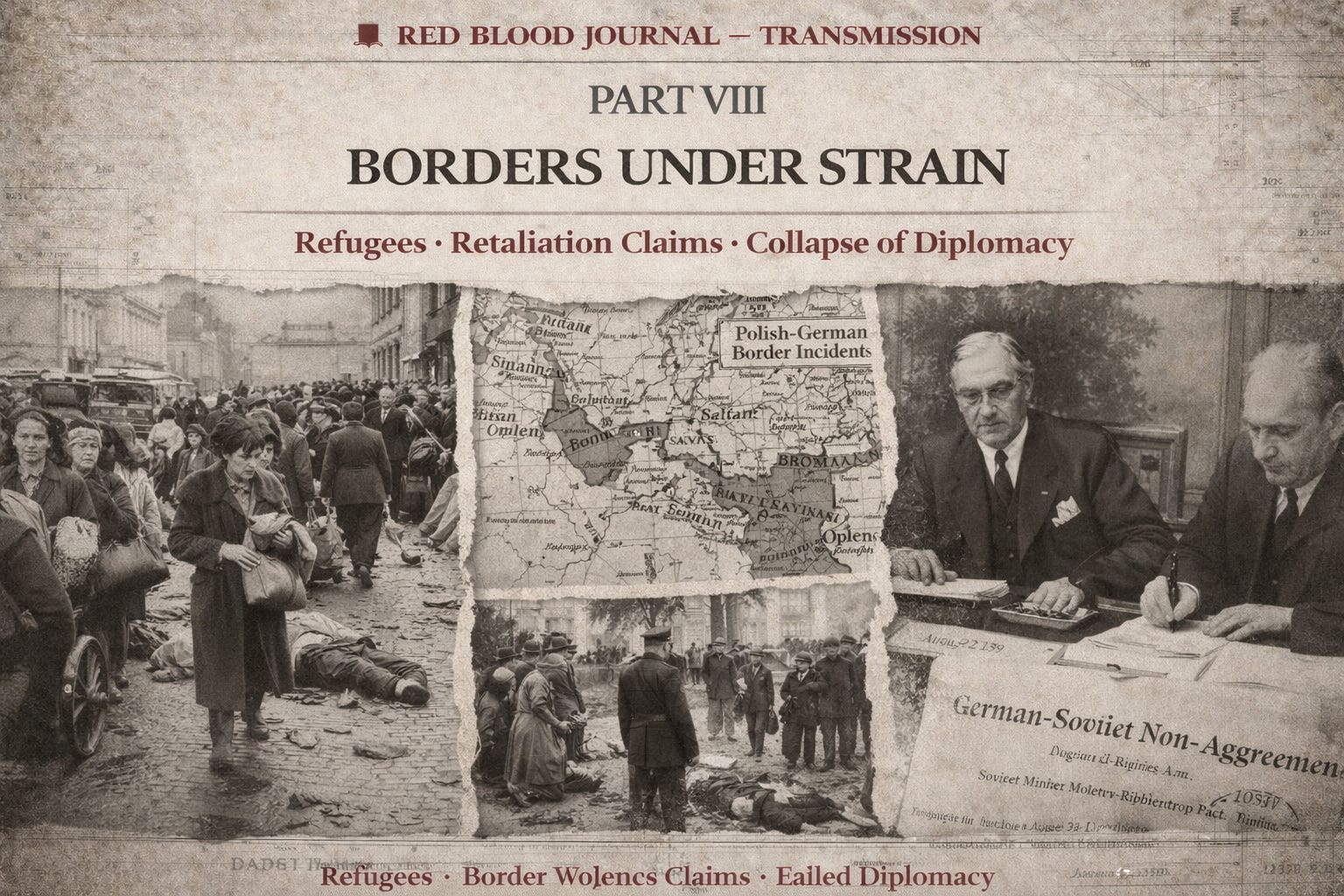
🩸 RED BLOOD JOURNAL — TRANSMISSION
PART VIII EUROPA THE LAST BATTLE
BORDERS UNDER STRAIN
Refugees, Border Violence, and the Collapse of European Diplomacy (1919–1939)
Classification: Contested History / Pre-War Escalation
Author’s Note: This report examines claims often omitted or minimized in mainstream narratives, while also identifying where evidence is disputed or fragmentary. No moral absolution is implied.
PROLOGUE — WHY THIS PART EXISTS
Most histories of World War II begin cleanly on September 1, 1939.
This report begins before that date, in the unstable years when borders were redrawn, minorities stranded, and violence normalized long before formal declarations of war.
What follows is not a verdict.
It is a record of pressures.
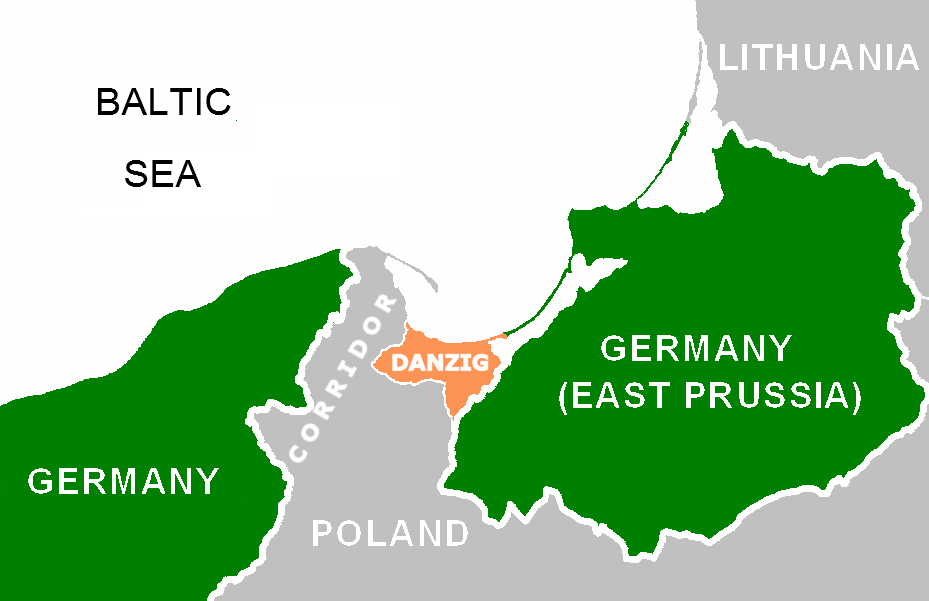
I. THE POST-VERSAILLES BORDER REALITY
After World War I, the Treaty of Versailles and related settlements reshaped Central and Eastern Europe:
Germany lost territory
New states were formed
Millions of ethnic minorities—Germans, Poles, Jews, Ukrainians, others—were left outside their historic national borders
By the early 1920s:
Ethnic Germans lived as minorities in Poland, Danzig, Czechoslovakia, and the Baltic regions
Poland inherited volatile border zones, especially the Polish Corridor and Free City of Danzig
These areas became flashpoints, not because of ideology alone, but because sovereignty, security, and identity were unresolved
This context is essential. Without it, later events appear sudden. With it, they appear cumulative.
II. CLAIMS OF BORDER VIOLENCE (1920s–1939)
Numerous contemporary German, Polish, and international sources—not all mutually consistent—describe:
Cross-border raids
Property seizures
Intimidation of minorities
Political assassinations
Armed clashes between partisans and police
German accounts emphasize:
Attacks on ethnic German civilians
Sabotage of farms, railways, and customs posts
Refugee flows into the Reich during the 1930s
Polish sources often counter:
That German paramilitaries provoked incidents
That German intelligence exaggerated or staged events
That internal Polish security measures were responses to separatism
Both sets of claims exist.
Neither side held a monopoly on truth—or fabrication.
III. THE BROMBERG / BYDGOSZCZ EVENTS (1939)
One of the most disputed episodes is the violence in Bromberg (Bydgoszcz) in early September 1939.
Claims include:
Hundreds to several thousand ethnic Germans killed
Civilian mobs, partisans, and military involvement
Retaliatory violence by German forces after occupation
Postwar investigations produced conflicting figures:
German wartime estimates were high
Polish postwar figures were significantly lower
Independent verification remains incomplete due to destroyed records and wartime propaganda
What is historically uncontested:
Civilians died
Ethnic identity played a role
The events were immediately weaponized by all sides for political justification
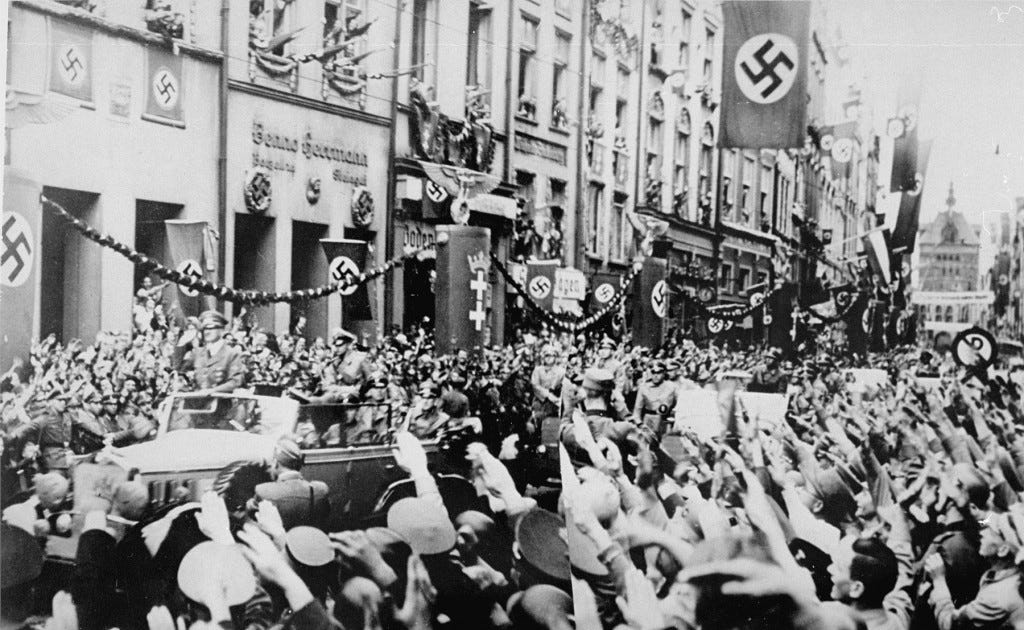
IV. REFUGEES BEFORE THE WAR — NOT AFTER
A critical but often overlooked point:
Large refugee movements preceded September 1939.
By late summer 1939:
Tens of thousands of ethnic Germans had already fled Polish territory
Fear, rumors, and reprisals accelerated displacement
Local violence—real or perceived—created irreversible panic
This matters because it challenges the simplified idea that population displacement began only after invasion.
In reality, collapse began earlier.
V. FAILED DIPLOMACY AND REJECTED PROPOSALS
Between 1934 and 1939, multiple proposals circulated concerning:
Danzig’s status
Transit corridors
Plebiscites
Demilitarization
Minority protections
Germany presented proposals.
Poland rejected them.
Britain and France guaranteed Polish security.
The Soviet Union watched—and waited.
Historians disagree on motives:
Some argue proposals were genuine attempts at compromise
Others argue they were tactical steps toward inevitable conflict
What is clear:
Negotiation hardened into ultimatum culture, and trust evaporated.
VI. THE GREAT POWER GAME
By 1938–1939:
Britain and France feared German dominance
Poland felt emboldened by Allied guarantees
The Soviet Union maneuvered for territorial advantage
Germany feared encirclement and a two-front war
The Molotov–Ribbentrop Pact did not cause the crisis.
It froze one front in a crisis already boiling.
VII. SEPTEMBER 1939 — A LINE, NOT A BEGINNING
When Germany crossed into Poland on September 1, 1939:
Border violence had already occurred
Refugees already existed
Propaganda already dominated public perception
Diplomatic channels were already broken
The invasion marked escalation, not origin.
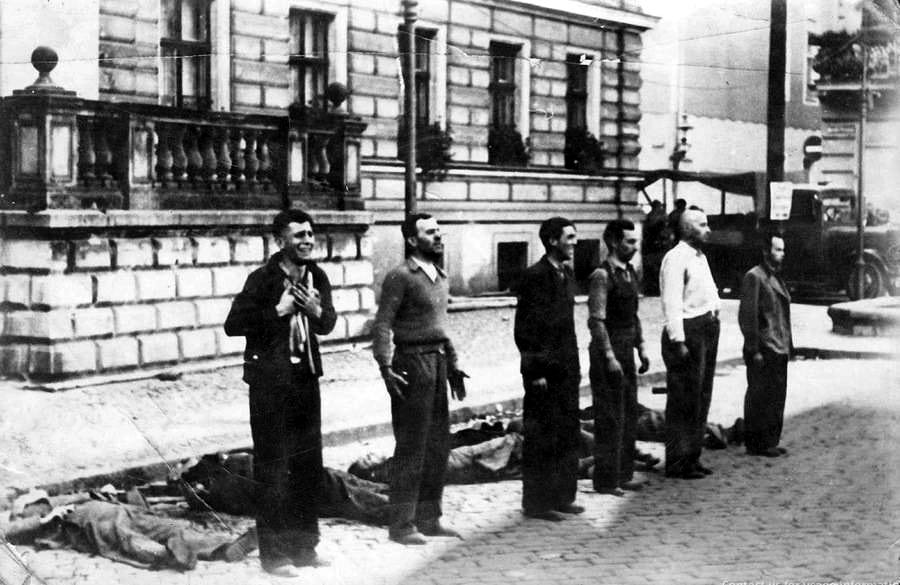
VIII. WHY THIS HISTORY IS CONTROVERSIAL
This period remains radioactive because:
It complicates moral binaries
It challenges postwar political settlements
It forces acknowledgment of suffering outside dominant narratives
It is vulnerable to ideological misuse
For that reason, many histories simplify it—or omit it entirely.
AUTHOR’S CLOSING NOTE
This report does not argue innocence.
It does not argue guilt.
It argues context.
Understanding how Europe collapsed into war requires acknowledging:
Minority tensions
Border instability
Pre-war violence
Diplomatic failure
Propaganda on all sides
History does not begin when it is convenient.
It begins when pressure becomes unbearable.
⚖️Border Violence Before World War II
This historical overview examines the volatile territorial disputes and ethnic tensions in Central Europe that preceded the official start of World War II.
It argues that the redrawing of borders after the First World War created unstable environments where minority populations faced systemic violence and displacement long before 1939.
The text highlights how conflicting claims regarding border raids and civilian casualties, such as the events in Bromberg, were utilized as political propaganda by various nations.
Furthermore, the report suggests that the failure of diplomacy and the movement of refugees indicate a collapse of order that began well before the German invasion.
Ultimately, the source contends that the war was the result of cumulative pressures and unresolved regional grievances rather than a sudden, isolated event.


