


🩸 RED BLOOD JOURNAL — TRANSMISSION T#BND-CHANUKAH-001
Classification: Restricted Circulation
Date: 14 December 2025
Subject: Bondi Beach Hanukkah Massacre — Anatomy of an Event That Was Not Supposed to Happen
PROLOGUE — THE CRIME THAT SLIPPED THROUGH EVERY NET
A father. A son. Guns. A crowded beach. A religious celebration.
At least fifteen dead.
The official story is already assembling itself—clean, linear, emotionally sufficient. Two radicalized men. Lone actors. Antisemitic hatred. Tragedy strikes without warning.
Red Blood does not reject grief.
Red Blood interrogates inevitability.
Because this did not simply “happen.”
I. THE IMPOSSIBILITY PROBLEM
Bondi Beach is not an unguarded village square.
It is:
One of the most surveilled public spaces in Australia
Ringed by CCTV, mobile carrier tracking, license-plate readers
Regularly policed during religious and political gatherings
Located in a city that has spent two decades perfecting counter-terror protocols
Yet a two-man gun team, allegedly including improvised explosive devices, reached:
A dense crowd
During a known, advertised religious event
And sustained violence for minutes, not seconds
This raises the first forbidden question:
What layers of detection failed simultaneously — and why?
Failures can happen.
Cascades of failures require explanation.
II. THE FATHER–SON VARIABLE
The media emphasizes the relationship as if it explains something.
It doesn’t.
It complicates everything.
Consider:
Radicalization models rarely rely on inter-generational dyads
Law-enforcement risk matrices flag family networks early
A father–son pair leaves long digital, social, financial trails
Which leads to the second question:
Were they truly invisible — or previously known?
Because in modern counter-terror systems, unknown actors are rare.
Unacted-upon known actors are common.
III. THE EVENT WAS KNOWN — THAT MATTERS
This was not a spontaneous gathering.
It was:
Publicly announced
Repeated annually
Advertised online
Attended by families
Predictable in time and place
Every security doctrine treats this as high-risk soft-target geometry.
So ask the third question:
What was the security posture — and who signed off on it?
Absence of visible security can mean one of two things:
Gross negligence
Assumed coverage by invisible systems
If invisible systems failed, why were they trusted at all?
IV. THE IED DETAIL THAT VANISHED
Early reporting briefly referenced improvised explosive devices.
Then:
Language softened
Emphasis returned to firearms
The IED angle receded from headlines
This is a pattern Red Blood has seen before:
When a narrative introduces complexity that implies planning, training, or networks, it is quietly minimized.
Because explosives mean:
Knowledge transfer
Materials acquisition
Testing
Storage
Detection opportunities
Which triggers the fourth question:
Who benefits from the public believing this was “just guns”?
V. THE SPEED OF THE STORY
Within hours:
Motive was declared
Actors were categorized
Context was framed
Moral conclusions were issued
This speed is not accidental.
Fast narratives:
Prevent contradictory facts from breathing
Lock emotional interpretation early
Reduce public appetite for process-level scrutiny
Red Blood notes the pattern:
When the story is settled before the investigation begins, the investigation rarely unsettles the story.
VI. THE CONTROL LAYER — WHAT FOLLOWS TRAGEDY
Every major mass-casualty event activates secondary mechanisms:
Expanded surveillance mandates
Accelerated digital ID discussions
Pre-emptive policing powers
Speech classification and moderation
“Community protection” funding streams
This is not conjecture.
It is precedent.
The question is not if new measures follow — but which ones were already drafted.
Because legislation moves fastest when grief removes resistance.
VII. THE UNASKED QUESTION
The most dangerous question is the one nobody is allowed to ask:
If the state cannot protect a publicly known religious gathering in a hyper-surveilled city, what exactly is the surveillance for?
If the answer is after-the-fact narrative control rather than prevention—
then the system is functioning exactly as designed.
VIII. WHAT RED BLOOD IS NOT CLAIMING
This transmission does not assert:
False flag certainty
State orchestration
Pre-known inevitability
It asserts something more unsettling:
That modern power systems prioritize narrative containment over systemic accountability.
IX. THE REAL CRIME SCENE
The beach was only the first scene.
The real crime scene is:
The chain of ignored signals
The architecture of “acceptable failure”
The bureaucratic immunity that follows
The silence around process-level culpability
Violence pulls the trigger.
Systems load the weapon.
X. CLOSING TRANSMISSION
Grieve the dead.
Honor the victims.
Reject the lie that this was unforeseeable.
Because when every warning system exists except the will to act,
the tragedy is not an accident.
It is an outcome.
🩸 END TRANSMISSION
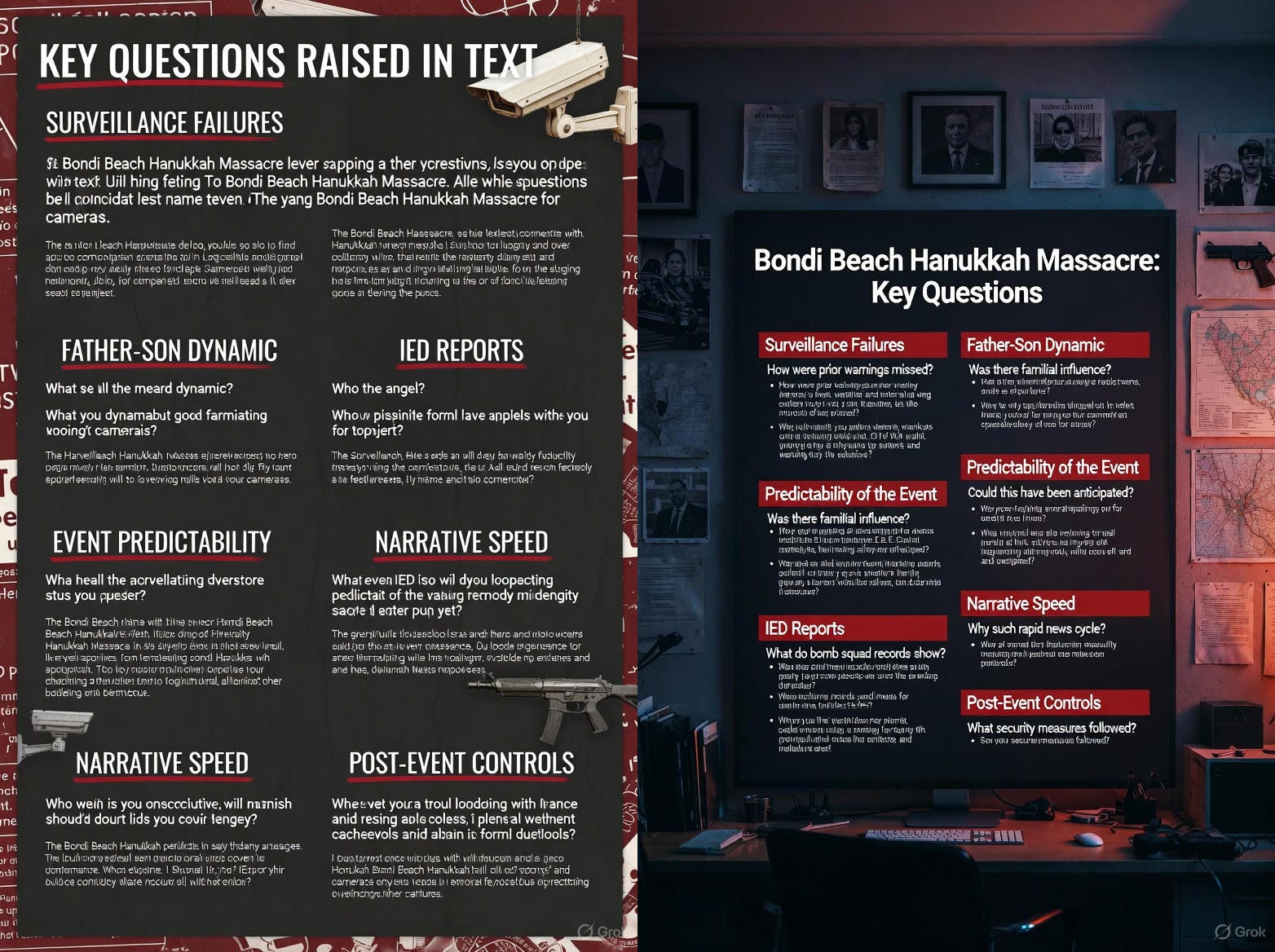
The provided text, “Bondi Beach Massacre: Anatomy of System Failure” from the Red Blood Journal, serves as a critical examination of a mass-casualty event that occurred during a religious celebration.
The analysis rejects the official narrative of the Hanukkah Massacre, which quickly attributed the tragedy to isolated “lone actors” motivated by antisemitic hatred.
Instead, the author presents ten key points questioning how a heavily surveilled and prepared location could permit a father-son team to sustain violence for minutes without intervention.
The text suggests that the immediate focus on motive and narrative overshadowed systemic failures in intelligence, detection, and security protocols, highlighting inconsistencies like the rapid minimization of initial reports about improvised explosive devices (IEDs).
Ultimately, the source argues that the quick framing of the event prioritized narrative control and accelerated new legislation over genuine process-level accountability for the cascading failures that led to the deaths.


