


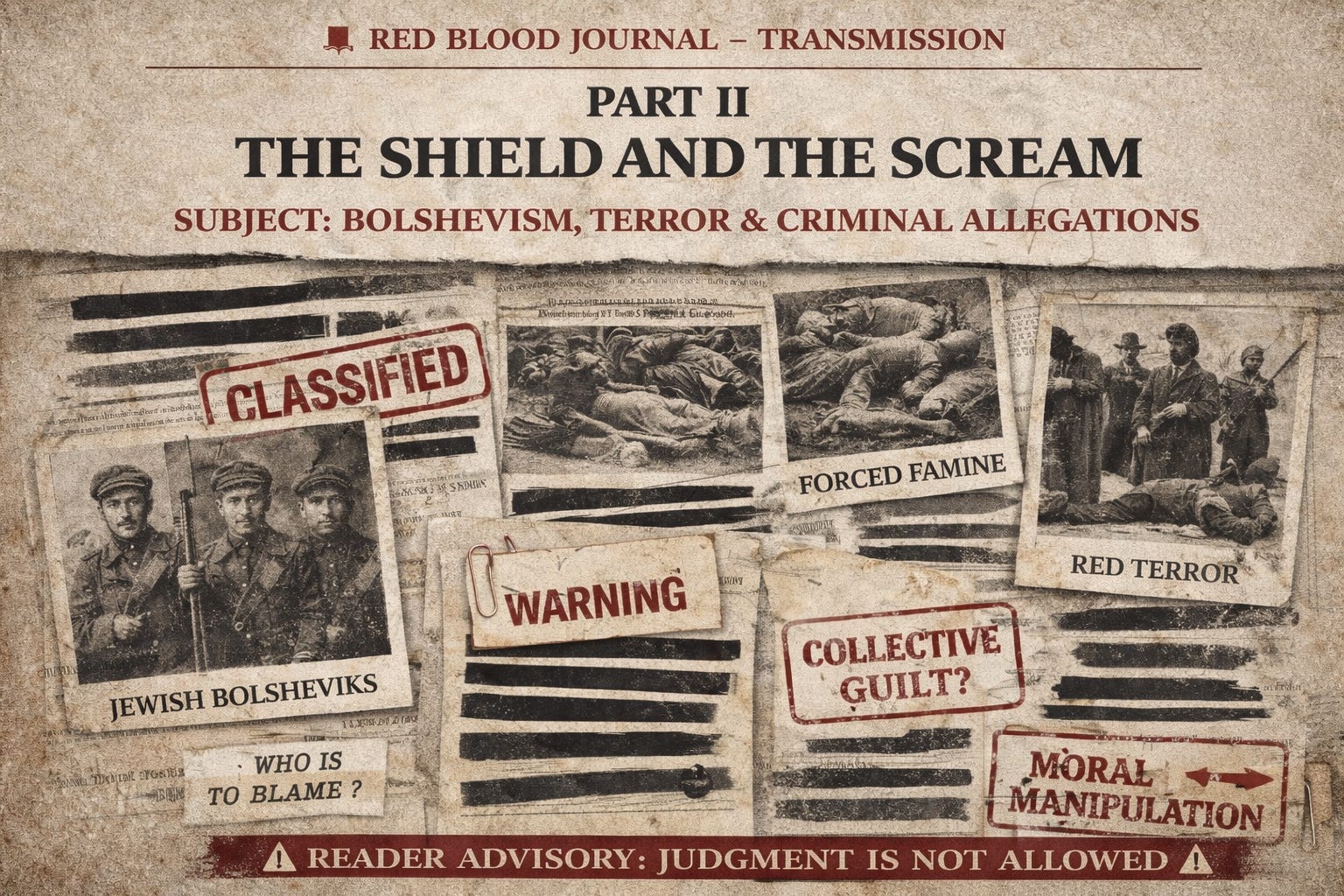
🩸 RED BLOOD JOURNAL — TRANSMISSION
PART II — THE SHIELD AND THE SCREAM
Subject: Bolshevism, Terror, and the Claim That Criticism Is Impossible
Status: Active Examination
Judgment: Reserved
I. THE OPENING MOVE — SILENCE AS PROOF
This section of the documentary does not begin with evidence.
It begins with a warning.
You are told that the moment you speak negatively about Jews, you will be labeled an anti-Semite.
Not because you are wrong — but because this label is allegedly a defensive weapon, used to shut down analysis and conceal crimes.
This is the first move.
If disagreement equals guilt, then no counter-argument can exist.
If objection equals proof of conspiracy, then logic is already defeated.
The reader should pause here.
Because any argument that declares itself immune to challenge is not seeking truth — it is securing territory.
II. FROM CRITIQUE TO COLLECTIVE CHARACTER
The narrative then accelerates.
What begins as criticism of Bolshevik violence quickly becomes something else:
a description of “Jewish philosophy” as criminal, immoral, and supremacist in nature.
At this point, the documentary stops analyzing actions and begins assigning character — not to individuals, not to institutions, but to an entire people.
This is a critical transition.
Systems disappear.
Structures disappear.
Power incentives disappear.
What remains is identity.
When ideology is replaced with ethnicity, explanation becomes accusation.
III. THE BOLSHEVIK QUESTION — WHAT IS BEING BLAMED?
The documentary is correct about one thing:
Bolshevik rule in Russia involved terror on a massive scale.
Forced collectivization.
Political purges.
Mass imprisonment.
Famine.
Execution quotas.
The gulag system.
Millions died. That is not in dispute.
But the documentary does not stop at describing what happened.
It insists on answering why — and it chooses a single answer:
Bolshevism was not a Russian revolution, but an ethnic invasion.
This is the core claim.
Not that Bolsheviks committed atrocities —
but that they did so because they were Jews.
This is where analysis must slow down.
IV. NUMBERS AS WEAPONS
Death tolls are introduced next — large ones, stated with certainty.
Tens of millions.
Sometimes more.
The famines of 1921–22, 1932–33, 1946–47 are grouped together and described as deliberate genocidal programs, attributed to a “Jewish Bolshevik regime.”
Here, the reader should ask:
Are these numbers agreed upon across sources?
Are intent and outcome being treated as the same thing?
Is ethnicity being used as evidence, or as explanation?
The documentary does not show the work.
It delivers the verdict.
And once again, disagreement is framed as proof of media control.
V. HORROR AS CERTAINTY
This section is saturated with brutality.
Graphic descriptions of torture.
Executions.
Starvation.
Cannibalism.
Children murdered.
Bodies mutilated.
These things happened — but not in the way the documentary presents them.
The horror is real.
The framing is not.
Atrocity is being used to create moral certainty, and that certainty is being attached to a collective identity.
This is not historical reconstruction.
It is emotional locking.
Once the reader is horrified enough, logic no longer feels necessary.
VI. QUOTES THAT CLOSE THE CASE
The documentary leans heavily on quotations — Lenin, Trotsky, Bolshevik officials, newspaper excerpts — presented as proof of intent.
Some of these statements are real.
Some are distorted.
Some are disputed.
Some circulate only in secondary propaganda sources.
But even if every quote were authentic, the leap remains:
From violent rhetoric →
to ethnic conspiracy →
to collective guilt.
A quote proves a person spoke words.
It does not prove a people planned history.
VII. THE UNFALSIFIABLE LOOP
This is the most important mechanism in Part II.
If you agree, the documentary is correct.
If you disagree, it proves media control.
If you ask for evidence, you are accused of denial.
If you point out complexity, you are accused of complicity.
There is no exit.
This is not analysis.
This is a closed system.
And closed systems are how propaganda survives scrutiny.
VIII. WHAT IS MISSING — AND WHY IT MATTERS
Absent from this section are questions that would threaten the narrative:
Why did Bolshevism later purge Jews as well?
Why did ideology, not ethnicity, determine loyalty?
Why were non-Jewish Bolsheviks equally brutal?
Why did the Soviet system turn on its own architects?
Why did terror follow institutional incentives, not lineage?
These questions are dangerous — not because they excuse crimes, but because they break the spell.
IX. RED BLOOD JOURNAL POSITION — PART II
This transmission does not deny Soviet atrocities.
It does not minimize suffering.
It does not defend Bolshevism.
But it rejects the replacement of mechanism with identity.
Once blame becomes collective, truth stops mattering.
Once criticism becomes racial, power hides behind outrage.
Once horror becomes proof, logic is no longer required.
That is not exposure.
That is misdirection.
X. RETURNING JUDGMENT TO THE READER
You are not being asked to protect institutions.
You are not being asked to protect historians.
You are not being asked to protect any group.
You are being asked to protect your ability to reason.
Ask yourself:
Does this explanation require a people to be inherently evil?
Does it survive if ethnicity is removed from the equation?
Does it allow falsification — or only belief?
If the answer is no, then whatever truth it contains is being used as bait.
⚖️Bolshevism, Terror, and the Claim That Criticism Is Impossible
This text critiques a documentary that attributes the violent atrocities of Bolshevik rule to a specific Jewish ethnic conspiracy rather than political ideology.
The author argues that the film uses graphic historical horrors to bypass logical reasoning and instill a sense of moral certainty in the viewer.
By framing any disagreement as proof of media manipulation, the documentary creates an unfalsifiable loop that prevents genuine historical analysis.
The source warns that replacing systemic explanations with collective identity serves as a form of propaganda rather than a search for truth.
Ultimately, the passage encourages readers to protect their reasoning by questioning narratives that demand belief over evidence.


