


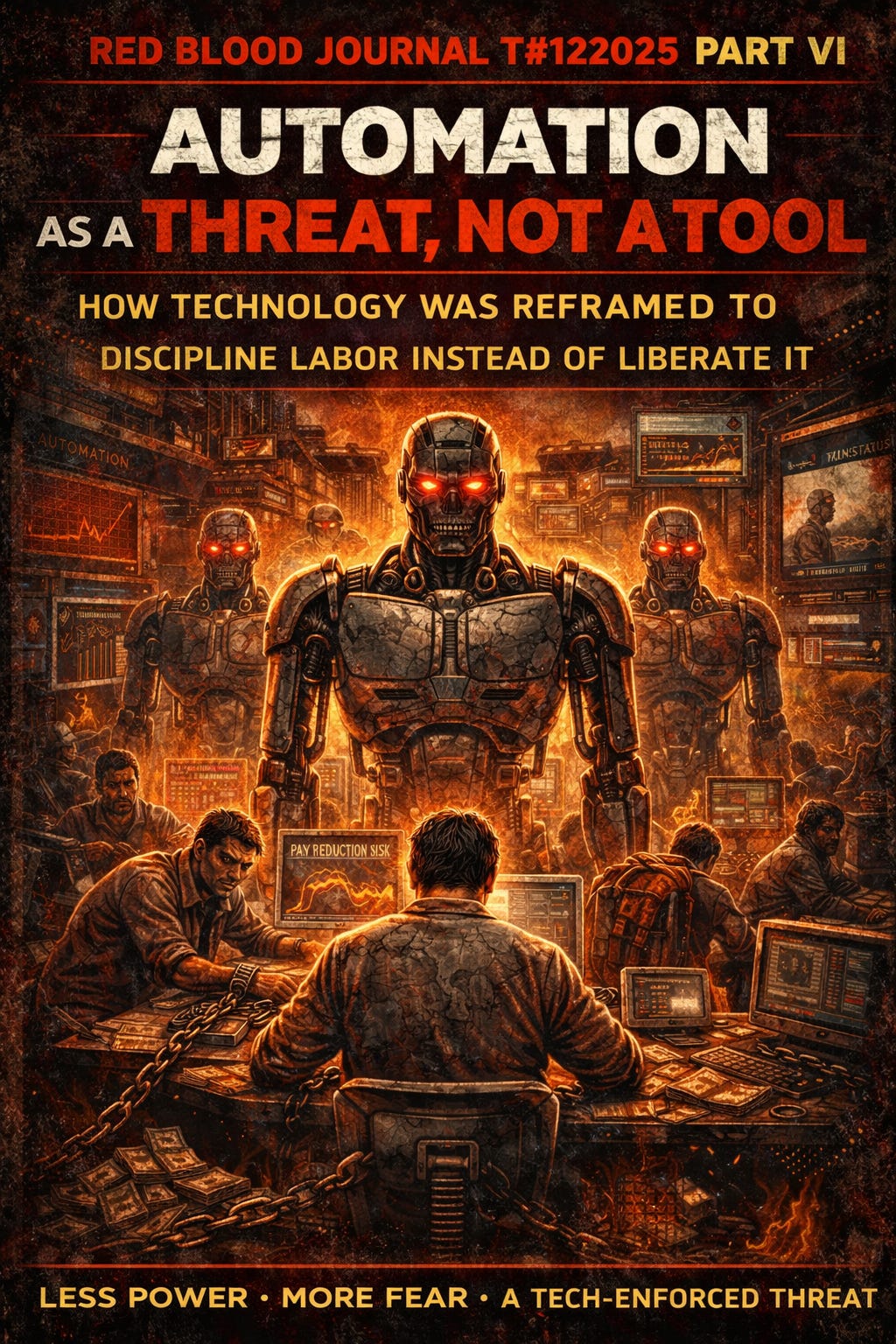
🩸 RED BLOOD JOURNAL — CONSPIRACY TRANSMISSION
T#122025–UNEMPLOYMENT–PSYOP
PART VI
AUTOMATION AS A THREAT, NOT A TOOL
How Technology Was Reframed to Discipline Labor Instead of Liberate It
Classification: Deep Pattern Analysis / Technological Control Systems
Distribution: Restricted
Method: Conspiracy Lens (Structural, Incentive-Based, Non-Allegorical)
PROLOGUE — THE PROMISE THAT WAS NEVER KEPT
Automation was sold as emancipation.
Machines would:
Reduce drudgery
Shorten work hours
Increase leisure
Share productivity gains
That future never arrived.
Instead, automation became a weaponized narrative—not to free workers, but to keep them compliant.
I. THE ORIGINAL LIE: TECHNOLOGY IS NEUTRAL
The public is taught that technology is value-neutral.
This is false.
Technology inherits the incentives of those who deploy it.
In a system optimized for profit extraction, automation does not reduce labor—it disciplines it.
II. AUTOMATION AS A PERMANENT BACKGROUND THREAT
Automation rarely needs to be fully implemented to be effective.
Its power lies in anticipation.
Workers are told:
“Your job may be automated”
“AI is coming”
“Robots don’t unionize”
This creates a constant psychological state:
Replaceability anxiety.
Fear does the work automation doesn’t need to.
III. THE PRE-EMPTIVE SURRENDER LOOP
Once automation is positioned as inevitable, workers internalize a quiet logic:
“I should accept less now, before I’m replaced.”
This produces:
Lower wage demands
Reduced organizing
Increased compliance
Self-censorship
The threat achieves its goal without mass layoffs.
IV. SELECTIVE AUTOMATION — NOTICE WHAT NEVER DISAPPEARS
Automation is rarely applied evenly.
Jobs that vanish:
Clerical work
Manufacturing
Customer service
Logistics
Jobs that remain untouched:
Executive management
Financial engineering
Rent extraction
Speculative capital roles
Automation is not about efficiency.
It is about replacing those with the least power.
V. AI AS A WAGE SUPPRESSION DEVICE
Artificial Intelligence is marketed as productivity enhancement.
In practice, it is used to:
Deskilling jobs
Compress roles
Eliminate bargaining leverage
Justify wage stagnation
Once a job is “AI-assisted,” it is reclassified as lower-value—regardless of output.
The worker becomes an accessory to the machine.
VI. DATA THEFT DISGUISED AS INNOVATION
Workers are unknowingly used to:
Train algorithms
Generate optimization data
Create institutional intelligence
Once extracted, this data:
Replaces them
Competes against them
Is owned by capital indefinitely
This is knowledge expropriation, not innovation.
VII. WHY GAINS ARE NEVER SHARED
If automation truly reduced labor costs, workers would expect:
Higher wages
Shorter hours
Shared dividends
Instead, automation delivers:
Layoffs
Speedups
Surveillance
Performance metrics
Productivity gains are captured upstream.
Risk is pushed downstream.
VIII. THE SURVEILLANCE TURN
Modern automation is inseparable from surveillance.
Workers are:
Timed
Tracked
Scored
Ranked
This creates a digital panopticon.
A watched worker does not organize.
A scored worker competes with peers.
Solidarity collapses.
IX. THE FALSE CHOICE — ADAPT OR DIE
Workers are presented with a binary:
Adapt to automation
Or be replaced by it
What is never offered:
Ownership
Control
Democratic input
Shared gains
The future is framed as inevitable—so resistance appears irrational.
X. THE END STATE — HUMANS AS TEMPORARY INTERFACES
In the automation control model:
Humans are transitional
Value is extracted quickly
Knowledge is captured permanently
The goal is not replacement.
It is dependency until replacement is possible.
CONCLUSION — AUTOMATION WAS TURNED AGAINST LABOR
Automation could have:
Freed humanity from scarcity
Reduced working hours
Democratized abundance
Instead, it was weaponized as:
A threat
A bargaining chip
A compliance engine
Not because that outcome was inevitable.
But because power chose it.
Automation is not the enemy.
The ownership of automation is.
🩸 END PART VI
⛓️AUTOMATION AS A THREAT, NOT A TOOL
This text examines how automation functions as a psychological and structural tool designed to exert control over the modern workforce.
Rather than fulfilling the historical promise of liberating workers from toil, the author argues that technology is weaponized to instill fear and ensure employee compliance through the constant threat of replacement.
The narrative highlights how selective implementation and surveillance allow corporations to suppress wages and dismantle collective bargaining power while capturing all productivity gains for the elite.
By reframing automation as an inevitable force of nature, the system forces laborers into a state of preemptive surrender where they accept lower standards of living.
Ultimately, the source contends that the problem is not the existence of technology itself, but the monopolization of its ownership by those who use it to exploit rather than empower humanity.


