


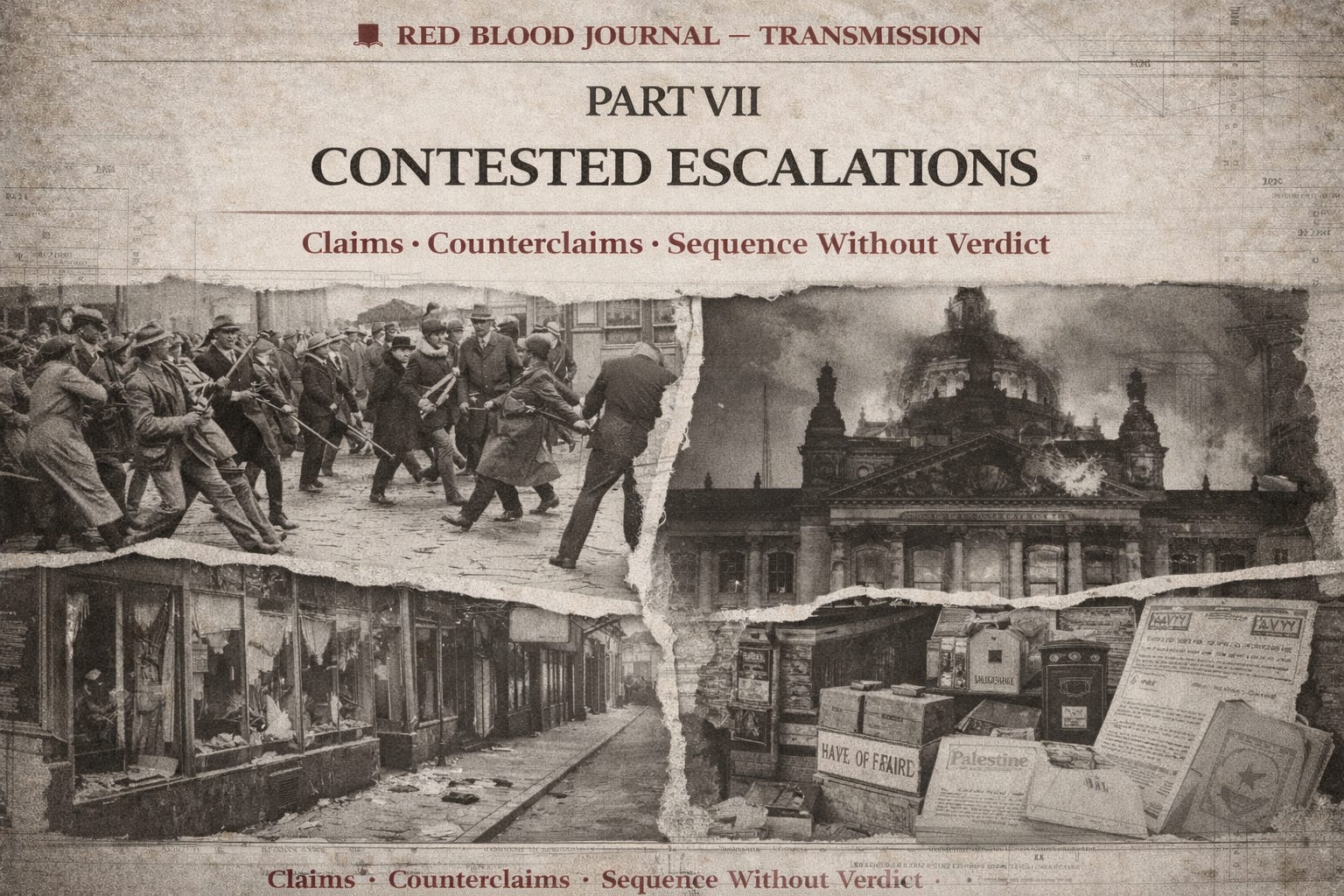
🩸 RED BLOOD JOURNAL — TRANSMISSION
PART VII — CLAIMS, CONTEXT, AND CONTESTED SEQUENCES (1923–1939)
Classification: Historical Claims Under Review
Position: Neutral Examination / No Endorsement
Addressed To: The Reader
PROLOGUE — WHY THIS PART IS DIFFERENT
This section contains some of the most consequential and most disputed claims in the entire series.
It deals not only with events, but with attribution of motive, assignment of responsibility, and interpretations of causality that—if mishandled—collapse analysis into accusation.
For that reason, this report does not retell the claims as fact.
It maps what is being claimed, what can be verified, what is disputed, and where evidence diverges or ends.
I. CORE CLAIMS PRESENTED IN PART VII (AS CLAIMS)
Part 7 asserts, broadly, that between 1923 and 1939:
Germany experienced sustained internal political violence, including:
Murders of nationalist figures
Armed actions by communist cells
Escalating street conflict between political factions
Communist organizations were involved in violent activity, including:
Assassinations
Attempts at destabilization
The Reichstag fire (attributed here to communist action)
State responses (emergency decrees, arrests, bans) are framed as:
Preventive measures against civil war
Not ideologically motivated repression
Kristallnacht (1938) is framed as:
A reactionary outbreak following specific violent incidents
Not a centrally planned state pogrom
Jewish emigration policies (e.g., Havara Agreement) are presented as:
Evidence of an early preference for relocation over destruction
A cooperative arrangement between German authorities and Zionist organizations
Later wartime policies (Madagascar Plan, deportations) are framed as:
Logistical or geopolitical responses
Not initial genocidal intent
The term “Final Solution” is argued to:
Pre-date National Socialism
Originate in Zionist political language
Be later retroactively reinterpreted
These are claims, not conclusions.
II. WHAT IS DOCUMENTABLE VS. WHAT IS DISPUTED
A. Areas with Partial or Substantial Documentation
These areas do have archival material, though interpretation varies:
Political violence in Weimar Germany
Communist–nationalist street conflict
Emergency decrees following the Reichstag fire
The existence of the Havara (Transfer) Agreement
Early Nazi-era emigration policy discussions
Use of the phrase “Final Solution” prior to 1941
B. Areas of Heavy Dispute or Contested Interpretation
These claims cannot be accepted without caution:
Unified intent across entire ethnic or religious populations
Attribution of all communist violence to one identity group
Characterization of Kristallnacht as wholly unsanctioned
Claims of purely defensive motivations without ideological factors
Assertions that no extermination intent existed after 1941
These are debated precisely because historians disagree, not because the questions are forbidden.
III. ON CAUSALITY VS. SEQUENCE
One of the most common analytical failures in historical revision—mainstream or counter—is confusing sequence with causation.
Violence preceding repression does not automatically justify repression
Repression following violence does not prove innocence
Earlier use of terminology does not define later implementation
Diplomatic or economic pressure does not equal formal warfare
Emotional retaliation does not replace documented intent
This report refuses to collapse complexity into moral arithmetic.
IV. ON LANGUAGE AND RISK
Part 7 relies heavily on:
Collective descriptors
Emotional intensifiers
Moral absolutism
Retrospective certainty
These techniques increase persuasive force but decrease analytical reliability.
This does not make the claims false.
It makes them require corroboration.
V. WHAT THIS PART DOES NOT SETTLE
This section does not resolve:
Ultimate responsibility for escalation into total war
Whether specific acts justify subsequent state policy
Whether intent evolved over time (and if so, when)
Whether historians omit material deliberately or selectively
Whether alternative outcomes were realistically possible
Those questions remain open—and must remain open—if neutrality is to be preserved.
VI. FINAL STATEMENT TO THE READER
This part is not an answer.
It is a catalog of contested assertions.
If you feel pulled toward certainty—pause.
If you feel repelled—pause again.
History demands discipline, not allegiance.
You are not being asked to believe.
You are being asked to examine.
🩸 End of Part VII — Analytical Brief
⚖️Analyzing Contested Nazi Germany Narratives
The provided text from the Red Blood Journal serves as a neutral analytical overview of controversial historical claims regarding Germany between 1923 and 1939.
It catalogs specific assertions concerning political violence, the origins of the "Final Solution" terminology, and the motivations behind state-sponsored repression.
Rather than presenting these points as established facts, the source functions as a methodological guide that distinguishes between documented archival evidence and highly contested interpretations.
The document emphasizes the importance of historical discipline, warning readers against confusing the chronological sequence of events with direct causality.
Ultimately, the text encourages a critical examination of history by mapping out the divergence between revisionist claims and mainstream academic consensus.


