


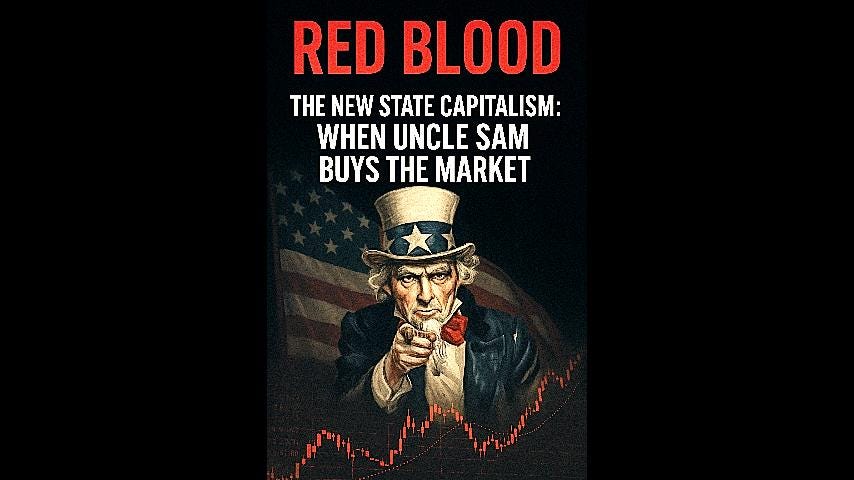
1. The Quiet Buy-In
In the shadows of legislative jargon and patriotic slogans, Washington has begun doing something it long warned other nations against: buying the market.
Recent disclosures show the federal government now owns:
≈10 % of Intel — via equity conversions under the CHIPS and Science Act
≈15 % of MP Materials — the sole U.S. rare-earth-mining firm, funded by the Pentagon through convertible preferred stock
≈10 % of Lithium Americas — through Department of Energy stock warrants tied to a $2.3 billion loan
≈10 % of Trilogy Metals — following federal infrastructure funding in Alaska
A “golden share” in U.S. Steel — giving veto power over any sale, merger, or plant closure deemed a national-security concern
This is no traditional privatization or nationalization—it’s equity infiltration. Using the CHIPS Act, Defense Production Act, and Energy Loan Guarantee programs, Treasury and Defense now negotiate ownership stakes instead of mere subsidies.
2. The Justification: “National Security”
The official line is familiar: “strategic autonomy.”
After decades of watching China dominate rare earths (90 %), lithium refining (70 %), and solar manufacturing (80 %), Washington argues it must secure the technological lifelines of the twenty-first century.
Yet behind that patriotic veneer lies a philosophical shift:
If you can’t beat a command economy, join it.
By adopting China’s playbook—state stakes, subsidies, and industrial targeting—the U.S. is blurring its own identity as the champion of free markets.
3. The Consequences: Winners, Losers, and the End of Neutral Capitalism
When the referee becomes a player, the game changes.
Political Capital > Innovation.
Companies now compete for Washington’s favor rather than consumers’ trust.
Lobbying replaces R&D.Market Distortion.
Investment may flow toward firms with friends, not ideas—mirroring China’s “rent-seeking” system.Safety-Net Markets.
With taxpayer equity at stake, the state has motive to prop share prices—especially in election years—creating a quasi-engineered market.Automation Over Jobs.
The celebrated “factory boom” hides a truth: most new plants will be robotic. These aren’t the steel-mill jobs of 1940—they’re server farms run by PhDs.
4. Historical Echoes
During the 1940s wartime economy, Washington seized control of steel, oil, and weapons.
Today, it’s AI, semiconductors, and lithium—the digital arsenal.
In Strauss-Howe’s Fourth Turning theory, each cycle ends with government consolidation of industry to ensure survival.
If that pattern holds, America may have entered its late-empire phase—where state power eclipses private enterprise.
5. The Global Chessboard
This policy also marks the next round of the U.S.–China economic cold war.
China’s command capitalism lets it weaponize supply chains.
The U.S., constrained by debt and shrinking manufacturing, now counters with equity power.
Each superpower is racing to control energy + chips + minerals + AI infrastructure—the four pillars of 21st-century dominance.
6. The Investor’s Dilemma
For Wall Street, state capitalism is both shield and sword.
Government backing could create a “too-strategic-to-fail” index—companies whose stocks enjoy implicit political protection.
Yet innovation may atrophy. As one analyst quipped:
“In America 2.0, you don’t pitch to venture capital—you pitch to the Pentagon.”
AI now joins the loop: algorithmic trading guided by state-owned stakes—an invisible hand wearing a flag pin.
7. The Moral Question
Patriotism or power-grab?
Efficiency or control?
Each percentage point the state buys erodes the line between republic and corporate republic.
When politics owns production, citizens become shareholders of a machine they can’t audit.
Red Blood’s Take
This isn’t socialism, capitalism, or even “mixed economy.”
It’s financial nationalism—a hybrid where profit and policy merge.
The same system Washington once condemned in Beijing may soon define Washington itself.
History suggests such mergers of state and market rarely end quietly.


